

Building around the AMD Ryzen 9 9800X3D means you need an AM5 motherboard that can feed its 3D V-Cache architecture without thermal throttling or power limitations. You want clean power delivery, adequate cooling, and modern connectivity like PCIe 5.0 and WiFi 7, but you don’t need to spend flagship money to get flagship performance. The right board in this range gives you everything the 9800X3D needs to dominate in gaming and productivity workloads.
This guide covers five AM5 motherboards that pair exceptionally well with the 9800X3D while staying comfortably within budget. Each board brings strong VRM configurations, multiple M.2 slots, and connectivity options that matter for modern builds. Whether you prioritize WiFi 7, extra M.2 slots, or specific aesthetics, you’ll find a solid match here. For builders considering other Processors or planning GPU upgrades, we’ve also evaluated options across various budgets.
Quick answer
This guide compares 5 picks, with GIGABYTE X870 AORUS Elite WiFi7 AM5 ATX Motherboard ranked first. GIGABYTE B850 AORUS Elite WiFi7 AM5 Motherboard - DDR5 has the most customer reviews.
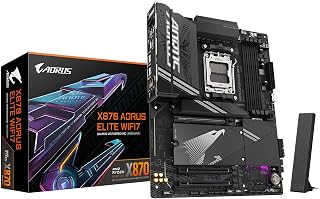
Four M.2 slots with PCIe 5.0 support let you configure a multi-drive setup that takes full advantage of the 9800X3D's fast data access patterns during game loading and streaming. The USB4 port delivers 40Gbps transfer speeds for high-performance external drives and capture devices popular with content creators who also game. Its 5-year warranty provides long-term protection for a motherboard paired with a flagship processor investment.
Pros
- 16+2+2 power delivery with thermal management supports the 9800X3D through demanding workloads
- Four M.2 slots with thermal guards enable multi-drive builds without throttling
- Dual USB4 ports and WiFi 7 set a high connectivity baseline for this price range
- Five-year warranty is a standout commitment for a board in this segment
Cons
- Single 2.5GbE port falls short for users who need faster or redundant wired networking
- Full ATX size requires a standard or larger case
The 16+2+2 power delivery design gives the 9800X3D clean, consistent power across its full boost range, and the dedicated VRM and M.2 thermal management keep temperatures in check during extended gaming loads. Four M.2 slots with individual thermal guards mean you can build out a multi-drive storage configuration without throttling, and PCIe 5.0 support is there whenever GPU or NVMe technology catches up. DDR5 reaches 8200 MHz with AMD EXPO profiles validated for straightforward overclocking, which is higher headroom than most competing boards at this tier. Dual USB4 ports deliver Thunderbolt-class external bandwidth, a rare addition at this price point. The EZ-Latch mechanism takes friction out of RAM installation, a small but genuinely useful detail. A 2.5GbE LAN port handles gaming traffic comfortably, and WiFi 7 covers wireless use cases going forward. The five-year warranty is an unusual commitment that reflects confidence in the hardware and matters for a long-term platform like AM5.
Socket and Compatibility: AMD Socket AM5, supports Ryzen 7000/8000/9000 series processors on Windows 11.
Memory Support: 4 x DDR5 DIMM slots, up to 256GB capacity, 8200 MHz support with AMD EXPO profiles.
Storage and Expansion: 4 x M.2 slots with thermal guards, 4 x SATA ports, PCIe 5.0 support, 3 PCIe slots total.
Connectivity: WiFi7, 2.5GbE LAN, dual USB4, USB-C (front and rear), 11 total USB ports, 1 HDMI output, Sensor Panel Link.
Power Delivery: 16+2+2 phase VRM, 24-pin ATX power connector. Form factor: ATX (9.61in L x 12.01in W x 1.38in H). Weight: 1.23 kg. Warranty: 5 years.
Best suited for 9800X3D builders who plan to grow their storage over time and want dual USB4 ports for external devices or fast peripherals. The five-year warranty makes it appealing for anyone treating this as a long-term platform investment. Skip it if you need multi-gigabit wired networking or are fitting everything into a compact case, since the full ATX footprint and single 2.5GbE port are real constraints in those scenarios.

The 14+2+2 power stage configuration provides clean, consistent voltage regulation that prevents throttling during intense gaming sessions with the 9800X3D. Its DDR5 AEMP support simplifies memory overclocking to reach 8000 MHz speeds that pair well with Ryzen's Infinity Fabric for reduced latency. Four M.2 slots give you ample expansion room for multiple NVMe drives to store your game library alongside the high-speed storage this processor deserves.
Pros
- 14+2+2 power stages at 80A per stage provide clean, stable delivery for sustained gaming loads
- Four M.2 slots with PCIe 5.0 support offer substantial NVMe expansion room
- WiFi 7 with Q-Antenna targets low-latency wireless for competitive gaming
- AI Advisor and AI Networking II simplify setup for builders of any experience level
Cons
- Large CPU coolers can obstruct tall RAM modules, requiring careful clearance checks
- Running Ethernet and WiFi simultaneously can cause connection conflicts
The processor is not a heavy overclocker by nature, but stable, clean power delivery still matters for sustained all-core gaming workloads, and this board delivers that. Four M.2 slots with PCIe 5.0 support give serious storage headroom, while WiFi 7 with Q-Antenna keeps wireless latency low for competitive play. ASUS AI Advisor handles initial configuration automatically, which reduces setup friction without limiting experienced builders. Massive VRM heatsinks with high-conductivity thermal pads keep the power delivery cool under load. The BIOS is easy to navigate, and Armory Crate covers fan curves, RGB, and performance profiles from one interface. Fast boot times and consistent stability round out a board that punches confidently within this budget.
Processor and Compatibility: Socket AM5, supports AMD Ryzen 9000, 8000, and 7000 series processors, chipset AMD B850.
Memory: DDR5 support up to 192GB, memory clock speed 8000 MHz, 4 DIMM slots, AEMP technology for enhanced memory performance.
Storage and Connectivity: 4 M.2 slots with PCIe 5.0 support, 2 SATA 6Gb/s ports, 17 USB ports total including USB 20Gbps Type-C, 1 Gigabit Ethernet, WiFi 7 with Q-Antenna, 3 PCIe slots.
Power and Thermal: 14+2+2 power stages at 80A per stage, 8+8-pin ProCool power connectors, integrated I/O cover, thick metal heatsinks with thermal pad coupling to VRMs.
Physical and Warranty: ATX form factor (14.1 inch length x 10.7 inch height x 2.9 inch width), 5 pounds, includes 3-year warranty, 1 unit included.

The 80A SPS VRM delivers stable power delivery crucial for the 9800X3D's demanding 120W TDP during sustained gaming loads. Its DDR5 support up to 8400 MT/s overclocked ensures you can extract maximum performance from high-speed memory kits that complement the X3D chip's large cache. PCIe 5.0 x16 and M.2 Gen5 slots future-proof your build for next-generation graphics cards and storage drives without bottlenecking this flagship gaming processor.
Pros
- 14-phase 80A SPS VRM delivers robust, stable power for demanding gaming sessions
- Dual M.2 Gen5 slots plus PCIe 5.0 x16 cover current and next-generation hardware
- 5G LAN and WiFi 7 together provide the fastest wired and wireless options in this category
- 2oz copper PCBs and solid thermal pads reflect strong long-term build quality
Cons
- Feature density may exceed what a straightforward 9800X3D gaming build actually requires
- Tool-free conveniences and premium connectivity are reflected in the board landing at the top of this price range
The 14-phase VRM with 80A SPS handles sustained loads confidently, which matters for a processor that boosts hard across gaming sessions. PCIe 5.0 x16 ensures the GPU slot runs at full bandwidth, and dual M.2 Gen5 slots cover next-generation NVMe storage without compromise. DDR5 support reaching 8400+ MT/s unlocks meaningful memory bandwidth headroom for the 9800X3D, which responds well to fast memory. The 5G LAN via Realtek alongside WiFi 7 and Bluetooth 5.4 covers every connectivity scenario, and USB 20G Type-C on the rear panel prepares the build for fast external devices. Heavy 2oz copper PCBs and solid metal heatsinks reinforce the sense that this board is built to last. Quick-release GPU latches and tool-free M.2 installation are practical touches that simplify future upgrades.
Chipset and Socket: AMD B850 Chipset, Socket AM5 (Supports Ryzen 9000/8000/7000 Series)
Memory Support: 4x DDR5 DIMM slots, up to 8400+ MT/s (OC), 1DPC 1R configuration
Storage Connectivity: 1x M.2 Gen5 x4 (128Gbps), 1x M.2 Gen5 x4 (128Gbps), 1x M.2 Gen4 x4 (64Gbps), 1x M.2 Gen4 x2 (32Gbps), 6x SATA ports
Power Delivery: 14-Phase Duet Rail Power System, 80A SPS VRM, dual 8-pin CPU connectors, 24-pin ATX main power
Expansion Slots: 1x PCIe 5.0 x16 (128GB/s) with Steel Armor II, multiple PCIe Gen3/Gen4 slots
Networking: Wi-Fi 7 (802.11be) with Bluetooth 5.4, Realtek 5G LAN, USB 20G Type-C
Audio: 7.1 USB High Performance Audio with Audio Boost 5, S/PDIF output support
Thermal Management: 7W/mK MOSFET thermal pads, extended heatsinks, EZ M.2 Shield Frozr II, Combo-fan header (3A)
Warranty: 3-Year Manufacturer Limited Warranty
This is the right pick for builders who want 5G wired LAN alongside WiFi 7 and do not want to sacrifice VRM quality to stay under budget. It also suits anyone planning future GPU or storage upgrades who needs Gen5 slots ready to go. Builders who have no use for 5G LAN and prefer a simpler board with fewer features may find it more than they need.

The 14+2+2 power phase design ensures consistent voltage delivery to handle the 9800X3D's power requirements during extended gaming marathons without thermal throttling. Three M.2 slots with PCIe 5.0 provide sufficient expansion for fast storage that complements the processor's quick cache access times. The EZ-Latch system simplifies graphics card installation and removal, making upgrades painless when paired with this long-lasting AM5 platform processor.
Pros
- 14+2+2 power phase design handles the 9800X3D's sustained gaming loads reliably
- Three M.2 slots with thermal guards cover most storage configurations at this tier
- 5-year warranty provides unusually strong coverage for a mid-range board
- WiFi 7 and PCIe 5.0 keep the platform current without inflating cost
Cons
- DDR5 support tops out at 5200 MHz, limiting headroom for memory overclocking
- WiFi antenna is not included and must be sourced separately
The GIGABYTE B850 AORUS Elite WiFi7 approaches the 9800X3D pairing from a value-first angle without stripping out the features that matter most. Its 14+2+2 power delivery keeps the processor fed cleanly through demanding gaming sessions, and the three M.2 slots with integrated thermal guards give enough NVMe capacity for a serious game library. PCIe 5.0 support future-proofs the platform for upcoming GPU and storage generations, while WiFi 7 and 2.5GbE LAN together handle modern connectivity needs. The clean black AORUS aesthetic fits most cases without clashing with other components. A 5-year warranty is a genuine differentiator at this price point and signals confidence in the hardware. DDR5 support at 5200 MHz is conservative compared to some competing boards, which means extreme memory overclocking is not this board's strength, though standard gaming workloads on the 9800X3D are well served. The lack of an included WiFi antenna is a minor inconvenience requiring an additional purchase. For builders who want a dependable, warranty-backed B850 platform without paying for features they will not use, this board represents a sensible, well-rounded choice.
Platform: AMD Socket AM5
Chipset: AMD B850
Memory: 4 DIMM slots, DDR5 up to 5200 MHz
Power Delivery: 14+2+2 phase design
Storage: 3x M.2 slots with thermal guards, PCIe 5.0 support
Connectivity: WiFi7, 2.5GbE LAN, USB-C, Sensor Panel Link
Form Factor: ATX
Warranty: 5 years
CPU Compatibility: Ryzen 7000, 8000, 9000 series processors

The X870 chipset unlocks full PCIe 5.0 bandwidth across both graphics and storage, maximizing throughput for the 9800X3D's gaming workloads. USB 40Gbps connectivity enables blazing-fast external storage transfers and future peripheral support that matches this processor's premium positioning. Wi-Fi 7 with Bluetooth 5.4 provides cutting-edge wireless performance for low-latency online gaming where every millisecond counts with competitive titles that leverage the X3D cache advantage.
Pros
- Enhanced VRM and extended heatsink keep the 9800X3D stable under sustained load
- WiFi 7 and USB 4.0 at 40Gbps lead the connectivity stack in this price range
- PCIe 5.0 and M.2 Gen5 support protect the build against near-term obsolescence
- 4.4-star rating across 600-plus verified buyers signals dependable real-world performance
Cons
- Single ethernet port limits wired multi-device setups
- ATX form factor rules out small-form-factor and compact case builds
The MSI MAG X870 Tomahawk WiFi pairs the X870 chipset with the 9800X3D in a way that makes sense on paper and in practice. The power delivery architecture, built around an enhanced circuit topology with extended heatsink coverage, gives the 9800X3D the stable voltage it needs to hold boost clocks during long gaming sessions. PCIe 5.0 support means your GPU and storage are not the bottleneck, and the M.2 Gen5 slot is ready whenever next-gen drives become affordable. DDR5 support reaches 7800 MHz, which is well within the range where the 9800X3D performs best. The ATX layout gives you a familiar, spacious build environment, and 256GB maximum RAM capacity leaves room for a workstation-adjacent setup. Audio Boost 5 rounds things out for gamers who use headsets directly from the board. With over 600 verified buyers and a 4.4-star rating, real-world reliability is not in question.
Core Specifications: Socket AM5, AMD X870 chipset, ATX form factor (13.4" x 10.9"), 24-pin main power connector, 3-year warranty
Memory Support: 4 DIMM slots, DDR5 support up to 256GB capacity, 7800MHz memory clock speed
Connectivity: WiFi 7, Bluetooth 5.4, 5Gbps Ethernet (1 port), USB 4.0 (40Gbps), 13 total USB ports, 1 HDMI, 1 DisplayPort, 4 SATA 6Gb/s ports, 3 PCIe slots (including PCIe 5.0 M.2)
CPU Compatibility: AMD Ryzen 9000, 8000, and 7000 series desktop processors. Note: Does not support older AM4 generation CPUs
Dimensions: 13.4" length x 10.9" width x 3" height. Verify clearance in your PC case before purchase
A solid pick for anyone pairing the 9800X3D with a mid-to-full-size ATX case who wants modern connectivity without hunting for a specialty board. Competitive gamers and dual-purpose gaming and content creation rigs will appreciate the power delivery headroom and WiFi 7 readiness. Skip it if you are building in a compact case or if your home network still runs on older WiFi standards and you want to avoid paying for features you cannot yet use.
Buying Guide: What to Look for in a 9800X3D Motherboard
Power Delivery and VRM Design
The 9800X3D is a 120W TDP chip that can spike higher under all-core workloads. You need a VRM configuration with at least 14 phases and 80A power stages to maintain voltage stability during sustained gaming sessions or rendering tasks. Boards with weak VRMs will throttle the CPU or produce excessive heat that affects surrounding components.
Look for motherboards that pair robust phase counts with adequate heatsink coverage. The GIGABYTE X870 AORUS Elite WIFI7 AMD AM5 LGA 1718 uses a 16+2+2 design with substantial heatsinks, while the ASUS ROG Strix B850-A Gaming WiFi AMD AM5 B850 ATX delivers 14+2+2 stages with thick metal heatsinks bridged for thermal efficiency. Both configurations handle the 9800X3D comfortably even during extended stress scenarios.
Storage and Expansion Options
Modern builds demand fast NVMe storage, and the number of M.2 slots directly impacts your flexibility. Four M.2 slots is ideal for high-capacity builds, while three slots works for most gamers. Prioritize boards with at least one PCIe 5.0 M.2 slot for future storage upgrades, as Gen5 SSDs are becoming more accessible and offer meaningful performance gains in DirectStorage-enabled games.
The MSI MAG B850 Tomahawk MAX WiFi Motherboard, ATX stands out with quadruple M.2 connectors including two Gen5 slots, while the MSI MAG X870 Tomahawk WiFi Gaming Motherboard offers similar expansion with enhanced cooling through EZ M.2 Shield Frozr. For builders planning multi-GPU setups or capture cards, verify that the primary PCIe x16 slot is Gen5 rated, which all five boards in this roundup provide. If you’re also considering graphics card upgrades, our guide on the best GPU under $500 pairs well with these motherboard recommendations.
Connectivity and Networking
WiFi 7 is the current standard and delivers lower latency and higher throughput than WiFi 6E, which matters for competitive gaming and large file transfers. Pair that with 2.5GbE or faster wired networking for flexibility. USB connectivity should include at least one USB4 or USB 20Gbps Type-C port on the rear I/O for fast external storage and future peripherals.
The GIGABYTE B850 AORUS Elite WIFI7 AMD AM5 ATX includes WiFi 7, 2.5GbE LAN, and USB-C connectivity in a clean package, while the ASUS ROG Strix B850-A adds a Q-Antenna for improved wireless signal strength. Front-panel USB-C headers are increasingly common on modern cases, so verify your board includes at least one 20Gbps front header if your case supports it. Builders working on high-end systems may also want to review our coverage of PC cases for RTX 5090 builds to ensure all connectivity needs align.
Chipset Choice and Longevity
Both X870 and B850 chipsets support the 9800X3D, but X870 boards typically offer more USB ports, additional PCIe lanes, and better multi-GPU support. B850 boards deliver identical CPU performance and often match X870 in practical features while costing less. For single-GPU gaming builds, B850 is the smarter value unless you need the extra connectivity that X870 provides.
AMD has committed to AM5 socket support through at least the next generation of Ryzen processors, so any board you choose now will remain compatible with future CPU upgrades. This makes investing in a quality board with strong VRMs and ample connectivity a sensible long-term decision. Check that your chosen board includes BIOS flashback functionality for easy updates without a CPU installed, which all five boards here support.
Final Thoughts
Any of these five AM5 motherboards will extract maximum performance from the Ryzen 9 9800X3D without compromising on critical features or build quality. For builders who prioritize expansion and future-proofing, the MSI MAG B850 Tomahawk MAX WiFi delivers four M.2 slots and dual Gen5 support alongside WiFi 7 and 5GbE networking. If you want premium X870 features with excellent thermal management and comprehensive connectivity, the GIGABYTE X870 AORUS Elite WIFI7 offers robust 16-phase power delivery and four M.2 slots with USB4 support, making it an outstanding foundation for high-performance gaming and productivity systems.
Frequently Asked Questions
Do I need an X870 board for the 9800X3D or will B850 work?
B850 boards work perfectly with the 9800X3D and deliver identical CPU performance compared to X870. The main differences are in platform features like total USB ports, PCIe lane distribution, and multi-GPU support. For single-GPU gaming builds, B850 provides everything you need while saving money. Choose X870 only if you require the additional connectivity or plan to use multiple discrete GPUs, which most gamers do not need in 2026.
How many M.2 slots do I need for a gaming PC?
Most gamers will find three M.2 slots sufficient for a primary boot drive, a secondary games library drive, and future expansion. Four slots offer more flexibility for content creators or users who maintain large media libraries. Prioritize boards with at least one PCIe 5.0 M.2 slot to take advantage of faster storage as prices drop. All five boards reviewed here include adequate M.2 support with proper thermal management to prevent throttling during sustained transfers.
Is WiFi 7 worth it on a gaming motherboard in 2026?
WiFi 7 reduces latency and increases throughput compared to WiFi 6E, which translates to more stable online gaming and faster file transfers. If you game wirelessly or frequently move large files over your network, WiFi 7 provides measurable improvements. All five motherboards in this guide include WiFi 7, making it a standard feature at this price point rather than a premium upgrade. Even if your current router is WiFi 6, the adapter will work seamlessly and you’ll benefit when you eventually upgrade your network equipment.
Can these boards handle CPU overclocking or PBO tuning?
The 9800X3D benefits more from Precision Boost Overdrive tuning than traditional overclocking due to its 3D V-Cache design. All five boards here support PBO and curve optimizer adjustments through their BIOS, allowing you to extract additional performance within safe thermal and voltage limits. The robust VRM designs ensure stable power delivery during sustained boost periods. For builders considering other AMD platforms, our coverage of CPUs for the RX 9070 XT explores pairing strategies across different performance tiers.


Write Your Review
No reviews yet. Be the first to share your experience!