

Your lights flicker during a storm, your food is at risk in the refrigerator, or you need dependable electricity at a campsite. The generator vs power station decision matters because these tools solve very different problems: one produces electricity while fuel lasts, while the other stores a limited supply of battery energy for clean, cordless use.
This guide compares eight battery-powered options for campers, road trippers, apartment dwellers, and homeowners planning for short outages. We focus on useful output, stored capacity, recharge flexibility, and safe placement so you can narrow your search with our portable power station guides as a helpful starting point.
Quick answer
This guide compares 8 picks, with Jackery Explorer 1000 v2 Portable Power Station ranked first. Jackery Explorer 300 Portable Power Station 292Wh has the most customer reviews.

Anyone comparing generator noise and maintenance against battery backup will appreciate the 1500 watt output here, enough to run a fridge or CPAP during an outage, plus solar charging compatibility that lets a home backup setup recharge without relying on a fuel supply chain.
Pros
- One-hour emergency recharge for fast turnaround between outages
- Seven outlets and dual 100W USB-C ports cover most devices at once
- 23.8 lbs with foldable handle for easy indoor and outdoor moves
- LFP battery holds over 70% capacity after 4000 cycles
Cons
- Only 42 minutes of runtime at full 1500W load
- Solar charging requires separately purchased Jackery panels
Deciding between a generator and a power station starts with one question: do you want fuel and fumes, or batteries and silence? The Explorer 1000 v2 makes the case for the battery side when your backup needs are moderate. At 1070Wh and 1500W continuous output, it covers lighting, routers, phones, laptops, and smaller kitchen appliances during an outage without the noise, exhaust, or maintenance a generator demands. The one-hour emergency charging mode is the feature that matters most for power-outage prep, letting you top up quickly between grid interruptions rather than waiting hours as you would with a trickle charger. Seven outlets and dual 100W USB-C ports mean you can run several essentials at once without a tangle of adapters. At 23.8 lbs with a folding handle, it moves between rooms easily, something no generator can offer. For buyers weighing portability and quiet operation over raw sustained power, this is where the power station argument wins.
Capacity and Power Output: 1070Wh battery capacity, 1500W continuous AC output, 3000W surge peak, 7 total power outlets
Charging: 1-hour emergency fast charge or 1.7-hour standard charge, 100W USB-C PD output, ChargeShield 2.0 technology
Battery Technology: LFP battery with 4000+ charge cycles, maintains 70%+ capacity after 4000 cycles, 10+ year lifespan
Ports and Connectivity: 2x USB-C (100W PD), 1x USB-A, 1x DC car port, 3x pure sine wave AC ports, LED lights, smart app control
Physical Specifications: Weight: 23.8 lbs, Dimensions: 12.87in (L) x 8.82in (W) x 9.72in (H), Foldable handle for portability
Additional Features: Smart app control with three charging modes, 30 dB quiet mode, energy efficiency mode, compatible with Jackery solar panels
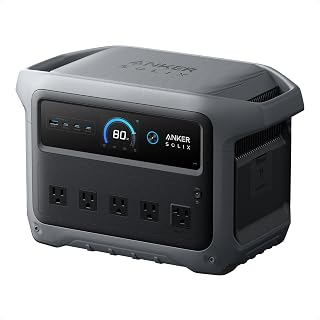
For a reader deciding between a gas generator and a cleaner backup option for camping, the 2000 watt output covers power-hungry gear like induction cooktops or space heaters, while solar fuel type input means no trips for gasoline when stretches away from an outlet run long.
Pros
- 49-minute full recharge via wall outlet with HyperFlash tech
- 2,000W continuous output with 10 ports for simultaneous devices
- 10ms UPS switchover protects sensitive electronics during transitions
- LiFePO4 battery retains at least 80% capacity after 4,000 cycles
Cons
- Solar input tops out at 600W, requiring optimal conditions for the fastest recharge
- Metal frame and casing add bulk compared to lighter alternatives
When comparing generators to power stations for 2026 backup plans, recharge speed is often the deciding factor, and the SOLIX C1000 Gen 2 leads with a 49-minute full recharge from a wall outlet. That speed changes the backup power equation: instead of planning around hours of fuel runs or idle generator time, you can top off between outages almost as fast as boiling a kettle. With 2,000W continuous output and a 10-port layout, it has enough headroom for routers, lights, a mini-fridge, and medical devices like CPAP machines running together, which matters for anyone treating this as a genuinee alternative to a gas generator rather than a camping accessory. The 10ms UPS switchover protects sensitive electronics from the kind of interruption a generator restart would cause. Solar input up to 600W adds an off-grid option generators can't match without separate fuel. At 11.3 kg, it's also something one person can reposition without the hauling and fueling hassle generators require.
Suited to homeowners and remote workers who want generator-level output without fuel storage, noise, or maintenance, and who value fast recharge over maximum runtime. Also a fit for van lifers and off-grid users who want solar flexibility. Skip it if your main need is multi-day runtime for heavy appliances with no recharge opportunity, since like all battery stations it depends on being topped up rather than refueled.
Capacity: 1,024Wh LiFePO4 battery
Output: 2,000W continuous, 3,000W peak
Ports: 10 total outputs
Wall Recharge: 1,600W input, 49 minutes to full
Solar Input: Up to 600W at 60V maximum, 1.8 hours to full
UPS Switchover: 10 milliseconds
Dimensions: 15.1L x 8.2W x 9.6H inches
Weight: 11.3 kg (24.9 lbs)
Battery Cycles: 4,000+ cycles with minimum 80% retention
Warranty: 5 years
Colors Available: Gray
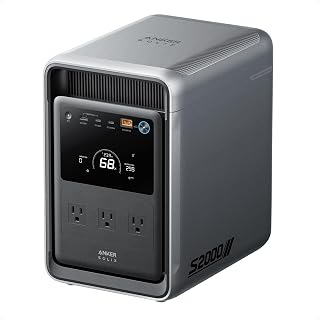
Readers sizing up whole home backup against a generator will note the 2010Wh capacity paired with 1500W output, enough to carry essential circuits through a multi-hour outage, and the lightweight, compact design means it stores easily between emergencies instead of taking up garage space.
Pros
- 1,500W continuous output covers 99% of essential household appliances
- 6W idle draw enables 35-hour refrigerator runtime
- Six recharge methods including 400W solar and generator input
- LFP battery rated for 10,000 cycles and a 15-year lifespan
Cons
- No 12V DC port, limiting some RV and niche device charging
- Real-world refrigerator runtime varies with model and conditions
If the generator-versus-power-station decision for 2026 comes down to replacing a generator entirely rather than supplementing one, the SOLIX S2000 is built for that comparison. Its 2,010Wh capacity and 1,500W continuous output are sized to cover 99% of essential household appliances, including refrigerators, freezers, and medical equipment, which is the same job a small generator would be asked to do during an outage. The difference is the 6W idle draw, which stretches a refrigerator runtime to 35 hours, a figure that would require constant refueling from a gas generator. Six recharge methods, including 400W solar, AC, generator input, and car outlet charging, mean it can be refilled almost anywhere, closing the main gap power stations usually have against generators. The sub-10ms UPS switchover also means connected devices never see the kind of power dip a generator startup would cause. For anyone deciding whether to buy a generator or go all-in on a battery system this year, the S2000 makes a strong case for skipping fuel entirely.
Capacity and Output: 2,010Wh LiFePO4 battery, 1,500W continuous output, 3,000W peak output
Battery Technology: 314Ah LFP cells, 10,000 cycle lifespan, 15-year warranty
Dimensions: 8.19L x 11.1W x 12.7H inches
Weight: 35.7 pounds
Outlets: 8 total (front and rear configuration)
Charging Options: AC input, solar (up to 400W), generator, car outlet, alternator charger
UPS Switchover: Less than 10 milliseconds
Idle Power Draw: 6W
Color: Black
Model: AS220
Warranty: 5 years
Best for homeowners who want to replace a generator outright for home backup, especially those running medical equipment, refrigerators, or freezers that need steady, interruption-free power. Also fits households planning for extended outages who want multiple recharge options. Skip it if you need a 12V DC port for RV accessories, or if your budget favors a smaller unit, since this is positioned above entry-level alternatives.

For readers weighing a quiet, no-fuel alternative to a generator for short outages, this 292Wh unit's compact form factor and 4 hour charge time make it an easy grab for a weekend trip or a few hours of lights and phone charging without dealing with fuel storage or engine noise at all.
Pros
- No fuel, fumes, or noise unlike a generator
- Charges 6 devices at once via varied ports
- LiFePO4 battery rated over 4,000 cycles
- Lightweight at 7.5 lbs with integrated handle
Cons
- 300W output can't run major appliances
- 292Wh capacity limits total runtime
Choosing between a generator and a power station often comes down to one question: how much runtime do you actually need, and how much noise and hassle are you willing to tolerate for it? The Jackery Explorer 300 answers that question for anyone whose backup needs are modest. At 292Wh and 7.5 lbs, it won't run a fridge or sump pump, but that's not its job. It's the choice for keeping phones, laptops, routers, and small medical devices alive during a short outage, with zero fumes, zero startup noise, and zero maintenance. Six devices can draw power at once across its AC outlets, USB-C PD, USB-A, and car port, and the LiFePO4 battery chemistry means it will still be useful a decade from now, unlike a gas generator that needs fuel stabilizer and carburetor cleaning to survive the off-season. If your 2026 backup plan is about bridging short gaps rather than running a household through a multi-day blackout, this is the lower-complexity half of the comparison.
Buy this if your backup power needs are limited to electronics and small devices during short outages, and you want something you can store in a closet with no upkeep. Skip it if you're comparing against a generator because you need to run a fridge, space heater, or power tools, or if you expect multi-day outages. In that case, a generator or a larger power station is the better side of the comparison.
Capacity: 292Wh (LiFePO4 battery)
Weight: 7.1-7.5 lbs
Dimensions: 15.43in D x 9.92in W x 11.89in H
AC Output: 2 outlets, 110V, 300W continuous (600W peak surge)
USB Ports: USB-C PD 100W, USB-A 2.4A (x2)
Car Port: 120W 12V output
Charging Time: Approximately 4 hours AC, 2.8 hours with 100W solar panel
Battery Cycles: 4,000+ before reaching 70% capacity
Warranty: 2 year manufacturer
Model: JE-300E

For someone torn between a generator's flexibility and a quieter unit, this station accepts solar, AC, car, lead-acid, or generator charging, so a 1024Wh reserve can be topped off however is available, while the 1800W output handles home backup essentials during a power outage.
Pros
- 1800W output with 3600W surge handles more than typical power stations
- 45-minute charge to 80% capacity
- Silent operation at 30dB with no fumes
- Sub-10ms UPS switchover protects sensitive electronics
Cons
- 25 lbs is noticeable for extended carrying
- Runtime still limited by 1024Wh capacity under heavy draw
The generator vs power station decision usually hinges on one tradeoff: generators give you high, sustained output but bring fuel, noise, and exhaust; power stations trade some runtime for silence and simplicity. The BLUETTI Elite 100 V2 narrows that gap more than most. With 1800W of continuous output and a 3600W surge rating, it can handle small appliances and tools that would normally push someone toward a generator, while running at a quiet 30dB in silent mode with no fumes. Charging to 80% in 45 minutes means it recovers quickly between uses, something no gas generator can match without a stationary fuel source. The sub-10ms UPS switchover is a meaningful advantage over a generator for home backup, since it keeps computers and networking gear running through the switch rather than requiring a manual restart. At 25 lbs it's heavier than smaller power stations, but still far more manageable than hauling and fueling a generator. For 2026 buyers who want generator-level capability without the generator-level hassle, this is the strongest case in that direction.
Power capacity of 1024Wh supports different devices with varying runtimes. A laptop typically runs 8-12 hours, a mini-fridge 12+ hours, and a phone charges 10+ times. High-draw devices like electric kettles or space heaters deplete the battery in hours. Use the BLUETTI app to monitor real-time consumption and plan charging accordingly.
Charging speed depends on input method. Wall outlet charging reaches 80% in 45 minutes using TurboBoost. Solar panel charging is slower but adds flexibility for extended trips. Car charging and generator inputs provide additional options when AC power isn't available, making this ideal for truly remote locations.
Buy this if you want power station convenience with enough output to replace a small generator for home backup or camping, especially if silent operation and instant UPS switchover matter to you. Skip it if you need to run high-draw appliances continuously for days, since the 1024Wh capacity still means runtime depends heavily on what's connected, or if 25 lbs feels too heavy for your use case.

For readers set on replacing a standby generator entirely, 3600W of AC output and a 3584Wh capacity can carry major home circuits through extended outages, and the easy to install feature means it slots into a home backup setup without the permitting hassle generators often require.
Pros
- Exceptional runtime capacity with expandability option makes it adaptable to changing household needs
- Advanced LFP battery technology delivers superior safety, longevity, and performance in extreme temperatures
- Multiple fast-charging paths including hybrid mode reduce downtime between uses
- Portable design with wheels and handle enables easy repositioning throughout the home
- Generous 5-year manufacturer warranty provides long-term peace of mind
Cons
- At 77.2 pounds, it requires effort to move despite wheels and handle, especially up stairs
- Requires pairing with compatible solar panels or AC charging system for maximum charging flexibility
The Jackery HomePower 3600 Plus is a premium portable power station engineered for homeowners who need reliable backup during outages or off-grid living. With a 3584Wh capacity and dual 120V/240V voltage output, it addresses the specific needs of households with high-demand appliances. This unit targets tech-savvy homeowners willing to invest in durability and scalability over budget options.
The standout feature is the expandable architecture: a single unit powers a 3-person household for over 2 weeks, while multiple units link to deliver 43kWh total capacity. The ceramic membrane LFP battery technology is built for serious use, rated for 6,000 cycles and surviving temperatures from -4°F to 302°F. Charging flexibility is remarkable, achieving full capacity in 2 hours via hybrid AC plus DC input, or 2.5 to 4 hours using AC-only or solar options.
Design and portability stand out for a unit this powerful. At 34% smaller and 29.3% lighter than competing 3.6kWh stations, the luggage-style wheels and telescopic handle make repositioning intuitive. The plug-and-play approach eliminates installation complexity, allowing users to simply connect and power up without professional setup.
The main limitation is weight, at 77.2 pounds, still requires two hands or wheels for movement. The price point is substantial upfront, though expandability spreads investment over time. Also, maximizing the charging speed advantage requires pairing with compatible solar panels or hybrid charging infrastructure.
The Jackery HomePower 3600 Plus delivers genuine value for homeowners prioritizing reliability, expandability, and performance over budget considerations. The strong rating reflects user satisfaction with real-world performance and durability.
Capacity: 3584Wh base, expandable to 21kWh per unit or 43kWh with multiple units
Power Output: 3600W AC (7200W in parallel configuration)
Voltage: 120V and 240V dual voltage support
Battery Type: Ceramic membrane LFP cells
Cycle Life: 6,000+ cycles with 10-year lifespan
Operating Temperature: -4°F to 302°F
Charging Options: Hybrid AC plus DC (2 hours), AC only (2.5 hours), solar (4 hours), gas generator (2.5 hours)
Weight: 77.2 pounds
Dimensions: 15.2 x 12.2 x 19.3 inches
Outlets: 2 outlets plus built-in cables
Warranty: 5-year manufacturer coverage
Who Should Buy: Homeowners with 3+ person households seeking robust backup power, small business owners needing reliable equipment protection, and outdoor enthusiasts wanting serious capacity without daily portability needs.
Budget Consideration: This is a premium investment positioned for users prioritizing longevity and expandability. If you need basic backup for a few hours, smaller units exist at lower price points. If you want multi-week household resilience, this competes well on cost-per-watt-hour against alternatives.
Expandability Strategy: Start with one unit for essential circuits, or buy two to four units stacked for whole-home coverage. The modular design lets you scale up as budget allows without replacing your initial investment.
Charging Setup: The 2-hour hybrid charging requires both AC power and solar input simultaneously. For fastest results without solar, plan on 2.5 hours via AC. Solar-only users should expect 4 hours to full capacity.
Installation Tip: Despite plug-and-play claims, plan your outlet locations ahead of time and consider a qualified electrician for 240V circuits to appliances like dryers or heat pumps, ensuring safe operation.

A reader who wants generator-level reliability without the fumes for a cabin or outage will find the 600W output enough for lights, a router, and small appliances, and the ability to recharge from solar, car, or lead-acid sources means it is not stranded without grid power.
Pros
- Genuinely portable and easy to carry for camping trips, road adventures, and emergency home backup
- True 600W output with Power Lifting capability punches above typical entry-level competitors
- Intelligent UPS function protects critical devices like laptops, routers, and CPAP machines instantly
- Multiple charging options mean you're never stuck without a way to recharge
- Low idle power consumption maximizes usable energy between charge cycles
Cons
- 288Wh capacity limits runtime for high-draw appliances like space heaters or multiple devices running simultaneously
- No customer reviews available yet to validate real-world reliability and performance claims
- Power Lifting Mode may increase component stress, reducing long-term durability despite UltraCell upgrades
The BLUETTI Elite 30 V2 is a lightweight portable power station built for users who want genuine backup power without the bulk. At 9.4 lbs with 288Wh capacity, it strikes a balance between portability and practicality for camping trips, weekend road adventures, emergency home backup during storms, and outdoor activities where wall outlets are non-existent.
The headline specs deliver real value. Standard 600W continuous output is legitimately double what typical competitors offer at this price point, and the Power Lifting Mode's 1500W surge capability means you can run energy-hungry devices like kettles, toasters, and small microwaves when needed. The 45-minute 0-80% fast charge via 380W wall adapter means you're back in business quickly, while the eight charging modes give you flexibility across AC, solar, car, and generator inputs for genuinely any scenario life throws at you.
Build quality impresses for an entry-level model. UltraCell technology cuts idle power drain to 4.5W, which matters when you're relying on stored energy. The 10ms UPS switch is a genuine safety feature that protects CPAP machines, routers, and laptops during sudden blackouts, preventing data loss and device damage when seconds count. The compact 9.8 by 7 by 6.6-inch footprint fits backpacks and car trunks without complaint.
Limitations exist. 288Wh capacity sounds adequate until you run a power-hungry device continuously, meaning realistic runtime depends heavily on what you're actually powering. The lack of verified customer reviews means performance claims haven't yet been tested at scale by real users in diverse conditions. Heavy Power Lifting usage may eventually stress components despite the UltraCell upgrades.
The Elite 30 V2 is a solid choice for casual users and emergency backup seekers who value portability and genuine power output over massive capacity. The 60-month warranty suggests confidence in longevity, and the price-to-performance ratio outperforms competitors in its weight class. Best suited for camping enthusiasts, RV owners, and households wanting reliable storm backup without commercial-grade complexity.
Power Output: 600W continuous, 1500W surge (Power Lifting Mode)
Capacity: 288Wh with LFP battery chemistry
Charging Speed: 0-80% in 45 minutes via 380W AC adapter, 0-100% in 70 minutes
Charging Modes: 8 modes including AC wall (380W/200W adjustable), solar input, car charging, and generator compatible
UPS Response: 10ms ultra-fast switch for critical device protection
Outlets: 9 total ports including AC, USB-C with 140W PD fast charging, and DC outputs
Weight: 9.5 lbs (9.4 lbs stated in marketing)
Dimensions: 9.8 inches long by 7 inches wide by 6.6 inches high
Standby Power Draw: 4.5W AC mode, 5W DC mode, 8W standby
Warranty: 60 months manufacturer coverage
Battery Technology: UltraCell LFP with enhanced thermal management
Recommended Uses: Camping, road trips, emergency home backup, outdoor recreation, and event power
Ideal For: Camping enthusiasts and RV owners seeking reliable lightweight backup power without compromise. Storm preparedness planners wanting home emergency backup that won't occupy closet space. Road trippers and van lifers who prioritize portability and charging flexibility. CPAP users and remote workers needing uninterruptible power protection during grid outages.
Not Ideal For: High-power continuous-draw applications like space heaters, air compressors, or sustained microwave use. Users requiring multi-day off-grid independence or supporting entire household loads. Budget shoppers unable to justify entry-level pricing, or those expecting zero maintenance or calibration.
Comparison Context: The Elite 30 V2 occupies the sweet spot between ultra-portable 100Wh emergency packs and full-size 1000Wh home backup systems. Its real advantage emerges when you value genuine 600W power output over competitors' claimed specs that underdeliver, combined with fast charging and lightweight portability.

For light duty needs where a generator would be overkill, this 88Wh unit with 120W surge and 24,000mAh capacity suits phones, lights, and small electronics on a fishing trip or short outage, and solar, AC, or battery charging keeps it ready without any fuel to manage.
Pros
- Compact and lightweight at 3.2 lbs
- 8 total ports for simultaneous device charging
- Built-in LED flashlight with three brightness modes
- UL certified with overcharge and short circuit protection
Cons
- Laptops drain it faster than spec suggests
- Some units reportedly lose full charge after years of use
When weighing a generator against a power station for 2026, size and simplicity matter as much as raw output. The MARBERO sits at the smallest end of that spectrum, a DSLR-sized unit at 3.2 lbs with 8 output ports including dual AC outlets, USB-C PD, USB-A, and a 12V car port. It's not a generator alternative for anyone needing to run appliances, but for the specific question of backup power for phones, tablets, and a small fan or light during an outage, it covers that ground without any of the fuel storage, exhaust venting, or maintenance a generator demands. The built-in LED flashlight with three brightness modes adds genuine utility during a blackout rather than just being a gimmick. Built-in protections against overcharge, short circuits, and overload, plus UL certification, give it credibility beyond its compact size. For readers deciding this is the year they want some backup power but don't want to deal with gasoline, this is the simplest entry point.
Buy this if you want the smallest, simplest form of backup power for devices and lighting, with no generator-style upkeep. Skip it if you're reading this comparison because you need to power anything beyond small electronics, since reviewers report laptops draining it faster than expected and high-wattage devices triggering shutoff. Also skip it if you need years of heavy daily reliability, as some units reportedly lose full-charge capacity after 3+ years.
Buying Guide: Generator vs Power Station
Match output to appliance startup demands
Start with wattage, not just the number of outlets. A refrigerator, sump pump, microwave, kettle, or power tool can need a substantial startup surge, so add the running watts of devices you expect to use together and leave headroom rather than operating at a unit’s limit.
The Anker SOLIX C1000 Gen 2 Portable Power Station supplies 2,000W of continuous AC output, while the BLUETTI Elite 100 V2 Portable Power Station offers 1,800W for demanding everyday loads. If you need long-duration power for large appliances, compare those needs with a fuel-powered option using this guide to inverter generators for backup and RV use.
Choose capacity based on your expected runtime
Watt-hours tell you how much energy a power station holds, and that figure is separate from its watt output. Divide the usable battery capacity by your appliance’s average draw for a planning estimate, then allow for inverter losses, refrigerator cycling, temperature, and other real-world variables.
The Anker SOLIX S2000 Portable Power Station, 2,010Wh makes more sense for a refrigerator and several essentials than a compact unit, while the Jackery Explorer 1000 v2 Portable Power balances a 1,070Wh battery with easy carrying. For phones, cameras, drones, and a laptop, the Jackery Explorer 300 Portable Power Station,292Wh provides a far more travel-friendly capacity.
Consider noise, ventilation, and where you can use it
A battery station creates no exhaust at the point of use, which makes it practical for a bedroom, tent, vehicle, or home office when used according to its manual. Keep its air vents clear, protect it from water, and remember that fan noise and power draw can rise when you run heavier loads or recharge quickly.
A combustion generator belongs outdoors, far from doors, windows, and vents because exhaust fumes are dangerous in enclosed areas. Explore the site’s generator buying resources if fuel-based backup remains the better fit; otherwise, the lightweight BLUETTI Elite 30 V2 Portable Power Station 288Wh and MARBERO Portable Power Station 88Wh, 120W Surge are easier options for small-device power and emergency lighting.
Plan how you will recharge during an extended outage
A power station is only as useful as your charging plan. Wall charging is convenient before a storm, vehicle charging supports travel, and solar can extend off-grid time, but panel output changes with weather, angle, and daylight, so review compatible equipment in our portable solar panel section.
The Jackery HomePower 3600 Plus Power Station, 3584Wh is aimed at higher-demand home backup with hybrid AC and DC charging, a much larger energy reserve, and a wheeled form factor. For sensitive electronics, look for a fast UPS transfer feature as well: the Anker SOLIX C1000 Gen 2 Portable Power Station lists a 10 ms switchover to help keep a router, computer, or CPAP running through a brief utility interruption.
Final Thoughts
Choose the Jackery Explorer 1000 v2 Portable Power if you want a capable, movable solution for camping and common outage essentials. For higher-demand household backup and longer runtime planning, the Jackery HomePower 3600 Plus Power Station, 3584Wh is the more suitable direction.
Frequently Asked Questions
Is a power station better than a generator during an outage?
A power station is often better for indoor essentials such as a router, laptop, CPAP, lights, and select kitchen devices because it has no exhaust at the point of use. A generator is usually more practical for lengthy outages involving high-draw appliances, provided you can operate it safely outdoors and maintain a fuel supply. Many homes benefit from both approaches, especially after reviewing a dual-fuel generator guide for backup power.
Can a portable power station run a refrigerator?
Yes, provided the station has enough continuous output for the compressor and enough surge capacity for startup. Runtime depends on the refrigerator’s energy use, door openings, room temperature, and the station’s usable capacity. A larger battery can support refrigeration much longer, but you should reserve energy for lights, phones, medical equipment, and other essentials if the outage may continue.
Can I use a generator or power station indoors?
Never operate a fuel-burning generator indoors, in a garage, in a tent, or near open windows and vents because carbon monoxide can accumulate quickly. A portable power station can be used indoors when its instructions allow it, though it still needs dry conditions, clear ventilation openings, and sensible load management. Do not confuse a battery unit with a gasoline generator simply because retailers sometimes use similar terms for both.
Which option makes more sense for camping in 2026, a generator or power station?
A power station is generally the more convenient camping companion for charging devices, powering lights, running a CPAP, and using modest appliances without the sound and fuel handling of a generator. Choose a generator when your campsite needs sustained high-wattage power and local rules permit it. For day trips where you only need to replenish phones and small electronics, a high-capacity power bank for travel may be all you need.




Write Your Review
No reviews yet. Be the first to share your experience!