

Off-grid living becomes complicated when a cloudy stretch coincides with refrigerator cycles, water-pump use, remote work, and a low battery alert. The right power station is not simply the largest unit you can carry, it is one with enough stored energy, inverter headroom, and charging flexibility for the loads that matter every day.
This guide to the best power station for off grid living compares compact solar companions with serious home-backup systems. It is designed for cabin owners, RV travelers, homesteaders, and anyone who wants clean power for essentials, work gear, and protected files stored on an external hard drive backup setup.
Quick answer
This guide compares 10 picks, with Jackery HomePower 1000 Plus v2 Expandable Portable ranked first. Jackery Explorer 1000 v2 Portable Power Station holds the highest customer rating among them. Jackery Explorer 300 Portable Power Station 292Wh has the most customer reviews.
Pros
- Intelligent two-circuit design prioritizes essential devices and extends runtime on reserve power
- LiFePO4 battery chemistry survives 6000 charge cycles and operates in cold temperatures down to 14°F
- Fast charging and Emergency Mode option get you backup power ready in under an hour
- Expandable architecture lets you grow capacity only as needed without replacing the base unit
- App control enables real-time monitoring, load adjustment, and energy-saving features on the go
Cons
- Limited by initial 1024Wh capacity, so high-power continuous loads drain the base unit quickly without expansion packs
- Expansion battery packs sold separately, adding significant cost to reach the full 11kWh potential
- Compact design and weight mean less total storage than larger non-portable alternatives
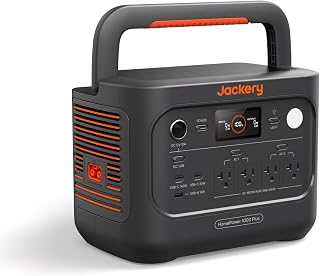
The Jackery HomePower 1000 Plus v2 is a portable LiFePO4 power station engineered for homeowners, remote workers, RV travelers, and outdoor enthusiasts who need reliable backup power without the bulk of traditional generators. It bridges the gap between compact convenience and serious runtime, starting at 1024Wh and scaling up to 11kWh through modular expansion. The smart circuit management and UPS capabilities make it equally suited for emergency home backup and off-grid adventures.
The standout feature is the dual independent AC circuit system that separates critical and non-critical loads. Assign your refrigerator, medical equipment, or desktop computer to Circuit 1 and set a minimum battery threshold, while Circuit 2 powers secondary devices. When battery depletes to your target level, Circuit 2 cuts off automatically, extending runtime for what matters most. Paired with 1800W continuous output and 3600W surge capacity, this system easily handles coffee makers, microwaves, power drills, and CPAP machines without stumbling.
The 10ms UPS switchover is where this unit earns its reliability claim. Connected to AC power, it seamlessly switches to battery in under 10 milliseconds during outages, so sensitive electronics like refrigerators and computers experience zero interruption. Built-in 3kV surge protection with 1000J energy rating shields against storm damage. The pure sine wave output means no compatibility quirks with modern appliances or chargers.
Design and build quality reflect Jackery's attention to real-world use. At 23.8 pounds and 12.3 x 7.9 x 9.3 inches, it's 18% more compact than similarly-powered competitors thanks to advanced CTB 2.0 battery architecture. The ceramic-coated LiFePO4 cells endure 6000 charge cycles while retaining 70% capacity, even in temperatures as low as 14°F. Charging takes 1.25 hours from a wall outlet, or drop to 50 minutes using Emergency Mode through the Jackery App, which also enables remote monitoring, speed adjustments, and energy-saving schedules.
The main limitation is that 1024Wh runs dry quickly under sustained heavy loads, requiring expansion packs to reach the marketed 11kWh ceiling. Expansion batteries are sold separately and represent a substantial additional investment. For primary home backup or serious off-grid living, budget accordingly. The compact form factor, while an advantage for portability, sacrifices total capacity compared to stationary alternatives.
The HomePower 1000 Plus v2 delivers genuine value for users wanting expandable, intelligent backup power in a portable package. The smart circuit system prevents a common backup power failure: losing essentials when batteries deplete. Combined with fast charging, surge protection, and cold-weather reliability, it justifies its position as a top choice for home backup, camping, and RV power management. Five-year warranty provides confidence in long-term durability.
This power station suits homeowners without generator access who want quiet, smoke-free backup power for outages. The UPS switchover and intelligent load management make it ideal for protecting refrigerators, medical devices, and work-from-home setups.
RV travelers and campers benefit from the expandable design, upgrading capacity as trips require more runtime. Off-grid cabin owners appreciate the app control and cold-weather capability. Remote workers needing to charge laptops and run fans during power loss find the 7-outlet configuration and multiple charging methods essential.
Conversely, skip this if you need permanent 24/7 power for a large household or industrial equipment. Fixed generators or wall-mounted battery systems serve those needs better. It's also overkill for casual camping if you only charge phones and lights.
Battery and Capacity: 1024Wh LiFePO4, expandable to 11kWh with up to 5 additional packs. Chemistry: Lithium Iron Phosphate with ceramic coating.
Power Output: 1800W continuous AC, 3600W surge peak. 7 outlets total, including 2 independently-controlled AC circuits, USB-C, USB-A, and car ports.
UPS and Protection: 10 millisecond switchover, 3kV / 1000J surge protection, pure sine wave output.
Charging: Wall outlet in 1.25 hours standard, 50 minutes with Emergency Mode. Solar input supported (solar panels sold separately).
Durability: 6000 charge cycles at 70% capacity retention. Operating range -10°C to 45°C (14°F to 113°F).
Physical: Weight 23.8 lbs. Dimensions 12.3 x 7.9 x 9.3 inches. Materials: ABS plastic, aluminum frame, LiFePO4 battery.
Warranty: 5 years. Includes AC charging cable, user manual, and quick-start guide.

The 1070Wh capacity and 1500W output let you run larger off-grid essentials like a compact refrigerator, power tools, or a coffee maker without hitting limits. Solar charging capability means you can sustain power in remote locations, and the dual battery and solar input gives flexibility when grid access isn't an option. It's built for extended stays where you need reliable power for multiple devices simultaneously.
Pros
- 1,070Wh capacity in a 23.8-pound unit
- Three AC outlets and seven total connections
- 100W PD USB-C ports for modern devices
- LFP battery exceeds 4,000 charge cycles
Cons
- Solar panels are sold separately
- Runs about 42 minutes at a full 1,500W load
A self-sufficient power setup needs enough capacity for essential loads, but it also needs to be easy to move, recharge, and adapt as conditions change. The Jackery Explorer 1000 v2 provides 1,070Wh of battery capacity with 1,500W of continuous AC output and a 3,000W surge rating, placing it in the useful middle ground for off-grid travel and short-term home backup. At full 1,500W demand, its runtime is about 42 minutes, so it is best used to prioritize essential devices rather than to replace a whole-house power system. Its seven connection points include three AC outlets and two 100W PD USB-C ports, giving a small off-grid setup room for appliances, laptops, phones, and other gear at the same time. The 23.8-pound body and foldable handle help when the station must move between a vehicle, tent, cabin, or home. LFP battery technology retains more than 70% capacity after 4,000 cycles. It can recharge in 1.7 hours normally or in one hour through emergency charging, though that faster setting must be activated in the app. Solar charging is available, but compatible panels are sold separately.
Capacity and Power Output: 1070Wh battery capacity, 1500W continuous AC output, 3000W surge peak, 7 total power outlets
Charging: 1-hour emergency fast charge or 1.7-hour standard charge, 100W USB-C PD output, ChargeShield 2.0 technology
Battery Technology: LFP battery with 4000+ charge cycles, maintains 70%+ capacity after 4000 cycles, 10+ year lifespan
Ports and Connectivity: 2x USB-C (100W PD), 1x USB-A, 1x DC car port, 3x pure sine wave AC ports, LED lights, smart app control
Physical Specifications: Weight: 23.8 lbs, Dimensions: 12.87in (L) x 8.82in (W) x 9.72in (H), Foldable handle for portability
Additional Features: Smart app control with three charging modes, 30 dB quiet mode, energy efficiency mode, compatible with Jackery solar panels
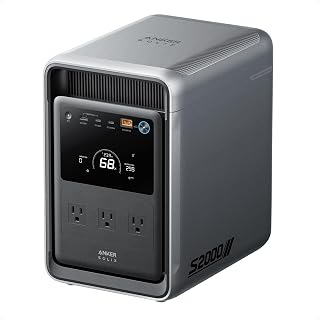
With 2010Wh of capacity, this station can handle multi-day off-grid living without frequent recharging, powering essentials like a mini fridge or medical equipment continuously. The 1500W output supports moderate appliances, and its lightweight, compact build makes it practical for cabins or mobile setups. Battery-powered operation eliminates fuel dependence, critical when you're far from resupply points.
Pros
- 2,010Wh capacity for longer essential runtime
- Low 6W idle draw
- Six recharge methods, including 400W solar input
- LFP battery rated for 10,000 cycles
Cons
- No 12V DC port
- 1,500W continuous output limits larger loads
For off-grid living, stored energy can matter more than peak output when refrigeration, communications, and basic household equipment need to stay powered over many hours. The Anker SOLIX S2000 brings a larger 2,010Wh battery to that job while maintaining 1,500W of running output and 3,000W starting power. Its low 6W idle draw is especially relevant for overnight and multi-day planning, as it is rated for up to 35 hours of refrigerator runtime, 20% longer than comparable systems in its class. Despite its capacity, the unit weighs 35.7 pounds and measures 8.2 by 11.1 by 12.7 inches. It is described as 30% smaller and 25% lighter than comparable 2kWh stations, which helps when space in an RV, cabin, or storage area is limited. Eight outlets on the front and rear simplify a multi-device setup. Recharge options include 400W solar input, AC, generator input, and a car outlet, among six methods total. The LFP battery is rated for 10,000 charge cycles and a 15-year lifespan. A sub-10ms UPS switchover also helps keep connected equipment running through grid interruptions.
Capacity and Output: 2,010Wh LiFePO4 battery, 1,500W continuous output, 3,000W peak output
Battery Technology: 314Ah LFP cells, 10,000 cycle lifespan, 15-year warranty
Dimensions: 8.19L x 11.1W x 12.7H inches
Weight: 35.7 pounds
Outlets: 8 total (front and rear configuration)
Charging Options: AC input, solar (up to 400W), generator, car outlet, alternator charger
UPS Switchover: Less than 10 milliseconds
Idle Power Draw: 6W
Color: Black
Model: AS220
Warranty: 5 years
Buy the SOLIX S2000 if your off-grid setup needs more stored energy for essentials such as a refrigerator, freezer, medical equipment, CPAP machine, or home devices. It is a strong fit for people who want a compact 2kWh-class station, flexible recharging, and very long battery-cycle ratings. Skip it if your equipment depends on a 12V DC port, since this model does not include one. It is also not the right choice for loads that exceed its 1,500W continuous output.

The 2048Wh capacity and 2400W output balance power and portability for off-grid camps or cabins needing to run multiple devices simultaneously. Solar fuel type means you can recharge indefinitely without generator noise or fuel runs, and at 18.9kg it remains movable between sites. It's suited for people who split time between locations and need substantial power without permanent installation.
Pros
- Fast 58-minute AC full recharge
- Six charging methods with dual-input solar
- 2,400W continuous and 4,000W peak output
- Expandable capacity in a 41.7-pound unit
Cons
- 2,048Wh base capacity can drain under heavy use
- Not ideal for frequent hiking at 41.7 pounds
Off-grid living calls for a station that can recover energy quickly between periods of sun, driving, or access to AC power, rather than simply offering the largest battery. The Anker SOLIX C2000 Gen 2 brings a 2,048Wh battery and 2,400W continuous output to that role, with 4,000W peak capacity for demanding starts. It can run multiple devices at once and is described as capable of supporting most window and RV air conditioners, making it relevant for a compact cabin or vehicle-based setup. Recharge options are a key advantage when utility power is unavailable. It supports six charging methods, dual-input solar, and up to 800W car charging, which can reach full capacity in three hours. An AC recharge can finish in 58 minutes when AC power is available. Its 9W standby draw is also useful for conserving stored energy between uses. The base capacity is not intended to cover long periods of heavy, uninterrupted demand: a refrigerator is cited at 32 hours. However, an added battery can extend that figure to 64 hours. At 41.7 pounds and 18.1 by 9.8 by 10.1 inches, it prioritizes movable, expandable power over a massive fixed bank.
Choose it for a van, RV, or small off-grid shelter where 2,400W output, fast AC recovery, and several ways to replenish the battery matter more than carrying the largest capacity from day one. It also suits people who want to add capacity later and can use solar, car, AC, or other supported charging methods. Skip it if your site must sustain heavy loads for days without recharging, or if 41.7 pounds is too much to move regularly.

With 3014.4Wh and 2400W output, this station handles off-grid RV living or remote homes where you're running AC units, heaters, or kitchen appliances. Multiple input options including solar, AC, car, and generator provide charging flexibility when conditions vary. The LiFePO4 chemistry implied by the capacity rating offers longevity for users who depend on it daily rather than occasionally.
Pros
- 3,014Wh LiFePO4 battery
- 2,400W AC output with 4,800W surge power
- TT-30 outlet and 12V/30A DC output
- Charges to 80% in 78 minutes
Cons
- One hour and 18 minutes of stated full-load runtime
- Only two AC outlets
An off-grid power station needs enough stored energy for regular appliances, a practical way to recharge, and outputs that fit an RV or isolated living space. The BLUETTI Elite 300 centers that balance around a 3,014Wh LiFePO4 battery, 2,400W AC output, and 4,800W surge power. It is listed for off-grid use, RVs, home backup, emergencies, and camping, while the TT-30 outlet and 12V/30A DC output directly support camper integration without an external adapter. For a fixed or semi-mobile off-grid base, its charging flexibility is a major strength. It can take power from solar, AC, a car, lead-acid sources, or a generator, and it reaches 80% in 78 minutes. The 10ms UPS function is valuable where a router, computer, or CPAP machine needs continuity during an interruption, though that feature matters most when the station is also used as backup. Its 6,000-plus full-cycle rating supports long-term regular use. The tradeoff is runtime under maximum demand: the stated full-load duration is one hour and 18 minutes, so appliances drawing near 2,400W will require frequent recharging. At 58 pounds, it is portable but not suited to constant carrying. Its two AC outlets may require a power strip.
Power Output: 2400W continuous, 4800W surge capacity with 10ms UPS backup switching
Battery: 3014Wh LiFePO4 with 6000+ charge cycles
Outlets: 2 AC outlets (120V), TT-30 RV port, 12V/30A DC output
Charging: 0 to 80% in 78 minutes via AC, solar, car charger, or generator input
Dimensions: 14.4L x 12W x 11.7H inches
Weight: 58 pounds
Runtime: Approximately 1 hour 18 minutes at full 2400W load
Buy the Elite 300 if your off-grid routine includes an RV, camper connection, or a semi-permanent base that can use solar, AC, car, lead-acid, or generator charging. It is particularly appropriate for buyers prioritizing 3,014Wh of capacity, 2,400W continuous power, a TT-30 outlet, and a battery rated for 6,000-plus cycles. Skip it if you need many built-in AC outlets, expect to carry the station often, or need extended runtime while drawing close to its maximum output.

At 292Wh and 300 watts, this compact unit handles essential off-grid needs like LED lighting, phone charging, and small electronics without the bulk of larger stations. The 4-hour recharge time means you can top it up quickly via solar during the day, and the 120-volt output covers standard devices. It's sized for weekend cabins or minimalist setups where you're powering basics rather than heavy appliances.
Pros
- 7.5-pound compact design
- Up to six-device charging
- LiFePO4 battery rated beyond 4,000 cycles
- Reaches 80% in 2.8 hours with compatible 100W solar
Cons
- 300W output excludes high-wattage appliances
- 292Wh capacity is limited for household power
Off-grid living often calls for a small, movable reserve for personal electronics rather than a substitute for a home electrical system. The Jackery Explorer 300 fills that narrower role with 292Wh of capacity and a 300W rated output. At 7.5 pounds, its compact body and integrated handle make it practical to move between a cabin, vehicle, tent, or work area. Two AC outlets, a 100W USB-C PD port, two USB-A ports, and a 120W car charging port support up to six devices at once, covering items such as phones, tablets, laptops, cameras, and drones. Its digital display provides a clear view of remaining capacity, while the LiFePO4 battery is rated for more than 4,000 charge cycles before reaching 70% capacity. Recharging takes about three to four hours with the AC adapter; with a compatible 100W solar panel, it can reach 80% in 2.8 hours. This is a useful off-grid companion for communications and small electronics, not a power station for refrigerators, air conditioners, or high-wattage tools.
Buy it if your off-grid setup needs a light, frequently moved power source for device charging, remote work electronics, cameras, or drones. It suits solo users and small crews that value an easy-to-carry 292Wh station and have a way to recharge it by AC or compatible solar panel. Skip it if the station must run a refrigerator, air conditioner, high-wattage tools, or other major household loads. It is also the wrong fit for anyone needing a large-capacity whole-home backup reserve.
Capacity: 292Wh (LiFePO4 battery)
Weight: 7.1-7.5 lbs
Dimensions: 15.43in D x 9.92in W x 11.89in H
AC Output: 2 outlets, 110V, 300W continuous (600W peak surge)
USB Ports: USB-C PD 100W, USB-A 2.4A (x2)
Car Port: 120W 12V output
Charging Time: Approximately 4 hours AC, 2.8 hours with 100W solar panel
Battery Cycles: 4,000+ before reaching 70% capacity
Warranty: 2 year manufacturer
Model: JE-300E

The 2048Wh LiFePO4 battery delivers long cycle life crucial for daily off-grid use, while 2400W output (3400W surge) handles demanding loads like well pumps or power tools. Solar charging compatibility makes it viable for sustained independence from the grid, and the chemistry tolerates temperature swings better than standard lithium. It's sized for permanent or semi-permanent off-grid installations needing reliable heavy-duty power.
Pros
- 2,048Wh starting capacity
- 2,400W continuous output
- Expansion up to 6kWh
- 43-minute 80% charge with solar plus AC
Cons
- 23kg unit is better stationed than carried
- Expansion requires additional battery modules
An off-grid base needs more than a phone charger: it needs enough stored energy and output to cover a meaningful share of daily electrical use. The EcoFlow DELTA 2 Max starts with 2,048Wh of capacity and 2,400W of continuous output, with up to 3,400W through X-Boost mode. That combination makes it positioned for household appliances, RV use, and longer stays away from utility power, while its capacity can be expanded to 6kWh with additional battery modules. Fifteen outlets reduce the need to choose between devices, and app integration permits remote monitoring and automation. For recharging, combined solar and AC input can bring the battery to 80% in 43 minutes. The LFP battery is rated for 3,000 cycles before falling to 80% capacity, and the station runs as quietly as 30dB, qualities that matter when it is part of a regular off-grid routine. At 23kg, however, it makes more sense as a semi-stationary hub than a station carried far from camp or cabin.
Capacity and Power: 2048Wh capacity, 2400W continuous output, 3400W peak output with X-Boost mode, 15 outlets total.
Battery Technology: LiFePO4 chemistry with 3000 charge cycles to 80% capacity, 10-year lifespan, 5-year extended warranty included.
Charging Options: AC charging (1.1 hours to 80%), solar input up to 1000W, vehicle charging support. Combined input enables 43-minute 80% charge.
Physical Specs: 2048 watt-hours, 23kg weight, dimensions 12.2in x 9.7in x 20in, black and grey color, 60Hz frequency.
Operation: Ultra-quiet 30dB operation, app-based management, advanced battery management system with real-time voltage, current, and temperature monitoring, no fumes or maintenance required.
Choose the DELTA 2 Max for an off-grid cabin, RV, or household-oriented setup where appliance-level output, frequent charging options, and future expansion matter. It is particularly suitable when the station can remain near its point of use and quiet operation is important. Skip it if you only need occasional charging for a phone, laptop, or camera, or if you must carry the unit over distance often. At 23kg, it is not the most convenient pick for highly mobile use.

At 3584Wh with 3600W continuous output, this station powers full-size appliances like refrigerators, microwaves, and washing machines in off-grid homes. The easy installation and residential antenna location suggest it's designed for stationary setups rather than portables. Two outlets and 120VAC output mirror standard home electrical, making the transition to off-grid life less complicated for households needing serious power reserves.
Pros
- 3,584Wh capacity and 3,600W AC output
- System expansion up to 43kWh
- Battery rated for 6,000 cycles
- Luggage-style wheels and telescopic handle
Cons
- 77.2-pound unit
- Fastest two-hour charge uses hybrid AC plus DC input
For a fixed off-grid home, stored capacity and expansion potential can matter more than one-person portability. The Jackery HomePower 3600 Plus provides 3,584Wh and 3,600W of AC output, giving it a far broader role than a compact device-charging station. Its system can scale to 43kWh by linking multiple units, while a single unit is described as able to power a three-person household for more than two weeks. The ceramic-membrane LFP battery is rated for 6,000 cycles and designed to operate in temperatures from -4°F to 302°F, making durability a central part of its appeal for regular, independent power use. Full charging can take two hours using hybrid AC and DC input, or 2.5 to four hours by AC-only or solar charging. Despite a 77.2-pound listed weight, luggage-style wheels and a telescopic handle simplify relocating it around a property. Plug-and-play operation also avoids professional installation. This is best viewed as a scalable off-grid power hub, although its size and weight make it less suited to users who routinely carry their station.
Capacity: 3584Wh base, expandable to 21kWh per unit or 43kWh with multiple units
Power Output: 3600W AC (7200W in parallel configuration)
Voltage: 120V and 240V dual voltage support
Battery Type: Ceramic membrane LFP cells
Cycle Life: 6,000+ cycles with 10-year lifespan
Operating Temperature: -4°F to 302°F
Charging Options: Hybrid AC plus DC (2 hours), AC only (2.5 hours), solar (4 hours), gas generator (2.5 hours)
Weight: 77.2 pounds
Dimensions: 15.2 x 12.2 x 19.3 inches
Outlets: 2 outlets plus built-in cables
Warranty: 5-year manufacturer coverage
Buy this model for a home-based off-grid system where substantial capacity, a 3,600W AC output, and eventual expansion are priorities. It suits households that can keep the unit in one main location but may need to roll it between areas of the property. Skip it for backpacking, frequent vehicle transfers, or minimal device charging. The 77.2-pound weight makes it a poor choice for people who need to lift and carry their power station regularly.
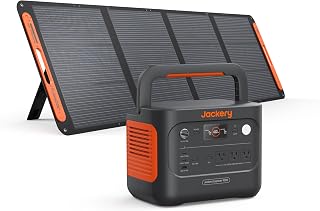
Bundling the 1070Wh station with a 200W solar panel creates a complete off-grid charging system in one package. The 1500W output runs essentials like laptops, lights, and small appliances, while the panel keeps you powered indefinitely in sunny locations. This combo eliminates guesswork for people new to solar off-grid setups who need everything to work together immediately.
Pros
- Includes a 200W solar panel
- 1,500W AC output with 3,000W surge
- LFP battery rated for 4,000 charge cycles
- Multiple AC, USB-C, USB-A, and car outputs
Cons
- 1,500W limits simultaneous high-draw loads
- Solar panel and station take up storage space
Off-grid living calls for a power source that can cover daily electronics and occasional appliance starts without turning a simple setup into a heavy installation. This Jackery bundle combines a 1,070Wh LFP battery, 1,500W continuous AC output, and the included 200W solar panel, giving it a practical role at a campsite, cabin, RV stop, or backup location. Its 3,000W surge capability helps with motor-driven loads such as microwaves and power tools, while three AC outlets, two 100W PD USB-C ports, USB-A, and a DC car outlet support a mix of devices. The solar panel can bring the station to 80% in six hours under clear conditions, which is useful when sunlight is the main recharge source. For times with grid access, it reaches a full charge in 1.7 hours, or one hour in emergency mode. At 23.8 pounds, the foldable handle makes moving the unit manageable for one person. Its LFP battery retains over 70% capacity after 4,000 charge cycles, supporting long-term use. The panel and station do require meaningful storage space, however, and 1,500W is not enough for several high-draw household appliances at once.
Buy this bundle if you want a ready-to-use solar power setup for modest off-grid electricity needs, including refrigeration, CPAP use, phones, laptops, lighting, and camping equipment. It suits solo travelers, RV users, and cabin owners who value a portable 23.8-pound station with several outlet types and a supplied solar panel. Skip it if your off-grid plan depends on continuously running multiple high-wattage appliances, or if storage space is very limited. The emergency charging mode also requires app activation each time.
Battery: 1070Wh LFP (Lithium Iron Phosphate) with 4000+ cycle lifespan
AC Output: 1500W continuous, 3000W surge peak at 120V, 60Hz
Solar Input: 200W panel included, reaches 80% charge in 6 hours (clear conditions)
AC Charging: 1.7 hours standard, 1 hour emergency mode via app
Alternator Charging: 3 hours with 600W charger (sold separately)
Ports: 3x pure sine wave AC outlets, 2x USB-C (100W PD max), 1x USB-A, 1x DC car outlet, LED lights
Weight: 23.8 lbs with foldable handle
Dimensions: 12.87"L x 8.82"W x 9.72"H
Warranty: 2-year manufacturer coverage, 5-year coverage included with purchase
Model: JE-1000D (E1000v2+200W bundle)

Pros
- Exceptional recharge speed of 1.29 hours makes it practical for frequent use
- Expandable capacity means you can start small and add more power later
- Enterprise-grade LiFePO4 battery provides reliability and exceptional cycle life
- Comprehensive port selection covers phones, laptops, power tools, and home appliances
- Federal tax credit eligibility reduces effective cost for qualified buyers
Cons
- 92-pound weight makes portability challenging for frequent movement between locations
- Limited review count suggests newer product with less long-term user feedback available
The ABOK Ark3600 is a premium portable power station designed for homeowners, RV enthusiasts, and off-grid users who need serious backup power. With 3600W continuous output and expandable 3840Wh to 11520Wh capacity, it bridges the gap between lightweight portable units and whole-home backup systems.
The standout feature is its ultra-fast 1.29-hour recharge time when combining AC and solar input, making it practical for daily use rather than emergency-only backup. The 15 versatile output ports mean you can simultaneously charge phones, laptops, power tools, WiFi routers, and run small appliances, eliminating the need for multiple charging solutions.
Build quality is solid with EV-grade LiFePO4 batteries rated for 4000+ charge cycles and a 10-year lifespan. The station includes advanced protection against overload, overheating, and short circuits. Bluetooth app connectivity adds convenience, letting you monitor battery levels and adjust settings remotely from your phone.
The main drawbacks are its 92-pound weight, which limits casual portability, and the premium $1,799 price tag. However, the federal Residential Clean Energy Tax Credit of up to 30% significantly improves the value proposition for qualified homeowners, and the expandable capacity provides long-term scalability.
The Ark3600 represents a smart investment for those serious about energy independence or backup power. It's overbuilt for casual camping but ideal for home backup, RV living, or off-grid applications where reliability and power capacity matter more than lightweight portability.
Power Output: 3600W rated, 1500W AC input, up to 2000W solar input
Battery: 3840Wh base capacity, expandable to 11520Wh, LiFePO4 chemistry
Cycle Life: 4000+ cycles with 10-year lifespan
Charging Time: 1.29 hours (combined AC + solar), 3 hours (AC only)
Output Ports: 1x AC 30A, 4x AC 20A, 2x USB-A QC3.0, 3x USB-C PD 20W, 1x USB-C PD 100W, 2x DC5521, 1x XT60, 1x 12V cigarette lighter
Weight: 92 pounds
Voltage: 120 volts
Fuel Type: Battery with solar and AC charging options
Best For: Home backup power, RV living, off-grid applications, and emergency preparedness. Ideal for users who want expandable capacity and fast recharge capabilities.
Consider This If: You need to power multiple devices simultaneously, want a scalable solution that grows with your needs, or qualify for federal clean energy tax credits that reduce the effective cost.
Skip If: You prioritize portability and need to move the unit frequently, have a tight budget under $1,500, or only need power for occasional camping trips where lighter models suffice.
Tax Credit Opportunity: Verify eligibility with your utility provider for the Residential Clean Energy Credit, which can cover up to 30% of qualified solar electric property costs, making this investment more affordable.
How to Choose an Off-Grid Power Station
Published watt-hour capacity tells only part of the story. We focused on usable energy, continuous output, solar input, expansion options, battery longevity, and physical practicality, because an off-grid station must fit your actual routine rather than an idealized emergency scenario.
Match Battery Capacity to Your Daily Loads
Start with a 24-hour list of must-run devices: refrigerator, lights, router, water pump, laptop, medical gear, and cooking appliances. Add their wattage and expected hours of use, then leave a meaningful buffer for inverter losses, startup surges, colder temperatures, and days when solar production is limited.
A 1,070Wh class unit such as the Jackery Explorer 1000 v2 Portable Power suits moderate essentials and mobile use, while the Jackery Explorer 300 Portable Power Station,292Wh is better for small electronics and CPAP-style needs. For a cabin server or networked storage, include the draw of your NAS hard drive setup in the daily energy plan.
For longer appliance runtime, the Anker SOLIX C2000 Gen 2 Portable Power Station starts at 2,048Wh and can expand to 4kWh. The BLUETTI Elite 300 Portable Power Station for RV provides 3,014Wh in a compact format, while the Jackery HomePower 3600 Plus Power Station, 3584Wh is built for larger household loads and extended backup plans.
Prioritize Continuous Output, Not Just Surge Power
Watt-hours determine runtime, but continuous watts determine what you can run at all. A refrigerator, induction cooker, power tool, or pump can demand substantially more power at startup, so compare the rated AC output with the highest combined load you expect to use at one time.
The Jackery Explorer 1000 v2 Portable Power offers 1,500W of AC output, which is suitable for many everyday combinations. The EF ECOFLOW Portable Power Station DELTA 2 Max raises that to 2,400W, giving you more room for appliances and a workstation with a high-refresh display from a 500Hz monitor guide.
If you need to support pumps, heaters, or several kitchen devices, 3,600W models deserve attention. The Jackery HomePower 3600 Plus Power Station, 3584Wh and ABOK Ark3600 Portable Power Station with 3×200W provide that higher-output class, but you should still confirm appliance labels and avoid treating surge capacity as continuous capacity.
Build Around Realistic Solar Recovery
Solar input limits how quickly a station can recover after an overnight discharge. Panel output changes with season, weather, shade, panel angle, and cable placement, so plan around conservative production instead of ideal midday figures. A useful system can recharge enough energy each day to cover the following night’s essential loads.
The Jackery Solar Generator 1000 v2 and 200W Solar simplifies the first step by including a matching 200W panel. For larger solar arrays, the Anker SOLIX S2000 Portable Power Station, 2,010Wh accepts up to 400W of solar input, the EF ECOFLOW Portable Power Station DELTA 2 Max supports up to 1,000W, and the ABOK Ark3600 Portable Power Station with 3×200W supports up to 2,000W of PV input.
Also check panel compatibility before ordering. The standalone Jackery Explorer 1000 v2 Portable Power is designed for Jackery panels, while other units may use broader connector options. Solar-ready storage is especially practical for low-draw work devices, including an external SSD for Mac that keeps your important files accessible without consuming much energy.
Consider Expansion, Battery Life, and Everyday Handling
For a fixed cabin, expansion can be more valuable than choosing one oversized station at the outset. The Jackery HomePower 1000 Plus v2 Portable Power starts with 1,024Wh and can grow to 11kWh with add-on batteries, while the EF ECOFLOW Portable Power Station DELTA 2 Max can expand from 2kWh to 6kWh.
LiFePO4 battery chemistry is a strong fit for frequent use because it supports long cycle life. The Anker SOLIX S2000 Portable Power Station, 2,010Wh lists 10,000 cycles, and the Jackery HomePower 1000 Plus v2 Portable Power lists 6,000 cycles. Fast UPS switching is also useful when a router, computer, or other sensitive device needs uninterrupted power.
Portability still matters when you must bring the station indoors, load it into an RV, or reposition it for solar. The Jackery Explorer 300 Portable Power Station,292Wh weighs only 7.5 pounds, the Jackery Explorer 1000 v2 Portable Power has a foldable handle, and the Jackery HomePower 3600 Plus Power Station, 3584Wh adds wheels and a telescopic handle for heavier-duty use.
Do not overlook smaller connected devices in your load calculation. An external SSD for gaming uses little energy by itself, but its power needs add to a laptop, monitor, router, and charging accessories. Choose enough outlets and USB-C capacity to avoid relying on power strips in a compact living space.
Final Thoughts
For a portable, balanced setup that can support cabin essentials and mobile work, the Jackery Explorer 1000 v2 Portable Power is an approachable fit. If your priorities are high-demand appliances, larger stored energy, and a scalable household system, the Jackery HomePower 3600 Plus Power Station, 3584Wh is the stronger long-term direction.
Frequently Asked Questions
How large should an off-grid power station be?
Choose capacity based on your critical loads over a full day, not on a single appliance label. Around 1kWh can cover lighter needs such as communications, lighting, laptops, and limited refrigeration, while 2kWh to 4kWh is more comfortable for regular fridge use and broader household essentials. Larger expandable systems make sense when you need multiple days of autonomy or must support pumps and cooking equipment.
Can a portable power station run a refrigerator overnight?
Yes, provided the station has enough usable capacity and AC output for your refrigerator’s compressor startup. Runtime varies greatly with refrigerator size, ambient heat, door openings, and the station’s idle draw, so use the appliance’s energy information as your starting point. Keep a buffer rather than planning to drain the battery completely every night.
Are solar panels included with every off-grid power station?
No, many power stations are sold without panels, so confirm what is in the package before you build your system. A bundle can be convenient for a first solar setup, while a standalone station may be better if you already own compatible panels. In 2026, check both the station’s maximum solar input and its accepted voltage range before adding more panels.
Can I power a laptop, monitor, and storage drives off grid?
Yes, these are generally manageable loads for most stations in this guide, particularly when you use USB-C charging where available. Displays can consume more energy than storage drives, so include the draw of a budget 1440p monitor and all connected accessories in your plan. A pure sine wave AC outlet and UPS capability can add useful protection for a desktop-based workspace.




Write Your Review
No reviews yet. Be the first to share your experience!