

At a dispersed campsite, a compact battery pack can seem capable until your compressor refrigerator, water pump, laptops, lights, and charging gear are all working at once. A dependable RV setup starts with enough stored energy, enough inverter output, and a practical recharge plan for the way you travel.
This guide narrows down the best power station for rv travel by comparing compact weekend units, mid-capacity workhorses, and high-capacity systems with RV-focused connections. If your rig doubles as a mobile office, our portable SSD options for Mac can help you build a travel-friendly workflow around your power setup.
Quick answer
This guide compares 10 picks, with Jackery Explorer 1000 v2 Portable Power Station ranked first. Jackery Explorer 300 Portable Power Station 292Wh has the most customer reviews.

With 1070Wh capacity and 1500W output, this station powers demanding RV appliances like coffee makers, microwaves, and portable refrigerators without hesitation. The dual solar and battery charging options give you flexibility at remote campsites where shore power is unavailable. Its balance of capacity and portability makes it suitable for extended trips where you need reliable power for both convenience appliances and emergency backup.
Pros
- 1,070Wh capacity with 1,500W output
- One-hour emergency charging mode
- Two 100W USB-C ports
- 23.8-pound design with foldable handle
Cons
- Only about 42 minutes at a full 1,500W load
- Compatible solar panels are sold separately
For RV travel, the Explorer 1000 v2 works best as a manageable electricity reserve for everyday electronics and moderate appliance use, rather than as a replacement for sustained high-draw power. Its 1,070Wh battery and 1,500W continuous output give it a clear middle ground between compact personal batteries and much larger backup systems. Three AC outlets, two 100W USB-C ports, and seven total connection points make it easier to keep laptops, phones, and several other devices connected at the same time. The 23.8-pound body and foldable handle are meaningful advantages when a station has to move between an RV, campsite, and home. LFP battery technology is rated to retain over 70% capacity after 4,000 cycles, while the standard 1.7-hour charging mode is intended to favor battery longevity. When turnaround matters, an emergency mode can recharge it from empty in one hour, though that mode must be enabled manually in the app each time. Solar use is possible, but compatible Jackery panels are separate. At a full 1,500W load, estimated runtime is only 42 minutes, so continuous high-demand RV appliances will exhaust it quickly.
Capacity and Power Output: 1070Wh battery capacity, 1500W continuous AC output, 3000W surge peak, 7 total power outlets
Charging: 1-hour emergency fast charge or 1.7-hour standard charge, 100W USB-C PD output, ChargeShield 2.0 technology
Battery Technology: LFP battery with 4000+ charge cycles, maintains 70%+ capacity after 4000 cycles, 10+ year lifespan
Ports and Connectivity: 2x USB-C (100W PD), 1x USB-A, 1x DC car port, 3x pure sine wave AC ports, LED lights, smart app control
Physical Specifications: Weight: 23.8 lbs, Dimensions: 12.87in (L) x 8.82in (W) x 9.72in (H), Foldable handle for portability
Additional Features: Smart app control with three charging modes, 30 dB quiet mode, energy efficiency mode, compatible with Jackery solar panels
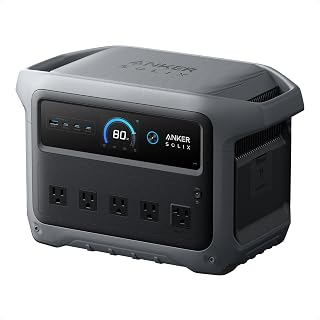
The 2000W surge capacity handles high-draw appliances common in RV living, from air fryers to electric skillets, without tripping protection circuits. Its solar charging capability means you can maintain power independence at boondocking sites far from hookups. The 120V AC output ensures compatibility with standard RV electronics and small appliances, making it a versatile companion for off-grid adventures.
Pros
- 2,000W continuous output
- 49-minute stated wall recharge
- Up to 600W solar input
- 10ms UPS switchover
Cons
- 1,024Wh capacity limits extended use
- Stated solar recharge time requires optimal conditions
An RV power station earns its space when it combines useful output with quick recovery at a campground hookup, and the SOLIX C1000 Gen 2 is built around that balance. Its 1,024Wh capacity and 2,000W continuous output sit between small battery packs and larger generator-style alternatives. The 3,000W maximum and nine outlets provide room to run and charge several items at once, while its 120V AC output suits ordinary plug-in gear. A key RV advantage is wall charging: HyperFlash accepts 1,600W input and is stated to refill the unit in 49 minutes. For off-grid stops, it accepts up to 600W of solar input, with a stated 1.8-hour full solar charge under optimal conditions. The 10ms UPS switchover can also help keep connected devices powered during an interruption. At 11.3 kg, with a 15.1-by-8.2-by-9.6-inch footprint and handles on both sides, it remains a one-person unit for short carries. Its LiFePO4 battery is rated to retain at least 80% capacity after 4,000 cycles. This is a compact, fast-recharging RV option, but its 1,024Wh capacity remains better for a controlled load plan than extended power-hungry use.
Buy the SOLIX C1000 Gen 2 if you travel in an RV with regular access to a wall outlet or enough solar capacity and want a 2,000W station that can recharge rapidly between uses. It is also a sensible match for owners carrying several small devices and wanting a compact, one-person unit. Skip it if a 1,024Wh battery is too limited for your expected runtime, or if you need a larger station for prolonged high-demand appliance use.
Capacity: 1,024Wh LiFePO4 battery
Output: 2,000W continuous, 3,000W peak
Ports: 10 total outputs
Wall Recharge: 1,600W input, 49 minutes to full
Solar Input: Up to 600W at 60V maximum, 1.8 hours to full
UPS Switchover: 10 milliseconds
Dimensions: 15.1L x 8.2W x 9.6H inches
Weight: 11.3 kg (24.9 lbs)
Battery Cycles: 4,000+ cycles with minimum 80% retention
Warranty: 5 years
Colors Available: Gray
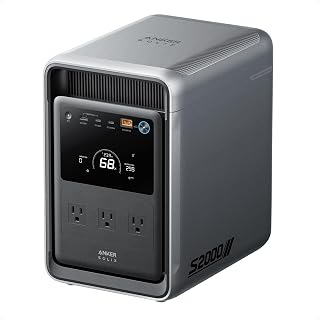
This 2010Wh unit provides multi-day power reserves for serious RV travelers who spend extended periods between charging opportunities. The 1500W continuous output supports simultaneous operation of multiple devices, from laptops to portable coolers. Its compact and lightweight design, combined with emergency backup functionality, makes it practical for both routine travel and unexpected situations where shore power fails.
Pros
- 2,010Wh battery capacity
- Stated 6W idle draw
- Six available recharge methods
- 10,000-cycle LFP battery rating
Cons
- No dedicated 12V DC port
- 35.7 pounds may be cumbersome to move
Longer stretches away from hookups favor higher battery capacity and low idle draw, which is where the SOLIX S2000 makes its RV case. Its 2,010Wh battery sets its focus on extended essential power, while the 1,500W running output and 3,000W starting wattage target appliances rather than unlimited high-load operation. The station has eight outlets arranged across its front and rear surfaces, helping keep a multi-device setup organized inside or outside an RV. For travelers keeping a refrigerator connected, its stated 6W idle draw is especially relevant. Anker cites up to 35 hours of refrigerator runtime, though actual runtime depends on the refrigerator, use pattern, and ambient conditions. The LFP battery is rated for 10,000 charge cycles and a 15-year lifespan. At 35.7 pounds, it is described as 25% lighter and 30% smaller than comparable 2kWh competitors, despite its large capacity. Six charging methods add flexibility when plans change, including 400W solar input, AC charging, generator input, and a car outlet. A sub-10ms UPS switchover supports uninterrupted power for connected equipment during grid transitions. The notable RV-specific omission is a 12V DC port, so it will not directly cover specialized 12V RV appliances.
Capacity and Output: 2,010Wh LiFePO4 battery, 1,500W continuous output, 3,000W peak output
Battery Technology: 314Ah LFP cells, 10,000 cycle lifespan, 15-year warranty
Dimensions: 8.19L x 11.1W x 12.7H inches
Weight: 35.7 pounds
Outlets: 8 total (front and rear configuration)
Charging Options: AC input, solar (up to 400W), generator, car outlet, alternator charger
UPS Switchover: Less than 10 milliseconds
Idle Power Draw: 6W
Color: Black
Model: AS220
Warranty: 5 years
Buy the SOLIX S2000 if your RV travel priorities are longer backup time for essential appliances, flexible recharging, and a relatively compact 2kWh-class station. It makes particular sense for travelers who want to keep a refrigerator connected and can use AC, solar, generator, or car charging. Skip it if your setup relies on a dedicated 12V DC port for specialized RV equipment, or if 35.7 pounds is more weight than you want to move.

Pros
- Exceptional portability at 41.7 lbs makes it genuinely packable for camping and travel
- Industry-leading fast charge at 58 minutes covers most emergency backup needs quickly
- Expandable architecture lets you start small and scale capacity without replacing the unit
- Robust 4,000W peak power handles demanding loads like window AC units and RV systems
- Six recharge options provide flexibility across home, vehicle, and off-grid scenarios
Cons
- Base 2,048Wh capacity may run out quickly if powering large appliances continuously, though expansion addresses this
- 41.7 lb weight is lighter than competitors but still requires two hands for comfortable transport
- Premium price point demands long-term ownership or frequent use to justify investment
The Anker SOLIX C2000 Gen 2 is a mid-to-premium portable power station designed for camping enthusiasts, RV owners, and households seeking reliable backup power. Its 2,048Wh capacity and expandable architecture appeal to users who want flexibility without overpaying for capacity they don't immediately need.
The standout performance metric is the 58-minute full charge via AC power, combined with six recharge methods including 800W car charging that reaches 100% in just 3 hours. The dual-input solar capability and ultra-low 9W standby draw mean it can power a refrigerator for 32 hours or expand to 64 hours with an added battery. With 2,400W continuous and 4,000W peak output, it handles multiple devices simultaneously, including most window and RV air conditioners.
Build quality reflects Anker's reputation, with the unit being 25% lighter and 29% more compact than comparable products despite its power output. At 41.7 lbs and sized at 18.1 by 9.8 by 10.1 inches, it's genuinely portable while maintaining serious capability. The included accessories (AC cable, guides, warranty card) show attention to first-time user experience.
The main limitation is the base 2,048Wh capacity, which depletes quickly under heavy loads or extended off-grid use, though this is offset by the expandable design and reasonable price point. Some users may find the weight still noticeable for frequent hiking, and the premium price requires commitment to justify the investment versus cheaper alternatives.
The Anker SOLIX C2000 Gen 2 earns its high rating by delivering genuine portability, fast charging, and scalability in a feature-rich package. It's best suited for serious campers, RV owners, and homeowners who value flexibility and speed of recharge over maximum capacity in a single unit.
Choose the C2000 Gen 2 if you prioritize portability, fast charging, and expandability. Its 2,048Wh base capacity works well for weekend trips, emergency home backup, and RV use. If you need 4,000Wh+ permanently or expect to run heavy appliances 24/7, consider the expansion battery or a larger single unit.
The six recharge methods make this especially valuable for mobile use. Car charging at 800W is 8x faster than standard outlets, and solar compatibility future-proofs your investment. The 58-minute AC recharge means you can top up overnight or between camp days without frustration.
Consider your typical power draws: refrigerators (100-800W), laptops (20-100W), power tools (500-2000W), and air conditioners (1000-4000W). The C2000 Gen 2 handles mixed moderate loads well. For sustained high-draw use, the expansion battery option is worth budgeting for upfront.

Pros
- RV-ready TT-30 outlet with 12V/30A DC, no adapters needed
- 3014Wh LiFePO4 capacity with 6000+ cycle lifespan
- Charges to 80% in 78 minutes for quick turnarounds at powered sites
- Multi-source charging via solar, AC, car, or generator
Cons
- 58 pounds makes it awkward to move without help
- Only two AC outlets may require a power strip for multiple devices
If you're outfitting a rig for real RV travel, the Elite 300 is built around that exact scenario. The TT-30 outlet with 12V/30A DC output plugs straight into camper systems without hunting for adapters, and the 3014Wh LiFePO4 battery gives you enough reserve to run a fridge, CPAP, or laptop through a full night at a campsite with no hookups. On travel days, multi-source charging matters more than at home: top it off from solar panels while driving, plug into a car charger, or recharge at a campground pedestal, whichever is available. The 2400W continuous output with 4800W surge covers RV essentials like a microwave or AC compressor startup, something smaller units struggle with. Charging to 80% in 78 minutes also means a short stop at a powered site can get you most of the way back to full before you're on the road again. For travelers who want one unit that handles both boondocking and occasional backup power at home, this covers both without compromise.
Power Output: 2400W continuous, 4800W surge capacity with 10ms UPS backup switching
Battery: 3014Wh LiFePO4 with 6000+ charge cycles
Outlets: 2 AC outlets (120V), TT-30 RV port, 12V/30A DC output
Charging: 0 to 80% in 78 minutes via AC, solar, car charger, or generator input
Dimensions: 14.4L x 12W x 11.7H inches
Weight: 58 pounds
Runtime: Approximately 1 hour 18 minutes at full 2400W load
Buy this if you're equipping a camper or RV for off-grid stretches and want RV-specific outlets plus fast, flexible recharging between stops. It also suits anyone who wants a dual-purpose unit for home backup when not traveling. Skip it if you need something lightweight to carry daily, since 58 pounds requires two hands or a dolly, or if your rig runs several AC devices simultaneously, since there are only two outlets.

This compact unit delivers 292Wh capacity in a lightweight package, ideal for weekend warriors who need to charge phones, tablets, and small electronics without adding bulk to their RV storage. The 4-hour recharge time means you can top it off during morning stops and have full power by afternoon. With dual USB ports and a 300W AC outlet, it handles essential devices like CPAP machines or laptop charging while keeping your setup minimal.
Pros
- 7.5-pound compact design
- Charges up to six devices
- 100W USB-C PD port
- 4,000-plus cycle LiFePO4 rating
Cons
- Cannot power refrigerators or air conditioners
- Limited 292Wh capacity for extended loads
The Jackery Explorer 300 makes the strongest case for RV travelers who want a compact power reserve for personal electronics rather than a substitute for campground shore power. Its 292Wh battery, 300W rated output, and 7.5-pound weight target the everyday gear that tends to travel inside an RV: phones, tablets, laptops, cameras, and drones. Two AC outlets, a 100W USB-C PD port, two USB-A ports, and a 120W car charging port give it six-device charging flexibility, useful when several passengers need to recharge at once. The integrated handle and digital remaining-capacity display further suit frequent moves between the cab, campsite table, and trailer. A full AC charge takes about three to four hours, while a compatible 100W solar panel can bring it to 80% in 2.8 hours. Its LiFePO4 battery is rated for more than 4,000 cycles before reaching 70% capacity. RV owners should keep its role in perspective: this is for modest electronics and overnight device charging, not refrigerators, air conditioners, or high-wattage tools.
Buy it if your RV trips center on keeping communication, camera, computer, and drone gear charged while limiting the weight of backup equipment. It is particularly appropriate for solo travelers, couples, and anyone who can recharge at a campground or through a compatible solar panel. Skip it if your travel plan requires running a refrigerator, air conditioner, or other high-wattage appliance. Campers seeking a large onboard energy reserve should also look beyond its 292Wh capacity and 300W output.
Capacity: 292Wh (LiFePO4 battery)
Weight: 7.1-7.5 lbs
Dimensions: 15.43in D x 9.92in W x 11.89in H
AC Output: 2 outlets, 110V, 300W continuous (600W peak surge)
USB Ports: USB-C PD 100W, USB-A 2.4A (x2)
Car Port: 120W 12V output
Charging Time: Approximately 4 hours AC, 2.8 hours with 100W solar panel
Battery Cycles: 4,000+ before reaching 70% capacity
Warranty: 2 year manufacturer
Model: JE-300E

The 1024Wh LiFePO4 battery provides reliable power for both outdoor adventures and residential-style comfort in your RV. Its 1000W capacity handles mid-range appliances like blenders, fans, and small cooking devices that make RV living more comfortable. Solar charging compatibility means you can extend your off-grid stays without worrying about depleting your house batteries, preserving them for critical RV systems.
Pros
- 1024Wh LiFePO4 battery
- 1000W continuous, 2000W starting output
- Up to 300W solar input
- Five-device charging capability
Cons
- 27.7-pound carry weight
- No UPS functionality
For RV travel, the Staryline 1000W pairs a 1024Wh LiFePO4 battery with 1000W continuous output, creating a middle ground between compact device chargers and much larger backup stations. That capacity is positioned to support a Wi-Fi router, mini fridge, CPAP machine, or home entertainment system, and its 2000W starting wattage accommodates brief startup demand. Two 110V AC outlets, a 60W USB-C PD port, and two USB-A ports allow five devices to charge simultaneously, a practical mix for a trailer shared by several people. Solar compatibility is especially relevant away from hookups: it accepts up to 300W of solar input, and an optional 200W panel can fully recharge it in six to eight hours of sun. Its automotive-grade LiFePO4 battery uses a six-layer smart battery management system and retains 80% capacity after more than 3,000 cycles. The 27.7-pound weight is the key RV trade-off. It is manageable as stored equipment, but not ideal for constant carrying. It also lacks UPS functionality and requires manual output shutdown to prevent drain.
Power Output: 1000W continuous, 2000W peak surge capacity
Battery: 1024Wh LiFePO4 with automotive-grade cells and six-layer smart BMS protection
Charging Ports: 2x 110V AC outlets, 1x 60W USB-C PD port, 2x USB-A ports
Solar Input: Up to 300W maximum, compatible with standard monocrystalline panels
Durability: 3000+ charge cycles with 80% capacity retention, approximately 6-year lifespan
Physical: 27.7 lbs, dimensions 18L x 12W x 16H inches, three colors available (Gray, Blue, Yellow)
Included: Power station, car charging cable, AC charging cable, user manual
Buy this for an RV that needs a 1024Wh power reserve for a mix of small electronics and selected essentials such as a Wi-Fi router, mini fridge, or CPAP machine. It suits travelers who can use solar input up to 300W and do not mind transporting a 27.7-pound unit. Skip it if seamless UPS switching is essential, if you want to avoid manually shutting down outputs, or if a lighter station is the priority.

Pros
- Silent operation makes it superior to gas generators, with instant push-button start
- Exceptional versatility with 15 different ports supporting diverse device types and power requirements
- Fast charging options via AC, solar, or car charging provide flexibility in any situation
- Durable LiFePO4 chemistry offers significantly longer lifespan than traditional lithium batteries
- Built-in Bluetooth app enables remote monitoring and energy optimization from anywhere
Cons
- Heavy at 92 pounds, requiring wheels for practical mobility despite the bulk
- Fan noise increases during high-load operation, which some users find noticeable
The ABOK Ark3600 is a premium portable power station designed for homeowners, contractors, RV enthusiasts, and anyone needing reliable backup power during outages or off-grid adventures. With 3840Wh of expandable capacity and 3600W continuous output, it bridges the gap between portable convenience and serious power delivery.
Real-world performance is impressive across the board. Contractors report running multiple power tools simultaneously, users have powered entire work-from-home setups with minimal battery drain, and emergency backup scenarios show the unit delivering dependable service when it matters most. The 15 output ports eliminate the need for adapters and splitters, while fast charging options mean you're rarely waiting long for a full charge.
Build quality reflects its premium positioning. The LiFePO4 battery chemistry delivers over 4000 cycles and a claimed 10-year lifespan, far exceeding traditional lithium alternatives. The unit rolls easily thanks to sturdy wheels and a telescoping handle, though its 92-pound weight means it's not exactly grab-and-go portable. The Bluetooth app adds genuine utility by letting you monitor and optimize power consumption remotely.
The main drawbacks are price and weight. At $1,299, this is a significant investment suited for serious users rather than casual campers. Fans do run audibly under heavy load, though most users accept this trade-off for silent operation under normal use. Battery percentage reporting appears miscalibrated in some cases, though actual usable power remains solid.
The Ark3600 is recommended for homeowners wanting emergency backup, remote workers needing power independence, contractors powering job sites, and anyone prioritizing reliability and versatility over portability. It's a no-compromise choice for those who can afford the investment.
Power Output: 3600W continuous, 4500W peak, 7200W starting wattage
Battery Capacity: 3840Wh base, expandable to 11520Wh. LiFePO4 chemistry with 4000+ cycles and up to 10-year lifespan
Charging Input: AC at 1500W, Solar (PV) at 2000W, Car charging at 120W. Full charge achievable in 1.29 hours with combined AC plus solar, or 3 hours AC only
Output Ports: 1x AC 30A, 4x AC 20A, 2x USB-A QC3.0, 3x USB-C PD 20W, 1x USB-C PD 100W, 2x DC5521 12V/3A, 1x XT60 12V/25A, 1x Cigarette Lighter 12V/10A
Dimensions and Weight: 21.6 inches L by 12.6 inches W by 18.5 inches H, weighs 92 pounds. Features extendable telescoping handle and durable wheels
Smart Features: Bluetooth app for remote monitoring, 10ms UPS response for seamless power switching
Warranty: 2 years plus 3 years extended coverage. Manufactured by Shenzhen SYD Network Technology Co., Ltd
Ideal For: Homeowners wanting emergency backup power during outages, off-grid residents, RV and camping enthusiasts, remote workers needing power independence, contractors and job site managers, and outdoor adventure seekers who demand reliability.
Best Use Cases: Hurricane and storm preparedness, weekend camping trips, extended outdoor activities, powering work-from-home setups, charging multiple devices simultaneously, running power tools at remote locations, and maintaining essential appliances during grid failures.
Consider Alternatives If: You need ultra-portable equipment (this is 92 pounds), require solar panels specifically included in purchase, have a tight budget under $1,000, or prioritize fan silence under all load conditions. For casual day-trip camping with minimal power needs, smaller 2000Wh units may suffice.

This 3584Wh powerhouse with 3600W output serves full-time RVers who need home-level power capacity on the road. It can run air conditioners, full-size refrigerators, and multiple appliances simultaneously, essentially eliminating the limitations of typical RV electrical systems. The easy installation and residential-grade output make it suitable for those who work remotely from their RV or need extended autonomy from campground hookups.
Pros
- 3584Wh capacity and 3600W AC output
- Expandable to 43kWh
- Hybrid charging in two hours
- 6,000-cycle LFP battery rating
Cons
- 77.2-pound unit
- Only two outlets
The Jackery HomePower 3600 Plus is geared toward RV travelers who need far more than device charging and are willing to manage a 77.2-pound unit. Its 3584Wh capacity and 3600W AC output put it in a different class from compact stations, while two outlets provide AC connections for selected onboard loads. The existing description specifies dual 120V/240V output, a plug-and-play setup, and an expandable system reaching 43kWh when multiple units are linked. That expansion potential may appeal to travelers building a larger energy setup over time rather than relying on one small battery. Recharging is another centerpiece: hybrid AC plus DC input can fill the battery in two hours, and AC-only or solar charging takes 2.5 to 4 hours. The ceramic-membrane LFP battery is rated for 6,000 cycles and specified to withstand temperatures from -4°F to 302°F. Although its compact-for-capacity dimensions, telescopic handle, and luggage-style wheels help with repositioning, this is not a grab-and-go choice. At 77.2 pounds, it suits an RV where high capacity matters more than easy hand carrying.
Capacity: 3584Wh base, expandable to 21kWh per unit or 43kWh with multiple units
Power Output: 3600W AC (7200W in parallel configuration)
Voltage: 120V and 240V dual voltage support
Battery Type: Ceramic membrane LFP cells
Cycle Life: 6,000+ cycles with 10-year lifespan
Operating Temperature: -4°F to 302°F
Charging Options: Hybrid AC plus DC (2 hours), AC only (2.5 hours), solar (4 hours), gas generator (2.5 hours)
Weight: 77.2 pounds
Dimensions: 15.2 x 12.2 x 19.3 inches
Outlets: 2 outlets plus built-in cables
Warranty: 5-year manufacturer coverage
Choose it if RV travel routinely needs a high-capacity battery and you have room to store and roll a 77.2-pound station. It fits users who value a 3584Wh reserve, 3600W AC output, rapid charging options, and the ability to expand capacity with additional units. Skip it if you primarily charge phones, laptops, and other small electronics, or if lifting and moving heavy equipment is a concern. Travelers who need more than two AC outlets should also consider that limitation.

The 288Wh LFP battery chemistry offers superior longevity and thermal stability, crucial for RVs exposed to varying temperatures during travel. With 600W output and multiple charging options including car charging, it adapts to your route whether you're driving between sites or parked at a trailhead. The compact form factor fits easily in RV cabinets while providing enough power for road trip essentials like laptops and camera batteries.
Pros
- 600W output with 1500W Lifting Power
- 288Wh capacity in a 9.4-pound package
- Reaches 0 to 80% in 45 minutes with a 380W wall adapter
- Nine outlets and 140W PD fast charging
Cons
- 288Wh capacity limits runtime with high-load devices
- Heavy Power Lifting use may stress components over time
An RV power station does not always need to run every appliance in the rig. The Elite 30 V2 makes more sense as a compact, quick-recharge source for the smaller electrical jobs that arise at campsites and on travel days. Its 288Wh capacity and 600W continuous output give it more headroom than a basic device charger, while its 1500W Power Lifting Mode is listed for occasional use with devices such as kettles, toasters, and small microwaves. Runtime will still depend greatly on the device, so the capacity is not intended for extended use of power-hungry equipment. At 9.4 pounds, it is easy to stow in an RV, car trunk, or even a backpack. Nine outlets and a 140W PD fast-charging feature help it serve multiple devices, and eight charging modes accommodate AC, solar, car, generator, and lead-acid-powered charging. It can reach 0 to 80% in 45 minutes using a 380W wall adapter. Its ≤10ms UPS backup is also relevant for keeping a CPAP machine, router, or laptop protected through a sudden outage. UltraCell technology reduces idle drain to 4.5W, helping preserve stored energy between uses.
Power Output: 600W continuous, 1500W surge (Power Lifting Mode)
Capacity: 288Wh with LFP battery chemistry
Charging Speed: 0-80% in 45 minutes via 380W AC adapter, 0-100% in 70 minutes
Charging Modes: 8 modes including AC wall (380W/200W adjustable), solar input, car charging, and generator compatible
UPS Response: 10ms ultra-fast switch for critical device protection
Outlets: 9 total ports including AC, USB-C with 140W PD fast charging, and DC outputs
Weight: 9.5 lbs (9.4 lbs stated in marketing)
Dimensions: 9.8 inches long by 7 inches wide by 6.6 inches high
Standby Power Draw: 4.5W AC mode, 5W DC mode, 8W standby
Warranty: 60 months manufacturer coverage
Battery Technology: UltraCell LFP with enhanced thermal management
Recommended Uses: Camping, road trips, emergency home backup, outdoor recreation, and event power
Buy the Elite 30 V2 if your RV trips call for a small secondary battery for personal electronics, CPAP use, routers, or occasional short-duration kitchen-device needs, and if fast recharging and several input choices matter. Its 9.4-pound weight also favors travelers short on storage space. Skip it if you need long runtimes for high-wattage appliances or want a station intended to cover an RV's larger electrical demands. The 288Wh capacity means duration changes substantially with the load.
How to Choose an RV Power Station
Start With Usable Capacity and Daily Loads
Battery capacity, measured in watt-hours, determines how long a station can support your daily routine. List each load, its wattage, and expected hours of use, then leave room for inverter losses, warm weather, and the stop-and-start cycling of a refrigerator.
The Jackery Explorer 300 Portable Power Station,292Wh and BLUETTI Elite 30 V2 Portable Power Station 288Wh suit short outings focused on small electronics, lighting, and CPAP use. Near-1kWh choices, including the Jackery Explorer 1000 v2 Portable Power, Anker SOLIX C1000 Gen 2 Portable Power Station, and Staryline 1000W Portable Power Station 1024Wh LiFePO4, are more realistic for overnight fridge support and a modest work setup. Media-heavy travelers should also account for the steady draw of an 8TB hard drive for large file libraries.
Match Continuous Output to Your Appliances
Watt-hours tell you how long power may last, but continuous wattage tells you what can run at the same time. Check the running draw of your appliances, especially coffee makers, induction cooktops, hair tools, microwaves, and air conditioners, then compare their startup demand with the station’s surge rating.
The Anker SOLIX C1000 Gen 2 Portable Power Station supplies 2,000W of continuous output, while the Anker SOLIX C2000 Gen 2 Portable Power Station increases that to 2,400W for heavier combinations of loads. The Anker SOLIX S2000 Portable Power Station, 2,010Wh offers 1,500W output for essential appliances, whereas the Jackery HomePower 3600 Plus Power Station, 3584Wh and ABOK Ark3600 Portable Power Station 3600W are built for considerably larger demands. A laptop, display, and an external SSD for gaming use far less energy than heating appliances, but their combined draw still belongs in your plan.
Prioritize Solar, Alternator, and Fast Wall Charging
A power station is only as useful as your ability to replenish it between stops. Consider where you usually camp, how many sunny hours you receive, whether you drive frequently, and whether you can use shore power or a generator before choosing a recharge method.
For quick turnaround at hookups, the Anker SOLIX C1000 Gen 2 can use its app-enabled high-speed charging mode, while the Anker SOLIX C2000 Gen 2 supports fast AC-and-solar charging and high-speed alternator charging. The ABOK Ark3600 accepts substantial solar input, and the Jackery HomePower 3600 Plus supports several charging paths for longer stays. Solar performance changes with panel placement, temperature, shade, cable losses, and the station’s input limit, so treat manufacturer charging times as favorable-condition estimates rather than daily guarantees.
Check RV Connections, Weight, and Battery Longevity
Ports and physical layout matter more in an RV than they do in a living room. The BLUETTI Elite 300 Portable Power Station for RV stands out with a TT-30 outlet and 12V/30A DC output for RV-oriented equipment, while the ABOK Ark3600 includes a wide selection of AC, USB, DC, and high-current connections.
Confirm that the station has the exact output your fridge, pump, diesel heater, or accessories need, since the Anker SOLIX S2000 Portable Power Station, 2,010Wh does not include a 12V DC port. LiFePO4 battery chemistry is a strong choice for frequent travelers because it is designed for many charge cycles, but weight and storage footprint still determine whether you will actually move the station easily. For a home-base archive that syncs with your road gear, see our NAS hard drive recommendations before committing to a larger storage setup.
Final Thoughts
For most campers who want a capable, manageable power source for everyday RV loads, the Jackery Explorer 1000 v2 Portable Power offers a balanced combination of capacity, output, and portability. Travelers who need a dedicated RV outlet, larger energy reserve, and stronger support for onboard systems should look closely at the BLUETTI Elite 300 Portable Power Station for RV.
Frequently Asked Questions
Can an RV power station run an air conditioner?
It can in some cases, but success depends on the air conditioner’s running watts, startup surge, ambient temperature, and whether a soft-start device is installed. A higher-output unit such as the Anker SOLIX C2000 Gen 2 Portable Power Station is better suited to this role than a compact 300Wh-class station. Even then, air conditioning can deplete stored energy quickly, so it is best treated as a short-duration load unless you have substantial battery capacity and charging input.
How much battery capacity does an RV need for overnight camping?
For lights, phones, fans, and light electronics, a smaller station may be enough for a night or weekend. If you want to support a compressor fridge, laptops, a CPAP machine, or a water pump, around 1kWh is a more flexible starting point. Multi-day boondocking with several appliances generally points toward a 2kWh or larger system, particularly when solar conditions are uncertain.
What size power station is right for an RV workstation?
Add the wattage of your laptop, monitor, router, chargers, and storage devices, then multiply by the hours you expect to work without recharging. A 1kWh station is often a comfortable fit for a typical mobile desk, while larger capacities provide more margin for long workdays and refrigerator duty. Screen choice also matters, so consult our guide to the best 32 inch 4K monitors if you are building a productive RV desk.
Is solar charging enough for off-grid RV travel in 2026?
Solar can be an excellent primary recharge source when panel capacity, sunlight, and station input limits are properly matched. It is less predictable during cloudy weather, under tree cover, or in winter, so many RV travelers combine solar with alternator, shore-power, or generator charging. If you also use a display for travel work or entertainment, choosing from our budget 1440p monitor picks can help you keep your overall power demand reasonable.




Write Your Review
No reviews yet. Be the first to share your experience!