

A campground refrigerator, a remote workstation, and a surprise outage all create the same practical question: how much power can you carry without choosing a unit too heavy to move? A capable portable power station bridges the gap between small USB batteries and a noisy fuel generator, provided its capacity and output match your gear.
This guide compares compact stations for personal electronics with larger backup units for appliances, camping, and home essentials. We focus on battery capacity, AC output, recharging flexibility, and the features that matter in daily use; if your travel kit includes work files, our portable SSD guide for Mac users can help round out a reliable mobile setup.
Quick answer
This guide compares 10 picks, with Jackery Explorer 1000 v2 Portable Power Station ranked first. Jackery Explorer 300 Portable Power Station 292Wh has the most customer reviews.

Pros
- 1,070Wh capacity with 1,500W output
- Seven total connection points
- One-hour emergency charging mode
- LFP battery rated for 4,000 cycles
Cons
- Short runtime at a full 1,500W load
- Solar panels are sold separately
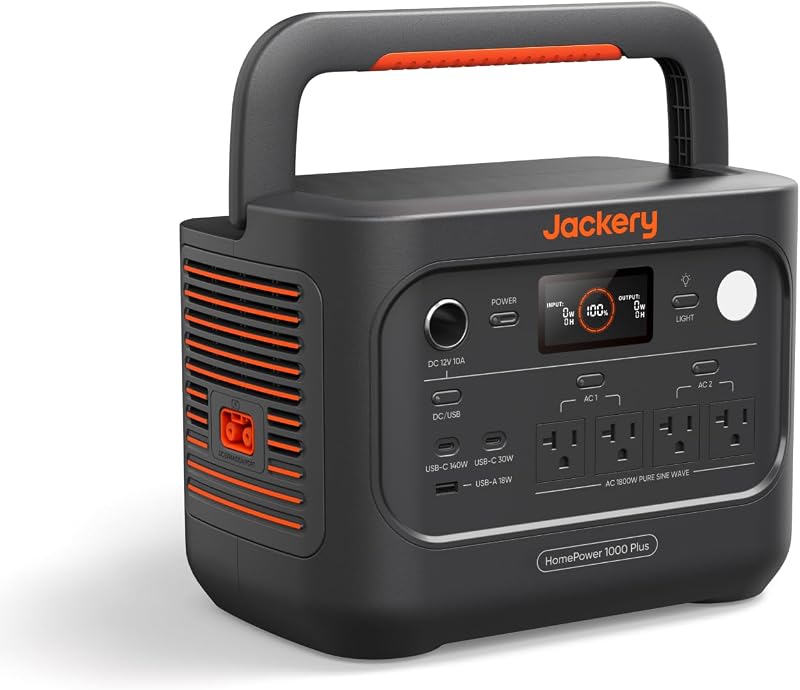
For a camping weekend that may turn into an outage plan at home, the Jackery Explorer 1000 v2 offers a useful middle ground between a small device charger and a much larger backup system. Its 1,070Wh battery and 1,500W continuous output can support a mix of essentials, while 3,000W surge capacity helps with appliances that need extra power at startup. Seven connection points, including three AC outlets and two 100W USB-C PD ports, make it easier to keep lights, phones, laptops, and other gear connected at once. Portability matters when power has to move from the car to a campsite or between rooms during an emergency. At 23.8 pounds, with a foldable handle, this model is more manageable than generator alternatives. Its LFP battery is rated to retain over 70% capacity after 4,000 charge cycles. Fast charging is another advantage: emergency charging can fill it in one hour, while the standard mode takes 1.7 hours. Keep expectations realistic for heavy loads, though, since it runs for about 42 minutes at the full 1,500W output.
Capacity and Power Output: 1070Wh battery capacity, 1500W continuous AC output, 3000W surge peak, 7 total power outlets
Charging: 1-hour emergency fast charge or 1.7-hour standard charge, 100W USB-C PD output, ChargeShield 2.0 technology
Battery Technology: LFP battery with 4000+ charge cycles, maintains 70%+ capacity after 4000 cycles, 10+ year lifespan
Ports and Connectivity: 2x USB-C (100W PD), 1x USB-A, 1x DC car port, 3x pure sine wave AC ports, LED lights, smart app control
Physical Specifications: Weight: 23.8 lbs, Dimensions: 12.87in (L) x 8.82in (W) x 9.72in (H), Foldable handle for portability
Additional Features: Smart app control with three charging modes, 30 dB quiet mode, energy efficiency mode, compatible with Jackery solar panels
Pros
- 2,000W continuous output
- Full wall recharge in 49 minutes
- Up to 600W solar input
- 10ms UPS switchover
Cons
- 11.3 kg can be cumbersome for longer carries
- More capacity and output than basic device charging needs
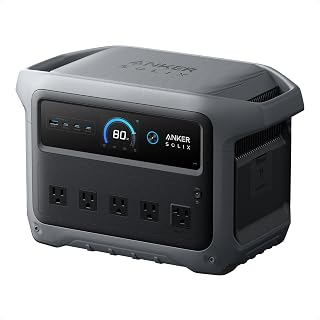
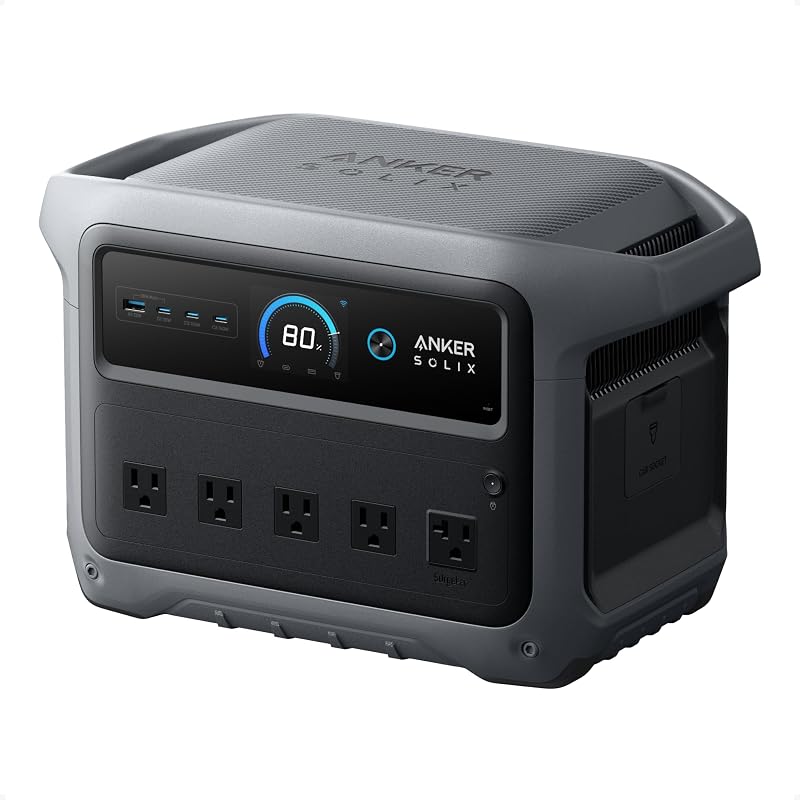
The Anker SOLIX C1000 Gen 2 is aimed at campers and outage planners who want a battery station capable of carrying several devices instead of choosing which one gets power. Its 1,024Wh capacity and 2,000W continuous output provide substantially more headroom than a basic camping battery, and its maximum engine power is listed at 3,000W. With nine outlets, it can serve a campsite setup or keep a collection of household essentials connected when the grid goes down. Recharge speed is its strongest argument for emergency readiness. HyperFlash technology supports a full wall recharge in 49 minutes at 1,600W input, which can be useful between outages or before leaving for a trip. The 10ms UPS switchover is designed for equipment that cannot tolerate an interruption. For extended camping, it accepts up to 600W of solar input and can recharge in 1.8 hours under optimal conditions. The LiFePO4 battery retains at least 80% capacity after 4,000 charge cycles. Its 15.1 by 8.2 by 9.6-inch footprint and 11.3 kg weight make it a practical one-person carry for short moves, rather than a unit to haul far from the vehicle.
Buy the SOLIX C1000 Gen 2 if camping power and blackout backup both need to cover several devices, with fast wall recharging as a priority. It fits campers who can use nine outlets, solar-capable charging, and a compact station that one person can carry short distances. Skip it if you only need to top up phones and lights, where its 2,000W output may be more than necessary. It is also not the best match for anyone unable to manage an 11.3 kg power station.
Capacity: 1,024Wh LiFePO4 battery
Output: 2,000W continuous, 3,000W peak
Ports: 10 total outputs
Wall Recharge: 1,600W input, 49 minutes to full
Solar Input: Up to 600W at 60V maximum, 1.8 hours to full
UPS Switchover: 10 milliseconds
Dimensions: 15.1L x 8.2W x 9.6H inches
Weight: 11.3 kg (24.9 lbs)
Battery Cycles: 4,000+ cycles with minimum 80% retention
Warranty: 5 years
Colors Available: Gray

Pros
- 1024Wh capacity and 1800W AC output
- 13 outlets for connected gear
- 80% charge in 30 minutes with solar and AC input
- Expandable from 1kWh to 5kWh
Cons
- 12.5kg weight limits carry-around portability
- Additional battery needed above 1kWh capacity
Camping trips and outages call for a station that can do more than recharge phones, and the Delta 3 starts with a 1024Wh capacity and 1800W AC output. That combination is positioned for household appliances, power tools, remote work, and extended outdoor trips. It has 13 outlets, and X-Boost raises available power to 2200W, with 3600W surge capacity, for compatible high-draw devices. For a base camp or home emergency setup, five fast recharge methods and the ability to combine 500W solar input with 1500W AC input address the need to get power back quickly: the supplied information cites 80% in 30 minutes and full charging in 56 minutes. The LiFePO4 battery is rated for 4,000 cycles to more than 80% capacity, while expansion batteries can take the system from 1kWh to 5kWh. At 12.5kg, with 15.7 by 8 by 11.2-inch dimensions, it is better suited to vehicle-supported camping and a fixed outage station than carrying from site to site. Its stated noise levels are below 30dB at 600W and below 40dB at 1200W.
Capacity and Output: 1024Wh total energy, 1800W continuous AC output, 2200W rated with X-Boost to 3600W surge power. Supports up to 13 simultaneous device connections.
Battery Technology: LiFePO4 chemistry, 4000 cycles to 80% capacity retention, 10-year lifespan under normal use, 5-year manufacturer warranty included.
Charging Methods: Five fast recharge options including 500W solar input, 1500W AC wall charging, and hybrid combinations. Full charge achievable in 56 minutes, 80% in 30 minutes via AC input.
Physical Specs: 12.5 kg weight, 15.7 x 8 x 11.2 inches dimensions, black and gray color. IP65 rating for splash, dust, and oil resistance.
Expandability: Modular design scales capacity from 1kWh base up to 5kWh with compatible DELTA 3, DELTA Pro 3, and DELTA 2 Max battery pack additions.
Buy the Delta 3 if car camping, a long-established base camp, or meaningful outage backup is your goal, and you need enough output for household appliances, power tools, or other compatible demanding gear. It is especially suitable for people who value rapid recharging, 13 outlets, expansion from 1kWh to 5kWh, and a LiFePO4 battery rated for 4,000 cycles to 80% or more capacity. Skip it for backpacking, frequent hand-carrying between campsites, or minimal-power trips, because it weighs 12.5kg.
Pros
- 2,010Wh battery capacity
- 35-hour rated refrigerator runtime
- Eight front and rear outlets
- 10,000-cycle LFP battery rating
Cons
- No 12V DC port
- Actual runtime varies by appliance and conditions
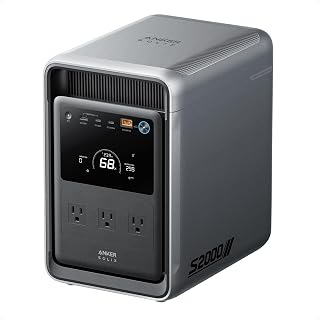
Longer outages and multi-day camping trips call for stored energy first, and the Anker SOLIX S2000 brings 2,010Wh to that job. Its 1,500W running output and 3,000W starting wattage are built for a broader set of essential loads than smaller portable stations. Eight outlets on the front and rear give it room for a more organized backup setup, whether it is supporting camp equipment or selected home devices during a power interruption. This model puts particular emphasis on keeping refrigerator backup practical. Its 6W idle power draw is rated for a 35-hour refrigerator runtime, though actual results depend on the refrigerator, usage, and ambient conditions. The compact design is notable for its capacity: it weighs 35.7 pounds and measures 8.2 by 11.1 by 12.7 inches. For recharging flexibility, it supports six methods, including 400W solar input, AC charging, generator input, and a car outlet. A sub-10ms UPS switchover helps attached equipment stay powered through a grid transition. The LFP battery is rated for 10,000 charge cycles and a 15-year lifespan, making this a compelling option for repeated emergency use as well as regular trips.
Capacity and Output: 2,010Wh LiFePO4 battery, 1,500W continuous output, 3,000W peak output
Battery Technology: 314Ah LFP cells, 10,000 cycle lifespan, 15-year warranty
Dimensions: 8.19L x 11.1W x 12.7H inches
Weight: 35.7 pounds
Outlets: 8 total (front and rear configuration)
Charging Options: AC input, solar (up to 400W), generator, car outlet, alternator charger
UPS Switchover: Less than 10 milliseconds
Idle Power Draw: 6W
Color: Black
Model: AS220
Warranty: 5 years
Buy the SOLIX S2000 if the priority is more reserve power for extended outages, refrigerator backup, or longer camping stays. It makes sense for households that want 2,010Wh capacity, eight outlets, several recharge options, and a sub-10ms UPS function for connected equipment. Skip it if you need a 12V DC port for specialized RV gear, because this model does not include one. People seeking the lightest possible camp battery may also prefer a smaller station than this 35.7-pound unit.

This 292Wh station delivers 120 volts of AC power, making it suitable for running small appliances during outages or charging laptops at the campsite. The compact form factor and 4-hour charge time mean you can prep it quickly before heading out. With 300 watts of maximum power and multiple output options, it handles everything from CPAP machines to mini fridges.
Pros
- 7.5-pound compact design
- Charges up to six devices
- 100W USB-C PD port
- LiFePO4 battery rated for 4,000+ cycles
Cons
- Not for refrigerators or air conditioners
- 292Wh capacity limits extended high-draw use
For a weekend campsite or a short outage, the Jackery Explorer 300 prioritizes easy carrying over whole-home ambition. Its 292Wh capacity and 7.5-pound weight make it a sensible reserve for keeping personal electronics available when grid power or campground hookups are absent. With a 300W rated output and 600W peak capability, it is suited to laptops, cameras, drones, phones, tablets, and other smaller gear, rather than a refrigerator, air conditioner, or high-wattage tools. The connection mix supports a compact camp or emergency kit: two AC outlets, a 100W USB-C PD port, two USB-A ports, and a 120W car port can serve up to six devices at once. A display reports remaining capacity, while the integrated handle helps with packing and carrying. It reaches a full charge in roughly three to four hours from its AC adapter; a compatible 100W solar panel can reach 80% in 2.8 hours. Its LiFePO4 battery is rated for more than 4,000 cycles before reaching 70% capacity, supporting regular preparedness use over the long term.
Buy the Explorer 300 if your camping checklist centers on a phone, tablet, camera, drone, laptop, or small electronics, and you want a 7.5-pound station that can move easily between a vehicle, tent, and outage kit. Its six-device capability is also useful for a small household’s personal devices during a brief interruption. Skip it if backup power means running a refrigerator, air conditioner, high-wattage tools, or other large appliances. Those loads fall outside the role of this 292Wh, 300W unit.
Capacity: 292Wh (LiFePO4 battery)
Weight: 7.1-7.5 lbs
Dimensions: 15.43in D x 9.92in W x 11.89in H
AC Output: 2 outlets, 110V, 300W continuous (600W peak surge)
USB Ports: USB-C PD 100W, USB-A 2.4A (x2)
Car Port: 120W 12V output
Charging Time: Approximately 4 hours AC, 2.8 hours with 100W solar panel
Battery Cycles: 4,000+ before reaching 70% capacity
Warranty: 2 year manufacturer
Model: JE-300E

Solar charging capability makes this particularly valuable for extended camping where grid access isn't available, letting you recharge off-panel during the day. The 288Wh capacity and 360-watt output handle camp lighting, portable coolers, and communication devices reliably. Dual battery and solar power sources give you flexibility whether you're preparing for storm season at home or planning a weekend off-grid.
Pros
- Eight total ports
- 80% wall recharge in 50 minutes
- 25dB stated operation
- LiFePO4 rated for 3,000 cycles
Cons
- 288Wh depletes faster with high-draw equipment
- Solar panel and shoulder strap are separate purchases
Camping trips and brief household disruptions call for a station that can keep a cluster of small essentials charged without taking over the car or closet. The Anker SOLIX C300 delivers 288Wh in a 4.13kg body measuring 6.46 by 6.34 by 9.45 inches, a portable scale for travel, campsites, and a grab-and-go outage supply. Its 300W continuous output, with 600W surge capability, supports typical personal electronics, lights, small appliances, cameras, drones, and laptops, but its capacity will drain more quickly with higher-draw equipment. Its eight ports make it unusually accommodating for a compact unit: three AC outlets, two high-power USB-C ports, a lower-power USB-C port, a USB-A port, and a 12V car socket. The 140W bidirectional USB-C ports offer a quick recharge path, bringing the station to 80% in 50 minutes from wall power, while also serving demanding devices. LiFePO4 chemistry is rated for 3,000 cycles, or 10 years of regular use. For quieter nights outdoors or less intrusive home backup, its stated 25dB operation is a practical advantage. It can also pair with a 100W solar panel when grid charging is unavailable.
Power Output: 300W continuous, 600W surge capacity
Battery: 288Wh LiFePO4, 3,000 cycle lifespan
Charging Ports: 3x AC outlets (300W total), 1x car socket (120W), 2x USB-C (140W each), 1x USB-C (15W), 1x USB-A (12W)
Recharge Time: 50 minutes to 80% via wall outlet (AC charging cable included)
Dimensions: 6.46"L x 6.34"W x 9.45"H
Weight: 4.13kg (9.1 lbs)
Noise Level: 25dB at 3.3 feet
Warranty: 5 years
Compatibility: Compatible with 100W and 60W Anker solar panels, not compatible with SOLIX PS30, PS200, or PS400
Buy the SOLIX C300 if you want to charge several phones, a laptop, camera, drone, or lights at camp, then bring the same unit home for short interruptions. It suits people who value eight ports, fast wall charging, quiet operation, and a compact 4.13kg format. Skip it if you expect long off-grid stays with no charging source, or need sustained power for large loads. Its 288Wh capacity is intended for smaller loads, and its solar panel and shoulder strap are separate purchases.

Pros
- 1024Wh LiFePO4 battery
- 1800W output with 3600W surge
- Reaches 80% in 45 minutes
- 10ms UPS backup
Cons
- 25-pound unit
- High-draw devices shorten runtime
An outage at home and a multi-day campsite place different demands on a battery, and the BLUETTI Elite 100 V2 is built to cover both better than compact phone-charging stations. Its 1024Wh LiFePO4 battery and 1800W AC output provide a larger reserve for devices ranging from phones and laptops to fans, small appliances, and a mini-fridge. The 3600W surge capacity helps manage startup demands, while four outlets support household or camp equipment. Capacity still depends on the load: high-draw devices consume the battery more quickly. For outage readiness, the standout feature is a UPS switchover of 10ms, intended to protect network equipment and computers when utility power drops. For camping, silent-mode operation at 30dB avoids generator noise, and the hidden carry handle makes its 25-pound weight easier to manage. It can recharge to 80% in 45 minutes through its 1200W TurboBoost charger, reducing turnaround time between uses. The station can be powered by solar, AC, car, lead-acid battery, or generator sources, providing charging flexibility away from a wall outlet. Its LiFePO4 battery is rated for more than 4,000 cycles, so this is positioned for repeated trips and ongoing emergency preparation.
Power capacity of 1024Wh supports different devices with varying runtimes. A laptop typically runs 8-12 hours, a mini-fridge 12+ hours, and a phone charges 10+ times. High-draw devices like electric kettles or space heaters deplete the battery in hours. Use the BLUETTI app to monitor real-time consumption and plan charging accordingly.
Charging speed depends on input method. Wall outlet charging reaches 80% in 45 minutes using TurboBoost. Solar panel charging is slower but adds flexibility for extended trips. Car charging and generator inputs provide additional options when AC power isn't available, making this ideal for truly remote locations.
Buy the Elite 100 V2 if camping means bringing laptops, fans, and small appliances, or if an outage plan needs more than phone charging. It is especially suited to households protecting computers or network equipment with UPS backup, and to users who can make use of rapid recharge and several charging inputs. Skip it if your priority is the lightest station for short outings. At 25 pounds, it is more noticeable to carry than smaller models, and high-draw equipment will shorten runtime.

Pros
- Compact 9.4-pound design
- 600W AC output with 1500W Power Lifting
- ≤10ms UPS backup
- Five available charging sources
Cons
- 288Wh capacity limits long runtimes
- Not designed for extended high-demand use
For campers who also want a compact reserve for brief blackouts, the Elite 30 V2 favors easy transport over long-duration energy storage. The station weighs 9.4 pounds and measures 9.8 by 7 by 6.6 inches, so it can fit a vehicle or campsite setup without much space. Its 288Wh capacity, nine outlets, 600W AC output, and 140W PD fast charging give it a defined role for small electronics and other compatible gear. During an interruption at home, the stated ≤10ms UPS backup is relevant for devices such as routers, laptops, and CPAP machines. It can recharge from AC, solar, a car, lead-acid, or a generator, useful when travel and outage conditions change. The 1500W Power Lifting capability expands support for higher-demand appliances, but storage remains 288Wh, so actual runtime depends heavily on the equipment connected. UltraCell technology cuts idle drain to 4.5W, a useful detail when conserving stored power between uses.
Power Output: 600W continuous, 1500W surge (Power Lifting Mode)
Capacity: 288Wh with LFP battery chemistry
Charging Speed: 0-80% in 45 minutes via 380W AC adapter, 0-100% in 70 minutes
Charging Modes: 8 modes including AC wall (380W/200W adjustable), solar input, car charging, and generator compatible
UPS Response: 10ms ultra-fast switch for critical device protection
Outlets: 9 total ports including AC, USB-C with 140W PD fast charging, and DC outputs
Weight: 9.5 lbs (9.4 lbs stated in marketing)
Dimensions: 9.8 inches long by 7 inches wide by 6.6 inches high
Standby Power Draw: 4.5W AC mode, 5W DC mode, 8W standby
Warranty: 60 months manufacturer coverage
Battery Technology: UltraCell LFP with enhanced thermal management
Recommended Uses: Camping, road trips, emergency home backup, outdoor recreation, and event power
Choose the Elite 30 V2 if you need a 9.4-pound power station for weekend camping, road trips, outdoor time, or brief emergency backup, and you value several recharge options. It suits people running compatible small devices who want 600W AC output, 140W PD fast charging, nine outlets, and UPS backup in a compact package. Skip it if your blackout plan depends on operating energy-hungry equipment for long periods or if an extended off-grid trip needs substantially more than 288Wh of storage.

The 50000mAh capacity and built-in wall plug make this ideal for short camping trips or keeping devices charged during brief outages. Four ports let you power multiple phones or tablets simultaneously, while the pocket-sized form factor means it won't take up precious pack space. The digital display keeps you informed of remaining charge so you're never caught off guard.
Pros
- Genuinely compact and lightweight despite 50000mAh capacity, making it travel-friendly
- All-in-one design with built-in cables and wall plug cuts travel clutter significantly
- Fast 22.5W charging across all ports reduces downtime for multi-device users
- Multiple customer reviews confirm reliable performance and impressive charge cycles
- 12-month warranty and 24/7 customer support provides peace of mind
Cons
- At 0.79 lbs, it's heavier than ultra-slim power banks, though justified by capacity
- 6-hour full recharge time is slower than some competitors with dedicated chargers
- Battery cell quality depends on manufacturer reputation, which may vary by region
The Sucrosey 50000mAh power bank is a no-compromise portable charging solution for professionals, travelers, and remote workers who refuse to compromise between capacity and convenience. With integrated charging cables and an AC outlet, this power bank eliminates the travel headache of tangled cords and forgotten chargers.
The standout feature is its genuinely useful design: the built-in Type-C cable, Lightning connector, and AC plug mean you can charge a dead phone directly from an outlet or top up other devices without hunting for adapters. The 22.5W fast charging across all ports is impressively practical, delivering 50% charge to an iPhone 15 in roughly 30 minutes. Real-world testing from verified buyers confirms the 50000mAh capacity lives up to claims, powering iPhones through 10+ complete cycles and tablets through 4-5 charges.
Build quality appears solid with a Lithium Polymer battery, digital display to track remaining charge, and a compact footprint that fits most bags and larger pockets. The 0.79 lb weight is substantial but appropriate for a high-capacity unit and not prohibitively heavy for daily carry or travel. The foldable AC plug adds genuine practicality by eliminating a jutting prong in your luggage.
The primary limitation is recharge time, requiring about 6 hours for a full top-up from wall power. For frequent users, this means planning ahead, though pass-through charging partially mitigates this by letting you charge your phone while the unit itself powers up. The warranty and support structure suggest decent manufacturer confidence.
Verdict: This power bank genuinely delivers on its promises. If you travel regularly or work remotely and want to eliminate cable management entirely, the Sucrosey CP1 is a practical choice at its price point. It balances real-world features over flashy specs, making it a solid option for practical users rather than gadget collectors.
This power bank is ideal for frequent travelers who want to pack light without sacrificing charging capacity. Business professionals on extended trips benefit from the integrated cables, pass-through charging, and wall outlet compatibility.
Remote workers and outdoor enthusiasts appreciate the 50000mAh capacity for full days away from electrical outlets. The compact design suits anyone tired of managing separate cables and chargers, from college students to freelancers working from coffee shops.
It's less ideal if you prioritize ultra-portability over capacity or if you need charging times faster than 6 hours. Those with only USB-A devices should verify port compatibility before purchase.

Pros
- Exceptional multi-device charging capability with five simultaneous outputs for families or teams
- Genuinely fast 30W charging with industry-standard protocols means less wait time
- Lightweight and compact form factor without compromising total capacity
- Digital display eliminates guessing about remaining battery life
- Integrated lanyard and soft-grip design enhance outdoor usability
Cons
- Not air-travel safe due to high mAh capacity, limiting convenience for frequent flyers
- Slower recharge time of 7 hours means planning ahead for extended trips
- Micro-USB input port lags behind universal USB-C standard on all ports
The Liahomco 70000mAh power bank targets travelers, campers, and multi-device users who need serious capacity without breaking their back. With five output ports and two input options, this is designed for situations where multiple people or devices demand simultaneous charging, from family road trips to outdoor adventures.
Performance stands out in two areas: charging speed and simultaneous output. The 30W fast charging with PD and QC 3.0 support genuinely delivers 60% smartphone charge in 30 minutes, and the five-device simultaneous charging works as advertised. Real-world performance means less device anxiety during long days away from outlets.
Design balances practicality with weight consciousness. At 0.83kg with compact dimensions of 2.7x2x5.7 inches, it packs nearly half the weight of conventional 70000mAh banks. The integrated lanyard and soft-grip material make it genuinely comfortable to carry, and the LED display removes battery-level guesswork during critical moments.
Real drawbacks exist. The 7-hour recharge cycle requires planning ahead, and the Micro-USB input port feels dated compared to the USB-C output. More significantly, high-capacity power banks cannot fly commercially, eliminating convenience for frequent air travelers.
This power bank earns consideration for stationary travelers and outdoor users who prioritize multiple simultaneous charges and weight efficiency over single-charge speed. The price and solid ratings reflect its actual capabilities rather than overpromising.
Capacity and Performance: 70000mAh battery capacity, 3.7V nominal voltage. Charges smartphones to 60% in 30 minutes using 30W PD and QC 3.0 fast charging protocols. Full recharge time from empty: 7 hours.
Ports and Outputs: 2x 30W USB Type-A ports, 2x 15W USB Type-A ports, 1x 20W USB Type-C output. Inputs include 1x Micro-USB and 1x USB-C with 18W input support. All five outputs can charge simultaneously.
Physical Design: Dimensions 5.7L x 2.7W x 2 inches (14.5 x 7 x 5cm). Weight 0.84kg (30oz) including integrated lanyard. Battery weight 0.68kg. Color: Black. Lithium Polymer cells with built-in multi-protection system.
Compatibility: Universal support for 5V USB devices including smartphones, tablets, cameras, gaming consoles, headphones, speakers, fitness trackers, and heating gear. Not compatible with laptops. Not approved for air travel.
Ideal Users: Outdoor enthusiasts on multi-day trips, families with multiple devices, content creators needing extended outdoor shoots, office workers charging shared devices, camping and hiking groups, and travelers using ground transportation exclusively.
Use Cases: Week-long camping trips, music festival weekends, family road trips, outdoor events, emergency power during outages, workplace device charging, and situations where single-user power banks fall short due to shared device needs.
Less Ideal For: Frequent air travelers (not TSA-approved for flight), minimalist users needing ultra-light solutions, users exclusively charging laptops or high-power devices, and those requiring faster complete recharge times.
How to Choose a Portable Power Station
Match battery capacity to your expected runtime
Battery capacity is measured in watt-hours, and it determines how long a station can support your devices. A 288Wh or 292Wh model, such as the Anker SOLIX C300 or Jackery Explorer 300, makes sense for phones, cameras, drones, a laptop, and modest overnight CPAP use.
For a refrigerator, several laptops, or a longer outage, move toward a 1,000Wh class station or beyond. Remember that AC conversion and a device’s changing power draw reduce usable runtime; a display from our 32-inch 4K monitor buying guide should be included in your wattage estimate if it is part of your desk setup.
Confirm continuous output and surge capacity
Capacity tells you how long power lasts, while continuous output tells you what the station can run at one time. The Anker SOLIX C1000 Gen 2 delivers 2,000W of AC output, while the EF ECOFLOW DELTA 3 and BLUETTI Elite 100 V2 provide 1,800W, enough for many household essentials when their combined draw stays within the limit.
Check the running watts of every appliance, then leave a safety margin for startup surges from compressors, pumps, and power tools. Small 300W stations are excellent for electronics but are not a practical choice for high-draw kitchen gear. A gaming desk also needs a total-load calculation, especially when paired with displays covered in our high-refresh monitor guide.
Plan for wall, car, and solar recharging
Fast AC charging is useful when an outage warning arrives or your next departure is close. The Jackery Explorer 1000 v2 offers an app-enabled emergency charging mode, while the Anker SOLIX C1000 Gen 2 lists a 49-minute full recharge when its HyperFlash mode is enabled in the app.
Solar input matters more for multi-day camping or off-grid use than for an occasional overnight stay. Compare each station’s maximum solar input, voltage limits, and panel compatibility before purchasing. The Jackery Explorer 1000 v2, for example, is specified for use with Jackery solar panels, so do not assume every portable panel will connect or charge correctly.
Prioritize portability, ports, and backup behavior
Large capacity is valuable only if you can place the station where it is needed. The Jackery Explorer 300 weighs 7.5 pounds for easy day-trip carrying, the BLUETTI Elite 100 V2 is a one-hand-friendly 1kWh option, and the higher-capacity Anker SOLIX S2000 is better suited to planned backup rather than frequent long carries.
Count the ports you will actually use, including AC outlets, USB-C PD, USB-A, and 12V connections. A fast UPS switchover can also help keep a router, laptop, or CPAP operating through a brief interruption. For a desk built around competitive play, compare the display’s demand with the rest of your equipment using our competitive FPS monitor guide. The USB-only power banks in this comparison are convenient for phones and tablets, but they do not replace a power station with AC outlets.
Final Thoughts
For a versatile balance of capacity, manageable weight, and useful AC power, the Jackery Explorer 1000 v2 Portable Power is a strong fit for camping and general emergency readiness. If your priority is longer appliance runtime at home, the Anker SOLIX S2000 Portable Power Station, 2,010Wh offers substantially more stored energy in a notably compact 2kWh format.
Frequently Asked Questions
What size portable power station do I need for a refrigerator?
Start with your refrigerator’s running wattage and account for its higher startup draw. A 1,000Wh station can support many efficient refrigerators for a limited period, while a 2,000Wh model gives you a more useful buffer for an extended interruption. Actual runtime changes with room temperature, compressor cycles, and how often the door opens.
Can a portable power station run a CPAP machine overnight?
Yes, many power stations can run a CPAP overnight, but the required capacity depends on pressure settings, heated tubing, and humidifier use. Check the machine’s wattage and calculate from watt-hours rather than relying on a general runtime claim. A station with quiet operation and reliable UPS capability is particularly useful for home backup.
Is a portable power station safe for a gaming PC and monitor?
It can be, as long as the station’s continuous AC output exceeds the combined draw of the PC, monitor, speakers, and accessories. Choose a pure sine wave AC model and allow room for short power spikes from the computer. If you also keep a large game library on the go, pair your setup with storage from our external SSD options for gaming.
Can I take a portable power station or large power bank on a plane?
Most full-size power stations exceed airline battery limits and are not suitable for air travel. Airline rules for power banks vary by carrier and battery size, so confirm the current policy before packing. The high-capacity USB power bank in this comparison specifically notes that it is not allowed on a plane.




Write Your Review
No reviews yet. Be the first to share your experience!