

After sunset at camp, a power station that can only top up phones feels very different from one that can keep a cooler, lights, camera batteries, and a CPAP machine running. The right choice depends on how long you will be away, what you plug in, and how much weight you can comfortably carry from the car to your site.
This guide covers the best portable power station for camping across compact weekend units and larger 1kWh-class models for longer stays. If your trips include laptops and photo transfers, pairing dependable power with one of these portable SSD options for Mac can make your off-grid workflow far easier.
Quick answer
This guide compares 10 picks, with Jackery Explorer 1000 v2 Portable Power Station ranked first. Jackery Explorer 1000 v2 Portable Power Station holds the highest customer rating among them. Jackery Explorer 300 Portable Power Station 292Wh has the most customer reviews.

Pros
- Exceptional fast charging capability reaches full capacity in just 1 hour when emergency mode enabled
- Industry-leading LFP battery technology ensures long-term reliability with minimal degradation
- Compact design weighs less than 24 lbs, making it genuinely portable unlike heavier competitors
- Abundant connectivity with six total output ports allows charging multiple devices at once
- App-based control provides flexibility to optimize charging strategy based on your needs
Cons
- 1-hour fast charging requires enabling emergency mode in app each time, adding a setup step
- Solar panels sold separately, adding significant cost to fully leverage renewable charging capability
- Best Sellers ranking at #2 in outdoor generators suggests premium pricing compared to some alternatives
The Jackery Explorer 1000 v2 is a premium portable power station designed for outdoor enthusiasts, campers, RV travelers, and homeowners seeking reliable emergency backup power. With its 1070Wh capacity and 1500W continuous output, it bridges the gap between ultra-compact power banks and full-size home generators, delivering practical power where you need it most.
The standout feature is undoubtedly the 1-hour fast charging capability through ChargeShield 2.0 technology. In emergency scenarios, you can fully recharge this unit in 60 minutes via the Jackery app, providing peace of mind during outages. The default 1.7-hour charging mode preserves battery health for extended longevity. Real-world performance across multiple output types means powering AC units, refrigerators, electric kettles, and numerous USB devices simultaneously without compromise.
Design and durability shine through the lightweight 23.8 lb construction with foldable handle that fits in car trunks or camping gear. The Dune White finish is practical and modern. The LFP battery technology is the key to longevity, retaining over 70% capacity after 4000 charge cycles, translating to a genuine 10-year lifespan that outlasts conventional lithium solutions. Six output ports including dual 100W USB-C with Power Delivery ensure compatibility with modern devices and flexibility for mixed-device charging.
Minor considerations include the required app interaction to activate emergency fast charging each session and the separate purchase needed for compatible solar panels to unlock the dual power-source advantage. The premium positioning reflects quality engineering rather than unnecessary complexity.
The Jackery Explorer 1000 v2 represents the sweet spot for portable power: genuinely portable weight, robust capacity for real appliance needs, exceptional charging speed, and industry-leading battery longevity. Whether preparing for emergencies, powering remote work setups, or supporting outdoor adventures, this unit delivers reliable performance backed by superior engineering.
Power Output: 1500W continuous, 3000W surge peak
Capacity: 1070Wh battery
Battery Type: LiFePO4 with ChargeShield 2.0 technology
Charging Time: 1 hour emergency mode, 1.7 hours standard
Weight: 23.8 lbs
Dimensions: 12.9 x 8.8 x 9.7 inches
Output Ports: 2x USB-C (100W PD), 1x USB-A, 1x DC car port, 3x pure sine wave AC outlets
Additional Features: LED lights, foldable handle, app control, quiet mode, efficiency mode
Battery Lifespan: 4000+ charge cycles, maintains 70% capacity
Color: Dune White
Model: JE-1000D
Camping and Outdoor Adventures: Lightweight and portable with sufficient capacity to run fans, lights, coolers, and charge devices for extended trips.
RV and Van Life: Permanent or semi-permanent power solution that charges quickly between destinations and manages multiple simultaneous loads.
Emergency Home Backup: Reliable power station for outages, extreme weather events, or situations requiring temporary power to essential devices.
Off-Grid Living: Pairs with compatible Jackery solar panels for sustainable renewable power in remote locations.
Remote Work Setups: Supports laptop, monitor, and peripheral charging in outdoor or temporary work environments without access to wall outlets.

The 1070Wh capacity and 1500-watt output handle power-hungry camping gear like portable refrigerators, electric grills, and CPAP machines that lighter stations cannot support. Solar charging capability extends usability on multi-day trips, and the robust capacity means you won't ration power when running essential devices overnight or during cloudy weather.
Pros
- 1,070Wh capacity with 1,500W output
- Seven total outlets for varied campsite gear
- Two 100W USB-C PD ports
- LFP battery rated for 4,000 cycles
Cons
- Only 42 minutes at a full 1,500W load
- Compatible solar panels are separate
For campers who want more than phone charging, the Jackery Explorer 1000 v2 provides a useful middle ground between a small battery pack and a bulky generator. Its 1,070Wh capacity and 1,500W output give it the headroom for a broader mix of campsite electronics, while seven outlets reduce the need to rotate devices through a single connection. The two 100W USB-C PD ports are especially relevant for laptops and other current USB-C gear, and the three AC outlets add flexibility for equipment that needs household-style power. Portability remains a priority here. At 23.8 pounds, with a foldable handle, it is easier to move around camp than larger backup-focused stations. The LFP battery is rated to retain over 70% capacity after 4,000 cycles, which suits frequent weekend use over time. Charging can take about 1.7 hours in the standard mode, while the emergency mode can recharge it in one hour when activated through the app. Campers should still plan around demand: at a full 1,500W load, runtime is listed at 42 minutes, and solar panels are sold separately.
Capacity and Power Output: 1070Wh battery capacity, 1500W continuous AC output, 3000W surge peak, 7 total power outlets
Charging: 1-hour emergency fast charge or 1.7-hour standard charge, 100W USB-C PD output, ChargeShield 2.0 technology
Battery Technology: LFP battery with 4000+ charge cycles, maintains 70%+ capacity after 4000 cycles, 10+ year lifespan
Ports and Connectivity: 2x USB-C (100W PD), 1x USB-A, 1x DC car port, 3x pure sine wave AC ports, LED lights, smart app control
Physical Specifications: Weight: 23.8 lbs, Dimensions: 12.87in (L) x 8.82in (W) x 9.72in (H), Foldable handle for portability
Additional Features: Smart app control with three charging modes, 30 dB quiet mode, energy efficiency mode, compatible with Jackery solar panels
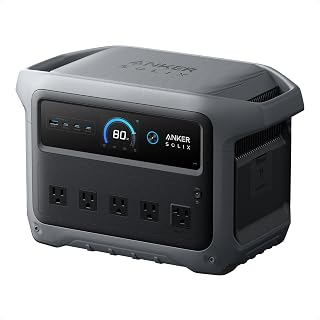
The 2000-watt output wattage supports high-draw camping equipment like induction cooktops, electric heaters, and power tools that most portable stations cannot run. The substantial capacity paired with solar compatibility makes this ideal for extended off-grid camping where you need reliable power for appliances beyond basic electronics and lighting.
Pros
- 2,000W continuous output
- Nine outlets for multi-device use
- 49-minute wall recharge capability
- Up to 600W solar input
Cons
- 11.3 kg is not suited to backpacking
- Solar recharge time requires optimal conditions
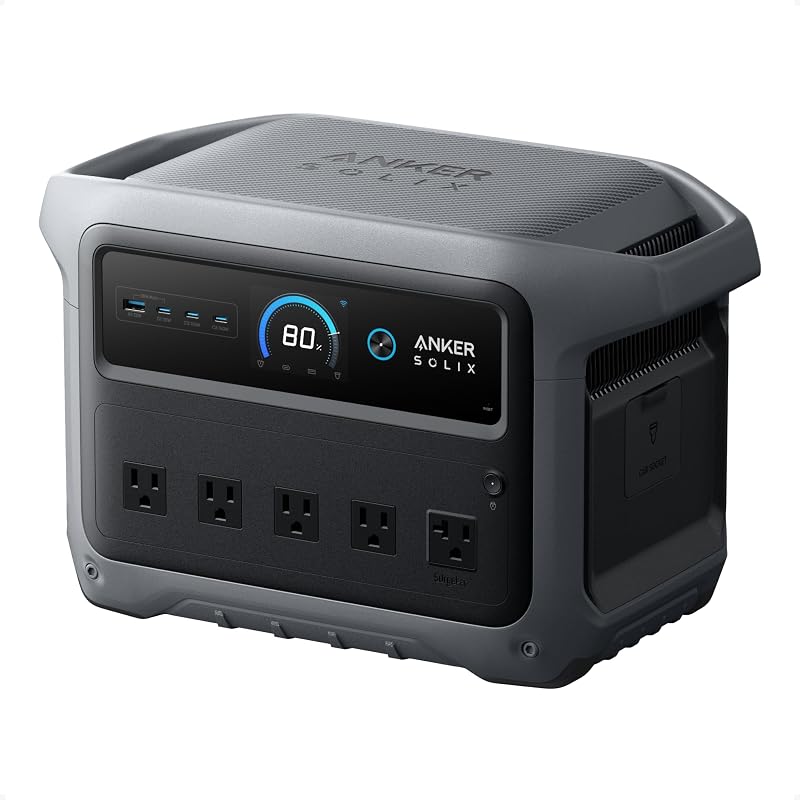
Camping groups that need to keep several devices powered at once can make strong use of the Anker SOLIX C1000 Gen 2. It combines 1,024Wh of capacity with 2,000W continuous output, giving it more scope than a compact electronics-only station. Its nine outlets allow a campsite to support a mix of phones, laptops, lights, fans, and other equipment without constantly swapping plugs. The 3,000W maximum engine power also provides extra capacity beyond its listed continuous output. Recharge speed is a major camping advantage for travelers who can top up before leaving or during a stop with wall power. HyperFlash charging accepts 1,600W and can fully recharge the unit in 49 minutes. For off-grid plans, it supports up to 600W of solar input and can recharge in 1.8 hours under optimal conditions. At 11.3 kg, with a compact 15.1 by 8.2 by 9.6-inch body and handles on both sides, it remains practical for one person to move short distances. Its LiFePO4 battery retains at least 80% capacity after 4,000 charge cycles, supporting repeated camping use.
Choose the SOLIX C1000 Gen 2 for car campers, RV travelers, or groups that need a high-output station with numerous connections and quick recharging between stops. It is particularly suitable when solar input is part of the plan or when laptops, lights, fans, and other devices will run together. Skip it if your camping power needs are limited to a phone, camera, and occasional small electronics, because its 1,024Wh capacity and 2,000W output may be more than necessary. Backpackers should also look elsewhere due to its 11.3 kg weight.
Capacity: 1,024Wh LiFePO4 battery
Output: 2,000W continuous, 3,000W peak
Ports: 10 total outputs
Wall Recharge: 1,600W input, 49 minutes to full
Solar Input: Up to 600W at 60V maximum, 1.8 hours to full
UPS Switchover: 10 milliseconds
Dimensions: 15.1L x 8.2W x 9.6H inches
Weight: 11.3 kg (24.9 lbs)
Battery Cycles: 4,000+ cycles with minimum 80% retention
Warranty: 5 years
Colors Available: Gray

The 292Wh capacity and compact form factor make this a smart choice for weekend camping trips where weight and portability matter. The 4-hour battery charge time means you can top it off quickly before heading out, and the 300-watt maximum power handles essentials like LED lights, phone charging, and small fans without overloading your setup.
Pros
- Lightweight 7.5-pound design
- 292Wh capacity for personal electronics
- 100W USB-C PD port
- More than 4,000 rated battery cycles
Cons
- 300W maximum limits appliance use
- Not intended for refrigerators or air conditioners
The Jackery Explorer 300 is built for campers who want dependable device power without devoting much space or carrying capacity to a power station. Its 292Wh battery and 300W maximum output are aimed at the everyday electronics that make a trip more convenient: phones, tablets, cameras, drones, and laptops. At 7.5 pounds, its compact body and integrated handle make it a practical choice for moving from car to tent or packing for a short trip. Connection options are well matched to a small campsite setup. Two AC outlets, a 100W USB-C PD port, two USB-A ports, and a 120W car charging port can support up to six devices at once. A digital display shows the remaining capacity, helping campers keep track of available power. It reaches a full charge in about three to four hours through the AC adapter, while compatible solar charging can reach 80% in 2.8 hours with a 100W panel. The upgraded LiFePO4 battery is rated for more than 4,000 cycles before reaching 70% capacity. Its limitation is straightforward: this is not the station for refrigerators, air conditioners, or high-wattage tools.
Buy the Explorer 300 if you camp light and mainly need to recharge personal electronics, camera gear, a drone, or a laptop. It is a particularly sensible fit for solo campers and couples who value a 7.5-pound station with several connection types rather than a large battery. Skip it if your campsite depends on a refrigerator, air conditioner, or high-wattage tools. Those needs exceed its 300W output, and a 292Wh capacity is better suited to smaller devices and shorter-duration use.
Capacity: 292Wh (LiFePO4 battery)
Weight: 7.1-7.5 lbs
Dimensions: 15.43in D x 9.92in W x 11.89in H
AC Output: 2 outlets, 110V, 300W continuous (600W peak surge)
USB Ports: USB-C PD 100W, USB-A 2.4A (x2)
Car Port: 120W 12V output
Charging Time: Approximately 4 hours AC, 2.8 hours with 100W solar panel
Battery Cycles: 4,000+ before reaching 70% capacity
Warranty: 2 year manufacturer
Model: JE-300E

Pros
- 1024Wh LiFePO4 battery
- 1000W continuous and 2000W starting power
- Five-device charging setup
- Up to 300W solar input
Cons
- 27.7-pound unit
- No UPS and manual output shutoff
At a campsite, a power station becomes more valuable when it can cover overnight essentials as well as keep small electronics charged. This 1024Wh LiFePO4 model supplies 1000W of continuous power with 2000W of starting capacity, giving it the headroom described for a mini fridge, CPAP machine, Wi-Fi router, and several devices at once. Its five charging connections, two 110V AC outlets, a 60W USB-C port, and two USB-A ports, are particularly useful when a group needs several devices connected. For campsites with sun, solar input of up to 300W gives the station a renewable recharging route. With the optional 200W panel, a full recharge takes six to eight hours in sunny conditions. The six-layer battery-management system is designed to guard against overcharging, overload, and temperature extremes, while LiFePO4 chemistry retains 80% capacity after more than 3,000 cycles. At 27.7 pounds, it is more appropriate for car camping than carrying far from the vehicle. Campers must also shut outputs off manually to avoid unnecessary battery drain.
Power Output: 1000W continuous, 2000W peak surge capacity
Battery: 1024Wh LiFePO4 with automotive-grade cells and six-layer smart BMS protection
Charging Ports: 2x 110V AC outlets, 1x 60W USB-C PD port, 2x USB-A ports
Solar Input: Up to 300W maximum, compatible with standard monocrystalline panels
Durability: 3000+ charge cycles with 80% capacity retention, approximately 6-year lifespan
Physical: 27.7 lbs, dimensions 18L x 12W x 16H inches, three colors available (Gray, Blue, Yellow)
Included: Power station, car charging cable, AC charging cable, user manual
Buy this unit for car camping where 1024Wh capacity, 1000W continuous output, and the ability to power five devices at once matter more than minimal carry weight. It makes particular sense for campsites using a mini fridge or CPAP machine and for users who can add a 200W solar panel for sunny-day replenishment. Skip it if you will carry your power source long distances, need seamless UPS-style switching, or prefer automatic output shutdown instead of manual shutdown.

The dual solar and battery power capability lets you recharge off-grid during extended camping trips, reducing reliance on wall outlets. With 288Wh capacity and 360-watt output, it supports multiple devices simultaneously, from smartphones and tablets to small appliances, making it practical for multi-day backcountry or campsite use.
Pros
- Compact 4.13kg design
- Eight charging ports
- 80% wall recharge in 50 minutes
- Quiet 25dB operation
Cons
- 288Wh capacity limits high-draw runtime
- Solar panel and shoulder strap sold separately
Camping gear earns its place when it travels easily, and the Anker SOLIX C300 emphasizes that priority. Weighing 4.13kg and measuring 6.46 by 6.34 by 9.45 inches, it is a compact option for travelers needing power for phones and laptops. Its 288Wh LiFePO4 battery can charge most phones more than eight times or run a laptop for several hours. The 300W continuous output and 600W surge capacity fit a camp setup centered on personal electronics, lights, cameras, drones, and a small appliance rather than sustained high-draw equipment. Eight ports make shared charging simpler: three AC outlets, three USB-C ports, a USB-A port, and a 12V car socket. The two 140W bidirectional USB-C ports can also charge the station, which reaches 80% in 50 minutes from wall power. Its 25dB operation helps preserve a quiet campsite, and pairing it with a 100W solar panel supports off-grid charging. Capacity remains the limiting factor, however, as higher-draw devices use its stored power more quickly. The solar panel and shoulder strap require separate purchase.
Power Output: 300W continuous, 600W surge capacity
Battery: 288Wh LiFePO4, 3,000 cycle lifespan
Charging Ports: 3x AC outlets (300W total), 1x car socket (120W), 2x USB-C (140W each), 1x USB-C (15W), 1x USB-A (12W)
Recharge Time: 50 minutes to 80% via wall outlet (AC charging cable included)
Dimensions: 6.46"L x 6.34"W x 9.45"H
Weight: 4.13kg (9.1 lbs)
Noise Level: 25dB at 3.3 feet
Warranty: 5 years
Compatibility: Compatible with 100W and 60W Anker solar panels, not compatible with SOLIX PS30, PS200, or PS400
Choose the C300 for weekend campers, solo travelers, or small groups who need a compact station for phones, a laptop, cameras, drones, lights, and occasional small-appliance use. It is especially appealing when quiet operation, many ports, and fast wall recharging are priorities. Skip it for longer off-grid stays running sustained high-draw devices unless you plan around its 288Wh capacity and add solar charging. Also look elsewhere if a panel and shoulder strap need to be included rather than purchased separately.

The 1024Wh capacity and 1800-watt output deliver enough power for extended camping trips with demanding equipment like portable air conditioners, electric kettles, or medical devices. Multiple charging options including solar, AC, and car charging provide flexibility when camping in varied locations, from developed campgrounds to remote off-grid sites.
Pros
- 1800W AC output with 3600W surge
- 1024Wh LiFePO4 battery rated for 4,000-plus cycles
- 80% charge in 45 minutes
- 30dB silent mode
Cons
- 25 pounds for long carries
- High-draw loads shorten runtime
Camping power stops being just a gadget charger when the trip calls for more than personal electronics. The BLUETTI Elite 100 V2 is aimed at that more demanding role, combining a 1024Wh LiFePO4 battery with 1800W AC output and 3600W surge power. Those figures give a campsite more flexibility for multiple devices and small appliances, while the listed 11 ports avoid forcing everyone to wait for a connection. It accommodates solar, AC, car, lead-acid, and generator power sources, useful when the trip does not follow one fixed charging plan. A 45-minute charge to 80% through 1200W TurboBoost helps between stops, and silent mode operates at 30dB for quieter overnight use. The 25-pound station has a hidden carry handle, but that weight still favors car camping and short carries. Its battery is rated for 4,000-plus cycles, and the 10ms UPS switchover extends its usefulness beyond camping for computers and network equipment during outages. Campers should match their loads to the battery: a laptop typically runs eight to 12 hours and a phone charges more than 10 times, but continuous high-draw use exhausts capacity sooner.
Power capacity of 1024Wh supports different devices with varying runtimes. A laptop typically runs 8-12 hours, a mini-fridge 12+ hours, and a phone charges 10+ times. High-draw devices like electric kettles or space heaters deplete the battery in hours. Use the BLUETTI app to monitor real-time consumption and plan charging accordingly.
Charging speed depends on input method. Wall outlet charging reaches 80% in 45 minutes using TurboBoost. Solar panel charging is slower but adds flexibility for extended trips. Car charging and generator inputs provide additional options when AC power isn't available, making this ideal for truly remote locations.
Buy the Elite 100 V2 for car campers or road trippers who want 1800W output, rapid recharging, and enough capacity to support a laptop, phones, fans, or small appliances from one station. It also fits users who value a 30dB silent mode and may use the unit for home backup between trips. Skip it for backpacking or long walks from the car because it weighs 25 pounds, and for extended high-draw use without a plan to recharge.

The LFP chemistry in this 288Wh station provides superior cycle life and safety compared to standard lithium batteries, important for frequent camping use. The 600-watt output handles mid-range camping loads like portable coolers, drones, cameras, and laptops, while multiple charging methods including solar and car adapters support diverse camping scenarios.
Pros
- 288Wh capacity in a 9.4-pound unit
- 600W AC output
- Nine total outlets
- AC, solar, car, lead-acid, and generator charging
Cons
- 288Wh capacity limits continuous high-demand use
- 9.4-pound carrying weight
Camping power needs shift from keeping phones charged to running a small collection of campsite gear, and the BLUETTI Elite 30 V2 is built for that middle ground. Its 288Wh capacity and 600W output give it more scope than a simple battery pack, while the 9.4-pound weight and 9.8-by-7-by-6.6-inch dimensions keep it manageable for a car-camping setup or packed road-trip trunk. Nine outlets can help organize several devices at once, and 140W PD fast charging suits USB-C gear. Recharging flexibility matters away from home. This model has eight charging modes and can use AC, solar, car, lead-acid, or generator power, providing options as an itinerary changes. A 45-minute 0-to-80% charge through its 380W wall adapter is useful when a campsite stopover is brief. For occasional higher-demand needs, it supplies 600W AC output and a 1500W Power Lifting mode. Idle draw is listed at 4.5W with UltraCell technology. Campers should still match devices to the station's capacity: 288Wh will go further for small electronics than for devices run continuously.
Power Output: 600W continuous, 1500W surge (Power Lifting Mode)
Capacity: 288Wh with LFP battery chemistry
Charging Speed: 0-80% in 45 minutes via 380W AC adapter, 0-100% in 70 minutes
Charging Modes: 8 modes including AC wall (380W/200W adjustable), solar input, car charging, and generator compatible
UPS Response: 10ms ultra-fast switch for critical device protection
Outlets: 9 total ports including AC, USB-C with 140W PD fast charging, and DC outputs
Weight: 9.5 lbs (9.4 lbs stated in marketing)
Dimensions: 9.8 inches long by 7 inches wide by 6.6 inches high
Standby Power Draw: 4.5W AC mode, 5W DC mode, 8W standby
Warranty: 60 months manufacturer coverage
Battery Technology: UltraCell LFP with enhanced thermal management
Recommended Uses: Camping, road trips, emergency home backup, outdoor recreation, and event power
Buy it if your camping is largely car-based and you want a compact station for phones, laptops, cameras, or other devices that benefit from several outlet choices and flexible AC, solar, car, lead-acid, or generator recharging. It also suits campers who occasionally need up to 600W AC output or the 1500W Power Lifting mode. Skip it for extended, high-consumption camping loads; its 288Wh capacity will be limiting when devices need continuous power. Backpackers may also prefer something lighter than 9.4 pounds.

This model's LiFePO4 battery chemistry delivers longer lifespan and better temperature tolerance than standard lithium-ion, which matters when camping in variable outdoor conditions. The 256Wh capacity and 300-watt output cover typical camping electronics like lanterns, portable coolers, and device charging without adding excessive bulk to your gear load.
Pros
- 6.4-pound, pocket-sized design
- 3,000-cycle LiFePO4 battery
- 300W pure sine wave output with 600W peak power
- AC, car, and solar recharging options
Cons
- 256Wh capacity
- 300W continuous output
On a campsite where the priority is charging personal electronics and supporting a few modest appliances, the ALLWEI 300W uses its 256Wh LiFePO4 battery to keep the setup compact. At 6.4 pounds and with pocket-sized dimensions, it is aimed at campers who need power carried from vehicle to tent rather than a large home-backup unit. The 300W pure sine wave inverter, with 600W peak power, is specified for laptops, mini fridges, CPAP machines, and drones, while the 3,000 charge-discharge-cycle rating points to long-term use. Its connection mix is useful for sharing a limited power supply. Six output ports include USB-C PD 60W, dual USB ports, and an AC outlet, so small devices do not all have to compete for one connection. The station can be recharged from AC, a car, or a solar panel; MPPT optimization is included for solar charging. A three-level LED light with SOS mode adds campsite utility after dark, and the BMS provides six layers of safety checks. Capacity remains the trade-off: 256Wh calls for careful planning on longer outings or with power-hungry equipment.
Power Output: 300W continuous, 600W peak surge with pure sine wave
Battery: 256Wh LiFePO4 with 3000 charge-discharge cycles
Voltage: 120V AC at 60Hz
Output Ports: 1x AC outlet, 1x USB-C PD 60W, 1x USB-A 18W fast charge, 2x DC5521, 1x car lighter socket
Charging Time: 3.5-4 hours AC or car charging, 4-5 hours solar (100W panel), 2-2.5 hours dual charging
Weight: 6.4 lbs
Dimensions: 9.25x5x6.8 inches
Runtime: 1500 hours
Warranty: 5-year manufacturer coverage
Choose this for car camping, tent camping, or short outdoor trips where 256Wh and 300W continuous power suit laptops, drones, phones, a CPAP machine, or a mini fridge. It is particularly sensible if a 6.4-pound unit, USB-C PD 60W charging, and AC, car, and solar recharging matter to your setup. Skip it if your trip requires sustained power for demanding equipment or long periods without recharging. Campers needing more than its stated 256Wh capacity should look elsewhere.

Pros
- 2.3-pound portable design
- Eight output ports
- AC, solar, and car charging options
- LED light with steady, flash, and SOS modes
Cons
- 88Wh capacity
- 120W continuous output
Minimalist camping setups often need a power source that fits alongside food, lights, and sleeping gear without adding much carrying weight. At 2.3 pounds, the HOWEASY station fills that role as an 88Wh option for keeping small electronics powered at camp. Its 120W continuous AC rating and 240W peak output set a clear boundary: it is suited to phones, tablets, cameras, and similar USB devices, not high-demand appliances or power tools. The station offers more connectivity than its size suggests. Eight outputs include two AC sockets, USB-C with 18W fast charging, two QC 3.0 ports, a standard USB port, and DC outputs. This layout lets a group charge several lower-draw devices at once. It can refill from an AC outlet, a compatible solar panel, or a 12V/24V car connection, which helps on short camping trips with vehicle access. A hidden handle preserves a compact profile, while the display shows power status. The built-in light has steady, flash, and SOS modes for nighttime use. The key planning constraint is the 88Wh capacity, which is modest for multi-day camping without recharging; a solar panel is separate.
Power Capacity: 88Wh rechargeable battery with 1500+ cycle life
Output Power: 120W continuous, 240W peak
AC Output: 2 ports at 110V
USB Ports: 1 USB-C (18W), 2 QC 3.0, 1 standard USB (5V 2.4A)
DC Ports: 2 ports (12V/10A)
Dimensions: 6.6 x 4 x 3 inches
Weight: 2.3 pounds
Charging: AC outlet (adapter included), solar compatible (15V-24V, panel not included), 12V/24V car charger (included)
Features: LED display, emergency lighting with SOS mode, simultaneous charging support
Warranty: 24 months with 24/7 customer support
Buy this for ultralight-minded campers, solo overnights, or short car-camping trips focused on phones, cameras, tablets, and USB accessories. Its 2.3-pound weight, 88Wh capacity, and multiple charging paths make sense when portability is the main goal and recharging is available through AC, a vehicle, or a compatible solar panel. Skip it if you need to run full-size laptops, power tools, or other higher-draw equipment. It is also a poor match for extended off-grid stays with no opportunity to replenish its 88Wh battery.
How to Choose a Portable Power Station for Camping
Match Battery Capacity to Your Camping Routine
Capacity, measured in watt-hours, tells you how much stored energy is available, while output tells you what the station can run at one time. Allow a practical buffer for AC conversion loss, cold nights, and unplanned charging, especially when you need dependable power for medical gear or a compressor cooler.
A 256Wh to 292Wh station suits short trips focused on phones, lanterns, cameras, and modest laptop use. The Jackery Explorer 300 Portable Power Station,292Wh and BLUETTI Elite 30 V2 Portable Power Station 288Wh fit that role, while larger capacity makes more sense for group camps or multi-day fridge use. Campers who bring a console or edit video outdoors should also account for their external SSDs for gaming and their charging accessories.
Check Continuous Output, Not Just the Battery Size
Continuous AC output is the non-negotiable limit for appliances. A 300W station is a sensible match for small electronics and many compact devices, but it is not the right tool for high-draw cooking appliances, hair dryers, or a large electric heater, even if its battery capacity looks generous.
For larger loads, the Jackery Explorer 1000 v2 Portable Power and Anker SOLIX C1000 Gen 2 Portable Power Station offer much more operating headroom for fridges, coffee makers, and several devices at once. Surge power helps with startup loads, but continuous wattage remains the figure to compare. RV campers using a console and display should total both loads before choosing, particularly when shopping for a competitive FPS monitor for their setup.
Plan How You Will Recharge Between Stops
Fast wall charging is useful when you pack at the last minute or move between campsites with access to an outlet. The Jackery Explorer 1000 v2 can use an app-enabled rapid charging mode, while the Anker SOLIX C1000 Gen 2 advertises a very short recharge window when its high-speed setting is enabled.
Solar is the better option for longer off-grid stays, but panel compatibility, input limits, cable requirements, weather, and sun angle all affect results. Confirm that a panel works with your chosen station before leaving home. Jackery models have brand-specific solar compatibility, while the Anker SOLIX C300 Portable Power Station has stated limits for certain Anker panels.
Prioritize Useful Ports and a Carry-Friendly Design
Look beyond the AC outlets. A strong port selection lets you charge a laptop, phone, camera, drone, and 12V device without burning energy through multiple wall adapters. The Anker SOLIX C300 Portable Power Station stands out for its high-watt USB-C capability, while the ALLWEI Portable Power Station 300W includes USB-C, USB-A, AC, DC, and car-style outputs for flexible small-device charging.
Weight and fan noise matter once the station leaves your trunk. The compact ALLWEI unit is especially easy to move, while the BLUETTI Elite 100 V2 Portable Power Station balances 1kWh-class capacity with a relatively manageable carry format. If your campsite doubles as a work or gaming nook, factor in the draw of any display, including the options in our budget 1440p monitor guide.
Final Thoughts
For campers who need serious output, fast recharging, and enough capacity for a fridge or several devices, the Anker SOLIX C1000 Gen 2 Portable Power Station is a capable all-around choice. If your priority is a light, straightforward station for weekend essentials, the ALLWEI Portable Power Station 300W offers a practical, easy-to-pack alternative.
Frequently Asked Questions
How many watt-hours do I need for camping?
Start with your daily energy needs rather than the number of gadgets you own. A phone, headlamp, camera battery, and occasional laptop charge need far less capacity than a CPAP machine, electric cooler, projector, or fridge running through the night.
For 2026, a 256Wh to 300Wh model is often enough for a light overnight trip, while roughly 1,000Wh is more appropriate for longer camps with refrigeration or multiple people. Add a buffer instead of planning to drain a station completely every day.
Can a portable power station run a camping fridge?
Yes, provided the station has enough continuous wattage for the fridge and enough capacity for its duty cycle. Compressor fridges pull more power when the compressor starts, then cycle on and off, so the actual runtime depends heavily on ambient temperature, insulation, and how often you open the lid.
A 1kWh-class station is generally the more comfortable choice for overnight or multi-day fridge support. Keep the fridge shaded, pre-chill it before departure, and use solar or vehicle charging to extend your available runtime.
Is solar charging worth bringing on a camping trip?
Solar charging is worthwhile when you will stay off-grid long enough to use a meaningful portion of the battery. It is especially helpful for maintaining power for lights, cameras, laptops, and a 12V fridge without relying entirely on a vehicle or campground outlet.
Panel wattage is only part of the equation, since shade, clouds, panel angle, and the station’s maximum solar input limit charging speed. Set the panel in direct sun, check compatibility in advance, and bring the correct cable or adapter specified by the manufacturer.
Can a portable power station support a remote photo workflow?
It can power camera chargers, a laptop, an external drive, and modest lighting, as long as the combined load stays under the station’s rated output. USB-C charging can be particularly efficient for modern laptops and cameras because it avoids using an AC adapter when direct PD charging is available.
Bring enough storage to make copies of important files before you leave the site, then archive the trip once you return home. For larger long-term media collections, these 8TB hard drive picks can help you plan a more spacious backup setup.



Write Your Review
No reviews yet. Be the first to share your experience!