

An outage can quickly turn a refrigerator, router, phone, and medical device into competing priorities. Choosing the best LiFePO4 power station means matching usable energy and inverter strength to the gear you truly need, rather than choosing the largest unit. It is also smart to keep essential files on a reliable external hard drive for backup when utility power is uncertain.
We compared compact stations for day trips with larger models built for home backup, RV travel, and remote work. You will see how capacity, output, charging speed, solar support, and long-term battery durability affect daily ownership, plus which features matter most for your situation. Remote workers carrying files between locations may also appreciate a dependable portable SSD for Mac alongside a portable power setup.
Quick answer
This guide compares 10 picks, with Jackery Explorer 1000 v2 Portable Power Station ranked first. Jackery Explorer 300 Portable Power Station 292Wh has the most customer reviews.

The 1070Wh capacity and 1500W output provide enough runtime to keep a refrigerator running during multi-hour outages or power larger camping gear like electric coolers and portable heaters. Solar charging capability adds flexibility for extended off-grid stays, making this a practical choice when you need reliable backup that goes beyond charging small devices.
Pros
- 1,070Wh capacity with 1,500W output
- One-hour emergency charging mode
- LFP battery rated for 4,000 cycles
- Portable 23.8-pound design with foldable handle
Cons
- About 42 minutes at a full 1,500W load
- Solar panels are purchased separately
The Jackery Explorer 1000 v2 suits campers and households that need one LiFePO4 power station for short outages, weekend trips, and everyday electronics rather than extended whole-home operation. Its 1,070Wh battery and 1,500W output provide a useful middle ground: enough capacity for meaningful backup duties while remaining far more portable than larger stations. At 23.8 pounds, with a foldable handle, it can be moved between a vehicle, campsite, and home without the bulk of a generator. Fast recharging is especially relevant for emergency preparation. The emergency mode can charge the unit from empty to full in one hour, while the 1.7-hour standard mode is intended to prioritize battery longevity. Seven total outlets, including three AC outlets and two 100W USB-C ports, allow it to support common camping gear and personal devices at the same time. Its LFP battery is rated to retain more than 70% capacity after 4,000 cycles. The tradeoff is capacity under demanding loads: at a continuous 1,500W draw, runtime is about 42 minutes.
Capacity and Power Output: 1070Wh battery capacity, 1500W continuous AC output, 3000W surge peak, 7 total power outlets
Charging: 1-hour emergency fast charge or 1.7-hour standard charge, 100W USB-C PD output, ChargeShield 2.0 technology
Battery Technology: LFP battery with 4000+ charge cycles, maintains 70%+ capacity after 4000 cycles, 10+ year lifespan
Ports and Connectivity: 2x USB-C (100W PD), 1x USB-A, 1x DC car port, 3x pure sine wave AC ports, LED lights, smart app control
Physical Specifications: Weight: 23.8 lbs, Dimensions: 12.87in (L) x 8.82in (W) x 9.72in (H), Foldable handle for portability
Additional Features: Smart app control with three charging modes, 30 dB quiet mode, energy efficiency mode, compatible with Jackery solar panels

The 1024Wh capacity and 1800W AC output handle demanding appliances during camping or home backup situations. Six outlets provide flexibility to run multiple devices simultaneously, while solar charging capability means you can extend runtime indefinitely at a campsite or during prolonged outages when grid power remains unavailable.
Pros
- 1024Wh capacity and 1800W output
- 80% AC charge in 45 minutes
- Sub-10ms UPS switchover
- LiFePO4 battery engineered for 10+ years
Cons
- No related-line battery expansion
- Separate 500W solar panel required
An outage can disrupt more than a phone, and the EcoFlow Delta 3 Classic occupies the middle ground between a compact campsite battery and full-home backup. Its 1024Wh capacity and 1800W continuous AC output provide considerably more headroom for household or camping loads, while its 26.7-pound, 7.9 by 11.1 by 15.7-inch form remains portable. Six outlets allow several devices to share the station. Fast charging and interruption protection are its defining advantages for backup use. X-Stream AC charging reaches 80% in 45 minutes, helpful when time is short. Its sub-10ms UPS switchover can reduce a power gap for computers, servers, and medical devices. X-Boost can raise output to 2600W for heavier loads. The LiFePO4 battery is engineered for 10+ years of daily cycling, and the unit carries a five-year manufacturer warranty. Solar expansion requires a separate 500W panel, and it cannot use extra batteries from related lines. Those limits, plus the need to manage a 1024Wh capacity during extended outages, make it a stronger choice for weekend camping, offices, and targeted household backup than whole-home coverage.
Battery and Power: 1024Wh capacity, LiFePO4 chemistry, 1800W AC output (3600W surge), expandable to 2600W with X-Boost technology
Charging: 45 minutes to 80% using X-Stream AC charging, 2.5 hours with optional 500W solar panel
Protection: Sub-10ms UPS switchover, smart Battery Management System, 5-year manufacturer warranty
Connectivity: 6 AC outlets, multiple USB ports, EcoFlow app for remote monitoring and control
Physical: 7.9 x 11.1 x 15.7 inches, 26.7 pounds, portable design for camping and travel
Compatibility: Not compatible with Delta 2 or Delta 3 series smart extra batteries
Buy the Delta 3 Classic if you want one LiFePO4 station to cover a weekend campsite, an office or studio, and key loads during a home interruption. It especially suits users who value 45-minute charging to 80% and sub-10ms UPS switchover for computers, servers, or medical devices. Skip it for whole-home backup, multi-week off-grid use, or a system you expect to expand with batteries from related lines. Its 26.7-pound weight and need for a separate solar panel also make it less ideal for ultralight travel.
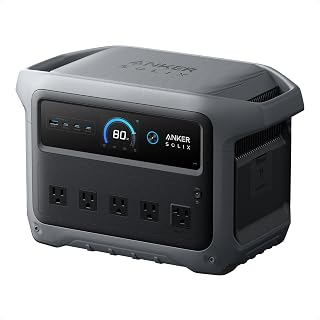
Delivering 2000W output with solar charging support, this station can run higher-draw appliances like microwaves or power tools at a campsite or during home outages. The substantial wattage headroom means you won't have to worry about surge limitations when starting motors or compressors, giving you confidence for both recreational and emergency scenarios.
Pros
- 2,000W continuous output
- Full wall recharge in 49 minutes
- Up to 600W solar input
- LiFePO4 battery rated for 4,000 cycles
Cons
- 1,024Wh capacity may be limited for extended outages
- 11.3 kg weight is best for short carries
For campers who also want serious outage coverage at home, the Anker SOLIX C1000 Gen 2 combines a 1,024Wh LiFePO4 battery with a substantial 2,000W continuous output. That pairing makes it more capable than a device-only power bank while keeping it within a size that one person can move for short distances. Its compact 15.1 by 8.2 by 9.6-inch footprint and 11.3 kg weight help it fit the practical role of a station that can travel to camp and return to a backup spot at home. Recharge speed is a central strength for backup planning. HyperFlash technology supports a full wall recharge in 49 minutes using 1,600W input. For off-grid use, it accepts up to 600W of solar input and can reach a full charge in 1.8 hours under optimal conditions. The 10ms UPS switchover gives added usefulness for connected equipment during a grid transition. Its LiFePO4 battery is rated to retain at least 80% capacity after 4,000 cycles, supporting repeated camping and preparedness use over time.
Choose the SOLIX C1000 Gen 2 if your camping setup includes several electronics and you want a portable station that can also serve as a fast-recharging home backup resource. It fits users who value 2,000W continuous output, solar compatibility, and a 10ms UPS switchover for connected devices. Skip it if you need a larger battery for longer-duration backup without recharging, or if portability means carrying the unit over long distances rather than moving it between a vehicle, campsite, and home.
Capacity: 1,024Wh LiFePO4 battery
Output: 2,000W continuous, 3,000W peak
Ports: 10 total outputs
Wall Recharge: 1,600W input, 49 minutes to full
Solar Input: Up to 600W at 60V maximum, 1.8 hours to full
UPS Switchover: 10 milliseconds
Dimensions: 15.1L x 8.2W x 9.6H inches
Weight: 11.3 kg (24.9 lbs)
Battery Cycles: 4,000+ cycles with minimum 80% retention
Warranty: 5 years
Colors Available: Gray

With 1024Wh expandable to 5kWh and 1800W output boosted to 2200W, this unit scales from weekend camping to extended backup needs. The 4000 cycle lifespan to 80% capacity means years of reliable service, while the quiet operation under 40dB at 1200W makes it suitable for both overnight camping and indoor backup use without disruptive noise.
Pros
- Expandable from 1kWh to 5kWh with add-on batteries
- 1800W output with 3600W surge handles tools and appliances
- Quiet operation under 40db at 1200W load
- 4000 cycle LiFePO4 battery rated for roughly 10 years of use
Cons
- Expansion batteries are sold separately and add significant cost
- 12.5 kg weight makes it impractical for backpacking or frequent relocation
When you're putting together a backup and camping power setup, the Delta 3 earns its place through sheer flexibility. Start with a single 1024Wh unit for weekend trips, then expand up to 5kWh with add-on batteries once you need whole-home backup during an outage. The 1800W AC output (2200W with X-Boost, surging to 3600W) covers everything from a camp fridge to power tools at a job site, and five different recharging methods mean you're never stuck waiting on one input type. For backup duty specifically, the LiFePO4 chemistry rated for 4000 cycles to 80 percent capacity means it can sit through years of outages without meaningful degradation. For camping, the quiet operation (under 40db even at 1200W) keeps it from being the loudest thing at the campsite. The 13 outlets let it run as a hub for multiple devices or appliances simultaneously, which matters more for extended off-grid stays than quick overnight trips.
Capacity and Output: 1024Wh total energy, 1800W continuous AC output, 2200W rated with X-Boost to 3600W surge power. Supports up to 13 simultaneous device connections.
Battery Technology: LiFePO4 chemistry, 4000 cycles to 80% capacity retention, 10-year lifespan under normal use, 5-year manufacturer warranty included.
Charging Methods: Five fast recharge options including 500W solar input, 1500W AC wall charging, and hybrid combinations. Full charge achievable in 56 minutes, 80% in 30 minutes via AC input.
Physical Specs: 12.5 kg weight, 15.7 x 8 x 11.2 inches dimensions, black and gray color. IP65 rating for splash, dust, and oil resistance.
Expandability: Modular design scales capacity from 1kWh base up to 5kWh with compatible DELTA 3, DELTA Pro 3, and DELTA 2 Max battery pack additions.
Buy this if you want one power station that can scale from camping trips to full backup power without replacing the unit itself. It suits campers who run multiple devices at once and homeowners who want expandable capacity for outages. Skip it if you need something ultralight for backpacking, since 12.5 kg is built for car camping and base camp setups, or if you only need basic phone and light charging and don't need the expansion path.
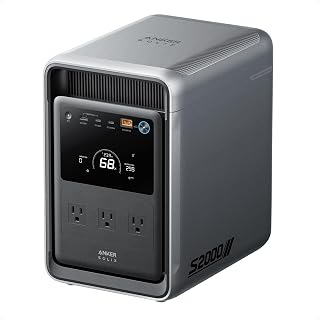
The 2010Wh capacity paired with 1500W output provides extended runtime for camping fridges or essential home circuits during outages. Its lightweight and compact design makes transport manageable despite the large capacity, so you get serious backup power without needing a dolly or help loading it into your vehicle for weekend trips.
Pros
- Large 2,010Wh battery capacity
- Low 6W idle power draw
- Sub-10ms UPS switchover
- LFP battery rated for 10,000 cycles
Cons
- No 12V DC port
- 35.7-pound weight reduces carry convenience
The Anker SOLIX S2000 is the stronger fit when backup runtime matters as much as camping portability. Its 2,010Wh battery offers substantially more stored energy than a typical mid-size station, while its 1,500W running output and 3,000W starting wattage support a broad range of essential loads. That makes it well positioned for people who want to keep a power station ready at home during outages, then bring the same unit on trips where longer time away from a wall outlet is useful. Efficiency is a meaningful part of its appeal. The station has a 6W idle power draw, and Anker cites up to 35 hours of refrigerator runtime. Eight outlets provide connections for several devices, while the sub-10ms UPS switchover supports equipment that benefits from uninterrupted operation during a grid changeover. It also supports six recharge methods, including 400W solar input, AC charging, generator input, and car-outlet charging. Despite the 2,010Wh capacity, it weighs 35.7 pounds and measures 8.2 by 11.1 by 12.7 inches. Its LFP battery is rated for 10,000 cycles and a 15-year lifespan.
Capacity and Output: 2,010Wh LiFePO4 battery, 1,500W continuous output, 3,000W peak output
Battery Technology: 314Ah LFP cells, 10,000 cycle lifespan, 15-year warranty
Dimensions: 8.19L x 11.1W x 12.7H inches
Weight: 35.7 pounds
Outlets: 8 total (front and rear configuration)
Charging Options: AC input, solar (up to 400W), generator, car outlet, alternator charger
UPS Switchover: Less than 10 milliseconds
Idle Power Draw: 6W
Color: Black
Model: AS220
Warranty: 5 years
Buy the SOLIX S2000 if you prioritize extended emergency coverage for essential home equipment and want enough capacity to make camping power more self-sufficient. It is a good match for users who can accommodate a 35.7-pound station and value low idle draw, UPS capability, and varied recharge options. Skip it if you need a 12V DC port for specialized RV equipment or other DC devices. It may also be excessive for campers whose needs are limited to phones, lights, and a laptop.

At 3014.4Wh and 2400W output, this station delivers serious backup capacity for whole-home essentials or extended RV trips. The substantial energy storage runs refrigerators, sump pumps, or medical devices through lengthy outages, while multiple charging options including solar and car inputs keep it topped off for both emergency preparedness and off-grid living scenarios.
Pros
- 3,014.4Wh LiFePO4 battery rated for 6,000+ cycles
- 2,400W AC output with 4,800W surge power
- RV-ready TT-30 and 12V/30A DC output
- 80% charge in 78 minutes and 10ms UPS backup
Cons
- 58-pound weight limits easy portability
- Only two AC outlets for a larger backup setup
Home outages and RV stops require a different scale of power station than a weekend device charger, and the Elite 300 is built for that larger job. Its 3,014.4Wh LiFePO4 battery, 2,400W AC output, and 4,800W surge rating make it the capacity-first BLUETTI choice here for backup and camping. The station is RV-ready, and the supplied information identifies a TT-30 outlet plus 12V/30A DC output, useful details for camper integration without an external adapter. It accepts AC, solar, car, lead-acid, and generator power, helping it move between home, RV, and off-grid use. For a blackout, the stated 10ms UPS backup is a meaningful capability for equipment such as routers, computers, and CPAP machines. It reaches 80% in 78 minutes, and its battery is rated for more than 6,000 cycles. Those strengths do not make it casual carry gear. At 58 pounds, it is portable in the vehicle-to-site sense rather than easy to walk with, and only two AC outlets may require a power strip for several household devices. At full load, the source material estimates about 1 hour 18 minutes of runtime, so sustained heavy use calls for recharging.
Power Output: 2400W continuous, 4800W surge capacity with 10ms UPS backup switching
Battery: 3014Wh LiFePO4 with 6000+ charge cycles
Outlets: 2 AC outlets (120V), TT-30 RV port, 12V/30A DC output
Charging: 0 to 80% in 78 minutes via AC, solar, car charger, or generator input
Dimensions: 14.4L x 12W x 11.7H inches
Weight: 58 pounds
Runtime: Approximately 1 hour 18 minutes at full 2400W load
Select the Elite 300 for RV owners, households planning for meaningful outages, and campers who can transport a 58-pound unit and need far more reserve than a small electronics-focused station. It makes particular sense when 2,400W continuous output, a 4,800W surge rating, RV-ready connections, and UPS backup are more important than easy carrying. Skip it for hike-in camping, short trips limited to phones and laptops, or any setup where a single person must move the station often. Its weight and two AC outlets are practical constraints.

With 292Wh capacity and 300W output, this compact unit handles essentials like phone charging and small electronics during weekend camping trips or short power outages. The 4-hour recharge time means you can top it off quickly between uses, while its portable form factor makes it easy to stash in a car trunk or closet until backup power is needed.
Pros
- 7.5-pound compact design
- More than 4,000 LiFePO4 cycles
- Six-device charging capability
- 100W USB-C PD port
Cons
- Not for major appliances
- Limited 292Wh capacity
For camping and limited emergency needs, the Jackery Explorer 300 prioritizes easy transport over running major appliances. Its 292Wh capacity in a 7.5-pound package suits a campsite, vehicle, or small outage kit where phones, tablets, cameras, drones, and a laptop are the priorities. The 300W rated output, with a 600W peak surge, is meant for those electronics rather than refrigerators, air conditioners, or high-wattage tools. Six devices can receive power at once through two AC outlets, a 100W USB-C PD port, two USB-A ports, and a 120W car port. That selection can keep personal gear and small devices supplied from one compact unit. It takes about three to four hours to charge via its AC adapter, while a compatible 100W solar panel can reach 80% in 2.8 hours. Its LiFePO4 battery is rated for more than 4,000 cycles before reaching 70% capacity, a lifespan stated as more than 11 years of regular use. For 2026 buyers seeking a genuinely portable LiFePO4 station, it is best positioned as a camping companion and focused backup for low-demand essentials.
Buy the Explorer 300 if your backup plan centers on communication gear, a laptop, cameras, drones, and other smaller electronics, and if a 7.5-pound station is more useful to you than appliance-level capability. It also suits camping, travel, and mobile work where its integrated handle and compact body matter. Skip it if an outage plan includes a refrigerator, air conditioner, power tools, or several high-draw appliances. Its 292Wh capacity and 300W rating call for modest, clearly prioritized loads.
Capacity: 292Wh (LiFePO4 battery)
Weight: 7.1-7.5 lbs
Dimensions: 15.43in D x 9.92in W x 11.89in H
AC Output: 2 outlets, 110V, 300W continuous (600W peak surge)
USB Ports: USB-C PD 100W, USB-A 2.4A (x2)
Car Port: 120W 12V output
Charging Time: Approximately 4 hours AC, 2.8 hours with 100W solar panel
Battery Cycles: 4,000+ before reaching 70% capacity
Warranty: 2 year manufacturer
Model: JE-300E

With 1024Wh capacity and 1000W output, this solar-compatible unit covers mid-range backup needs like keeping essentials running during outages or powering camp lighting and cooking equipment. The LiFePO4 chemistry provides long cycle life and stable performance across temperature ranges you encounter both outdoors and in home storage.
Pros
- 1024Wh LiFePO4 battery
- 2000W starting wattage
- Up to 300W solar input
- Six-layer battery management system
Cons
- No UPS functionality
- 27.7-pound carry weight
At a campsite or during an outage, the Staryline 1000W station directs its 1024Wh LiFePO4 capacity toward the essentials that keep a space functional. Its 1000W continuous output and 2000W starting wattage suit loads such as Wi-Fi routers, mini fridges, CPAP machines, and home entertainment systems, while its six-layer smart battery management system is designed to guard against overcharge, overload, and temperature extremes. The battery retains 80% capacity after more than 3,000 cycles, roughly six years of typical use. For camping, dual 110V AC outlets, a 60W USB-C PD port, and two USB-A ports let five devices charge simultaneously. The station accepts up to 300W solar input, and an optional 200W panel can fully recharge it in six to eight sunny hours. Its limitations matter in a backup plan: the 27.7-pound unit is not effortless to carry, it lacks UPS switching, and its outputs need manual shutdown to prevent drain. It makes sense for planned camping and selected outage loads, rather than seamless computer backup or a broad household system.
Power Output: 1000W continuous, 2000W peak surge capacity
Battery: 1024Wh LiFePO4 with automotive-grade cells and six-layer smart BMS protection
Charging Ports: 2x 110V AC outlets, 1x 60W USB-C PD port, 2x USB-A ports
Solar Input: Up to 300W maximum, compatible with standard monocrystalline panels
Durability: 3000+ charge cycles with 80% capacity retention, approximately 6-year lifespan
Physical: 27.7 lbs, dimensions 18L x 12W x 16H inches, three colors available (Gray, Blue, Yellow)
Included: Power station, car charging cable, AC charging cable, user manual
Choose this Staryline model when you want a 1024Wh LiFePO4 unit for planned campsite electricity or an outage kit centered on a router, CPAP machine, mini fridge, and personal devices. It is a fit for people able to use solar input and manually turn off outputs after use. Skip it if automatic UPS switchover is essential, if carrying 27.7 pounds is impractical, or if your plan calls for broad household coverage and several high-draw appliances. The 1000W continuous output requires deliberate load selection.

At 1024Wh and 1800W, this unit balances capacity with portability for camping and home backup. Multiple charging options including solar, AC, car, and even lead-acid or generator inputs give you flexibility to recharge wherever you are, whether at a campsite with solar panels or at home recovering from an outage.
Pros
- 1,024Wh LiFePO4 battery rated for 4,000+ cycles
- 1,800W AC output with 3,600W surge power
- Reaches 80% charge in 45 minutes
- 10ms UPS backup and quiet operation
Cons
- 25-pound weight is less suited to long carries
- High-draw devices reduce runtime quickly
For a backup-and-camping list, the Elite 100 V2 occupies the useful middle ground between a small device charger and a large home battery. Its 1,024Wh LiFePO4 battery supplies more stored energy than a pocket-size unit, while the 1,800W AC output and 3,600W surge rating cover a broader range of campsite and outage needs. Four AC outlets are specified, and the supplied information also describes 11 total ports for running or charging several items at once. It can draw power from solar, AC, a vehicle, lead-acid source, or generator, so it suits a campsite, road trip, and an emergency at home. What moves it beyond a camping-only station is its UPS function, which switches in 10ms or less. The quiet operation is especially relevant overnight, and Silent mode is described at 30dB. Reaching 80% in 45 minutes gives it an advantage when an outlet or generator is available briefly. Its battery is rated for 4,000-plus cycles. The tradeoff is capacity: continuous high-draw equipment will use the 1,024Wh reserve much sooner, and the listed 25-pound weight is not ideal for long carries.
Power capacity of 1024Wh supports different devices with varying runtimes. A laptop typically runs 8-12 hours, a mini-fridge 12+ hours, and a phone charges 10+ times. High-draw devices like electric kettles or space heaters deplete the battery in hours. Use the BLUETTI app to monitor real-time consumption and plan charging accordingly.
Charging speed depends on input method. Wall outlet charging reaches 80% in 45 minutes using TurboBoost. Solar panel charging is slower but adds flexibility for extended trips. Car charging and generator inputs provide additional options when AC power isn't available, making this ideal for truly remote locations.
Choose the Elite 100 V2 for car campers, road trippers, or households that need a portable station able to support laptops, phones, fans, small appliances, and backup-sensitive equipment such as a router or computer. It is also a fit when quiet operation, rapid charging, and multiple recharge sources matter. Skip it if the plan is to carry power a long distance on foot, since it is listed at 25 pounds, or if the main need is prolonged operation of high-draw loads. A larger-capacity model is better for that role.

The 288Wh capacity and 600W output handle lightweight camping needs like LED lights, laptops, and CPAP machines without the bulk of larger units. Multiple charging options including solar make it practical for remote camping, while the modest size means it fits easily in a tent or under a car seat for emergency backup.
Pros
- 9.4-pound, compact 288Wh design
- 600W AC output with 1,500W Power Lifting
- Nine outlets and 140W PD fast charging
- 10ms UPS backup and eight charging modes
Cons
- 288Wh capacity limits longer high-draw use
- Heavy Power Lifting use may stress components
Not every backup or camping situation calls for a multi-kilowatt station. The Elite 30 V2 is the compact option for keeping essential electronics available when travel space and carrying weight matter. At 9.4 pounds, with a 288Wh capacity and a 9.8 by 7 by 6.6 inch footprint, it is geared toward a backpack, car trunk, tent setup, or a small emergency kit. Its nine outlets and 140W PD fast charging give it a practical focus on phones, laptops, and other smaller gear. The 600W AC rating is its core limit and advantage: enough output for modest devices without the bulk of a larger backup unit. Power Lifting mode is rated to 1,500W, while its UPS feature switches within 10ms for interruption-sensitive items such as a CPAP machine, router, or laptop. Eight charging modes and AC, solar, car, lead-acid, and generator power options add flexibility between a campsite and a blackout. It can reach 80% in 45 minutes with the 380W wall adapter. Buyers should size it honestly: a 288Wh station will not run power-hungry equipment continuously for long.
Power Output: 600W continuous, 1500W surge (Power Lifting Mode)
Capacity: 288Wh with LFP battery chemistry
Charging Speed: 0-80% in 45 minutes via 380W AC adapter, 0-100% in 70 minutes
Charging Modes: 8 modes including AC wall (380W/200W adjustable), solar input, car charging, and generator compatible
UPS Response: 10ms ultra-fast switch for critical device protection
Outlets: 9 total ports including AC, USB-C with 140W PD fast charging, and DC outputs
Weight: 9.5 lbs (9.4 lbs stated in marketing)
Dimensions: 9.8 inches long by 7 inches wide by 6.6 inches high
Standby Power Draw: 4.5W AC mode, 5W DC mode, 8W standby
Warranty: 60 months manufacturer coverage
Battery Technology: UltraCell LFP with enhanced thermal management
Recommended Uses: Camping, road trips, emergency home backup, outdoor recreation, and event power
Buy this model for tent campers, day-trip travelers, and apartment dwellers who want a light station for phones, laptops, a CPAP machine, router, or other essentials during short outages. It also suits anyone who values a small footprint, several outlets, and fast wall charging. Skip it for RV use, extended refrigerator backup, or a campsite centered on sustained high-watt appliances. Its 288Wh capacity is limited, and even with the 1,500W Power Lifting rating, it is not the choice for continuously demanding loads.
How to Choose a LiFePO4 Power Station
Match battery capacity to realistic runtime
Capacity is measured in watt-hours, but your actual AC runtime will be lower once inverter losses and the power station’s own consumption are considered. Start with the wattage of the appliances you expect to run, then give yourself reserve capacity for refrigerator compressor surges, charging devices, and longer outages.
For light travel, the 288Wh BLUETTI Elite 30 V2 and 292Wh Jackery Explorer 300 suit phones, cameras, laptops, and small camping loads. A roughly 1kWh class unit is more flexible for home essentials, while the 2,010Wh Anker SOLIX S2000 and 3kWh BLUETTI Elite 300 fit longer backup plans. If your setup includes network storage, calculate its draw alongside the equipment in your home NAS drive setup.
Check continuous output, surge power, and outlets
Capacity determines how long equipment can run, while continuous output determines what it can run at all. Choose an inverter rating above your combined expected load, and allow extra headroom for appliances that briefly demand more power when starting, including refrigerators, pumps, and electric kettles.
The Anker SOLIX C1000 Gen 2 supplies 2,000W through 10 ports, making it a capable choice for demanding mixed loads. EF ECOFLOW Delta 3 and Delta 3 Classic provide 1,800W output, while the Staryline 1024Wh model supplies 1,000W for lighter needs. Count AC sockets, USB-C charging, DC outputs, and UPS capability before choosing. If a desktop display is part of your backup plan, compare its draw with the recommendations in our monitor for competitive FPS gaming guide.
Prioritize charging that fits your routine
Fast wall charging is useful when a weather event is approaching or when you need to repack quickly between trips. The Anker SOLIX C1000 Gen 2 lists a 49-minute full recharge through its app-enabled HyperFlash mode, while EF ECOFLOW Delta 3 lists a full recharge in 56 minutes under its rated fast-charge conditions. Delta 3 Classic reaches 80% in 45 minutes, and Jackery Explorer 1000 v2 offers an optional one-hour emergency charging mode.
Solar input matters more for multi-day camping and off-grid use than a fast wall refill. Anker SOLIX C1000 Gen 2 accepts up to 600W of solar input, EF ECOFLOW Delta 3 supports 500W, Anker SOLIX S2000 supports 400W, and the Staryline model supports up to 300W. Confirm panel voltage, connector compatibility, and brand-specific requirements before building a solar kit, especially because the Jackery Explorer 1000 v2 is designed for Jackery panels.
Consider battery longevity, portability, and UPS support
LiFePO4 chemistry is a major advantage for frequent use, but cycle claims still vary by model. The Anker SOLIX S2000 lists 10,000 cycles, while Anker SOLIX C1000 Gen 2, EF ECOFLOW Delta 3, BLUETTI Elite 100 V2, and Jackery Explorer 300 list roughly 4,000-cycle ratings at their stated retained capacity levels. The Staryline model lists more than 3,000 cycles, which remains substantial for occasional backup and camping duty.
Weight and shape make a meaningful difference when you are loading a vehicle or moving power between rooms. The Jackery Explorer 300 weighs 7.5 pounds, BLUETTI Elite 30 V2 weighs 9.4 pounds, and BLUETTI Elite 100 V2 weighs 25 pounds, while larger-capacity units trade portability for endurance. For computers, routers, CPAP machines, and similar gear, look for a sub-10ms UPS switchover like those offered by several models here, then keep runtime expectations realistic.
Final Thoughts
The right choice comes down to whether you need strong output in a manageable size or extended energy for a larger backup plan. The Anker SOLIX C1000 Gen 2 Portable Power Station is a well-rounded fit for demanding home and travel loads, while the BLUETTI Elite 300 Portable Power Station for RV makes more sense for RV owners and households that need substantially more runtime.
Frequently Asked Questions
What size LiFePO4 power station do I need for a refrigerator?
Start by checking the refrigerator’s running watts, then allow extra capacity for its startup surge and for other essentials you plan to plug in. A 1kWh station can support many modern refrigerators for a limited period, but runtime changes dramatically with room temperature, door openings, and the appliance’s efficiency. A 2kWh or 3kWh station provides more breathing room for longer outages or a shared load.
Are LiFePO4 power stations safe to use indoors?
Battery power stations can be used indoors because they do not produce combustion fumes like gasoline generators. Keep the unit dry, leave clearance around its vents, avoid covering it, and use the supplied charging equipment or compatible gear specified by the manufacturer. Follow the manual’s guidance for storage temperature, charging limits, and overload protection.
Can a LiFePO4 power station run a CPAP machine or home office?
Yes, provided the station’s output rating and available battery capacity suit your equipment’s actual draw. A model with a fast UPS transfer can help keep compatible routers, computers, and CPAP machines operating through a brief utility interruption. Check your device manual for any special power requirements, and account for humidifier or heated-tube use when estimating CPAP runtime.
What should I prioritize in a LiFePO4 power station in 2026?
Prioritize the output and runtime you genuinely need, then compare charging options, solar limits, port selection, weight, and UPS transfer speed. For a gaming or travel workstation, make sure the total load includes consoles, displays, networking gear, and storage devices. A fast external SSD for gaming can complement that setup by keeping your library portable while the power station supports the rest of your gear.




Write Your Review
No reviews yet. Be the first to share your experience!