

Power failures rarely happen at a convenient time. Whether you need to keep a refrigerator cold, run a CPAP machine overnight, power an RV kitchen, or maintain a remote workstation, the right battery station needs enough output and stored energy for the job.
This guide compares leading options for buyers seeking the best 2000W portable power station for emergency backup, road travel, and off-grid use. We assessed published output, capacity, charging, port selection, and backup features, while creators building a mobile setup can also explore our guide to the best portable SSD for Mac.
Quick answer
This guide compares 10 picks, with ABOK Ark2000 2000W Portable Power Station ranked first. Jackery Explorer 1000 v2 Portable Power Station holds the highest customer rating among them. Jackery Explorer 300 Portable Power Station 292Wh has the most customer reviews.

Pros
- Exceptional value at $599 with 2000W continuous power, 2400W A-Boost, and 3500W peak capacity
- Expandable architecture lets you start small and scale capacity as needs grow
- Comprehensive connectivity with 3 AC outlets, dual USB-C fast charging, and 12V car port
- Fast recharge times via AC or solar minimize downtime between uses
- EVE LiFePO4 chemistry with 4000+ cycle rating significantly outlasts standard lithium batteries
Cons
- 29.8-pound weight requires two hands for portability, less suitable for frequent hiking trips
- No reviews available yet, limiting real-world performance validation from other users
- Expansion batteries sold separately, adding to total system cost for higher capacity needs
The ABOK Ark2000 is a mid-range portable power station designed for homeowners, RV enthusiasts, and campers who need reliable backup power without premium pricing. It delivers 2000W of continuous pure sine wave power, enough to run refrigerators, microwaves, and most household appliances. The A-Boost feature pushes compatibility to 2400W for high-startup-current devices, with 3500W peak capacity for brief surge demands.
The standout feature is the expandable 1536Wh capacity system. Unlike competitors forcing full replacements, the Ark2000 lets you add matching expansion batteries to reach 3072Wh or 4608Wh, scaling investment to actual power needs. The eight-port layout (3 AC, 2 USB-A QC, 2 USB-C PD including 100W) handles multiple devices simultaneously. Charging speed impresses: 55 minutes to 80% via AC adapter, or 1.2 hours with 1200W solar input, making it practical for frequent use cycles.
Build quality centers on EVE LiFePO4 cells rated for 4000+ cycles and 10 years of service. The UL94 V-0 fire-resistant shell and 10ms UPS protection for sensitive electronics add durability confidence. The ABOK mobile app provides remote monitoring and off-peak charging scheduling to optimize electricity costs, while 2 years of warranty plus 3 years of service support backs your investment.
The 29.8-pound weight and 15.91 x 8.58 x 8.07-inch dimensions make it portable for vehicles but less ideal for backcountry hiking. The lack of user reviews currently limits real-world performance validation. Expansion batteries add cost, requiring careful budgeting if higher capacity is needed at purchase time.
The Ark2000 offers strong value for backup power and recreational use. Its combination of expandability, fast charging, comprehensive connectivity, and proven LiFePO4 chemistry makes it a practical choice for budget-conscious buyers entering the portable power market.
Power Output: 2000W continuous, 2400W A-Boost, 3500W peak
Battery: 1536Wh LiFePO4 (expandable to 3072Wh or 4608Wh), 4000+ cycle rating, 10+ year lifespan
Input Charging: 1500W AC (55 min to 80%), 1200W solar (1.2 hours to 80%)
Output Ports: 3 AC outlets, 2 USB-A QC 18W, 1 USB-C PD 20W, 1 USB-C PD 100W, 1 12V car port
Dimensions/Weight: 15.91L x 8.58W x 8.07H inches, 29.8 lbs
Protection: 10ms UPS, 3W emergency LED with multiple modes, UL94 V-0 fire-resistant shell
Smart Features: ABOK mobile app for monitoring and scheduling, 2+3 year warranty and service support
Pros
- Industry-leading 1400W AC charging input cuts recharge time to under an hour
- Whisper-quiet operation with zero emissions makes it suitable for indoor use, camping, and neighborhoods
- Nine versatile output ports accommodate multiple devices and appliances simultaneously
- Lightweight at 26.7 lbs with ergonomic handle fits easily in vehicle trunks for portability
- LiFePO4 chemistry offers superior safety, thermal stability, and longevity compared to lithium-ion alternatives
Cons
- Maximum 800W solar input requires three 240W panels for optimal off-grid performance, adding additional expense
- 26.7 lbs weight, while portable, may feel heavy for users prioritizing ultra-lightweight travel solutions
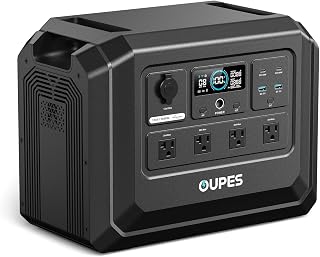
The OUPES Mega 1 Lite is a mid-capacity portable power station designed for camping, RV travel, emergency home backup, and off-grid adventures. With 1024Wh capacity and 2000W continuous output, it bridges the gap between compact portable chargers and heavy-duty home backup systems, making it ideal for families, outdoor enthusiasts, and remote workers who need reliable power mobility.
The standout feature is the blazing-fast 46-minute full charge time thanks to its 1400W AC input, combined with support for 800W solar input. Real-world performance data from customer reviews confirms it handles multiple appliances simultaneously and maintains power through extended use. The dual 140W USB-C PD ports eliminate adapter clutter and charge modern laptops at full speed, while nine total outlets ensure every device gets powered.
Build quality centers on premium LiFePO4 battery cells rated for 3,500+ cycles to 80% capacity, translating to roughly 10 years of daily use. The unit weighs just 26.7 lbs with an ergonomic carry handle, making it genuinely portable for trunk storage. The smart app integration lets you monitor real-time wattage draw, adjust charging speeds, and toggle outlets remotely via Bluetooth or Wi-Fi, adding convenience for tech-forward users.
The main trade-offs are price and weight compared to lighter alternatives. At $469, it costs more than smaller power banks but less than whole-home backup systems. The UPS feature with sub-20ms switchover ensures critical devices like routers, CPAP machines, and computers stay online during grid outages, though this is most valuable for home use rather than travel scenarios.
Verdict: The Mega 1 Lite delivers exceptional value for users seeking fast recharge times, multiple simultaneous charging options, and long-term reliability. It excels as a travel companion, emergency backup, and eco-friendly off-grid solution, particularly for those willing to invest in durability and convenience over absolute portability.
Capacity and Output: 1024Wh battery, 2000W continuous output, 4500W surge capacity, 120V AC.
Charging: 1400W AC input (46 min full charge), 800W solar input via Anderson port, 12V car charging supported, adjustable 700W slow charge mode.
Connectivity and Control: Dual 140W USB-C PD ports, QC3.0 charging, 9 total outlets, smart app control via Bluetooth and Wi-Fi, real-time monitoring.
Physical and Safety: 26.7 lbs, dimensions 15.1 x 9.1 x 11.6 inches, LiFePO4 battery chemistry, UPS switchover under 20ms, 5-year warranty, 3,500+ cycle lifespan.
Best For: Campers and RV owners seeking portable charging with solar capability, families preparing emergency home backup without gas generators, remote workers and digital nomads requiring reliable multi-device power.
Not Ideal For: Users prioritizing absolute ultralight weight, those needing 24/7 whole-home backup for extended outages (consider larger capacity systems), or budget shoppers unwilling to invest above $350.
What to Know: This power station requires an external solar panel kit for solar charging. The 46-minute recharge applies to wall outlet charging only. Verify your specific appliances fall within the 2000W continuous limit to ensure compatibility. The smart app requires smartphone setup but enables remote monitoring from anywhere with internet connectivity.

With 1500W output and 1070Wh capacity, this model approaches but does not meet the 2000W standard outlined in the title. Its dual solar and battery charging options support extended camping trips and emergency backup, yet the 1500W ceiling means it cannot handle simultaneous operation of heavy-draw appliances like electric grills or high-wattage tools that 2000W buyers typically need.
Pros
- 1,500W output with 3,000W surge capacity
- One-hour emergency charging mode
- Seven connection points, including 100W USB-C
- 23.8-pound design with foldable handle
Cons
- Falls short of 2,000W continuous output
- Only 42 minutes at a full 1,500W load
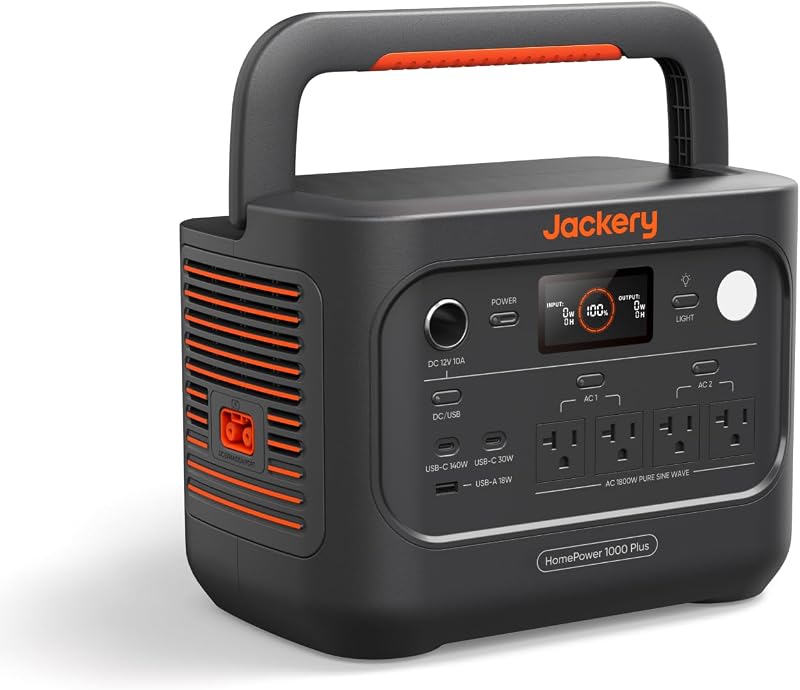
For a roundup focused on 2,000W portable power stations, the Explorer 1000 v2 is the deliberately smaller alternative: its 1,500W continuous rating falls below that headline target, though its 3,000W surge capacity can help with brief startup demands. Its 1,070Wh battery is better suited to a compact essential-power setup than sustained use of heavy appliances. There are seven connection points, including three AC outlets and two 100W PD USB-C ports, so it can keep laptops, phones, and selected appliances connected without constantly swapping plugs. Its strongest practical advantage is recharge speed. The emergency setting can charge it from empty to full in one hour, while the standard mode takes 1.7 hours and is intended to prioritize battery longevity. The LFP battery is rated to retain more than 70% capacity after 4,000 cycles. At 23.8 pounds, with a foldable handle, it is easier to transport than a larger station. Buyers should note its 42-minute runtime at a full 1,500W load and that compatible solar panels are purchased separately.
Capacity and Power Output: 1070Wh battery capacity, 1500W continuous AC output, 3000W surge peak, 7 total power outlets
Charging: 1-hour emergency fast charge or 1.7-hour standard charge, 100W USB-C PD output, ChargeShield 2.0 technology
Battery Technology: LFP battery with 4000+ charge cycles, maintains 70%+ capacity after 4000 cycles, 10+ year lifespan
Ports and Connectivity: 2x USB-C (100W PD), 1x USB-A, 1x DC car port, 3x pure sine wave AC ports, LED lights, smart app control
Physical Specifications: Weight: 23.8 lbs, Dimensions: 12.87in (L) x 8.82in (W) x 9.72in (H), Foldable handle for portability
Additional Features: Smart app control with three charging modes, 30 dB quiet mode, energy efficiency mode, compatible with Jackery solar panels
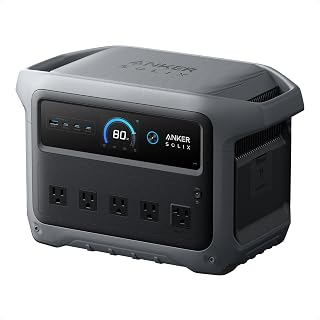
This unit delivers exactly 2000W of output power, matching the article's focus perfectly for readers running demanding equipment like refrigerators, microwaves, or workshop tools during outages or off-grid adventures. The solar fuel compatibility and 120V AC output ensure reliable performance for camping setups and home backup scenarios where maximum wattage capacity is essential for powering multiple high-draw devices simultaneously.
Pros
- 2,000W continuous output
- 49-minute wall recharge rating
- Up to 600W solar input
- LiFePO4 battery rated for 4,000 cycles
Cons
- 1,024Wh capacity limits extended heavy use
- Weighs 11.3 kg
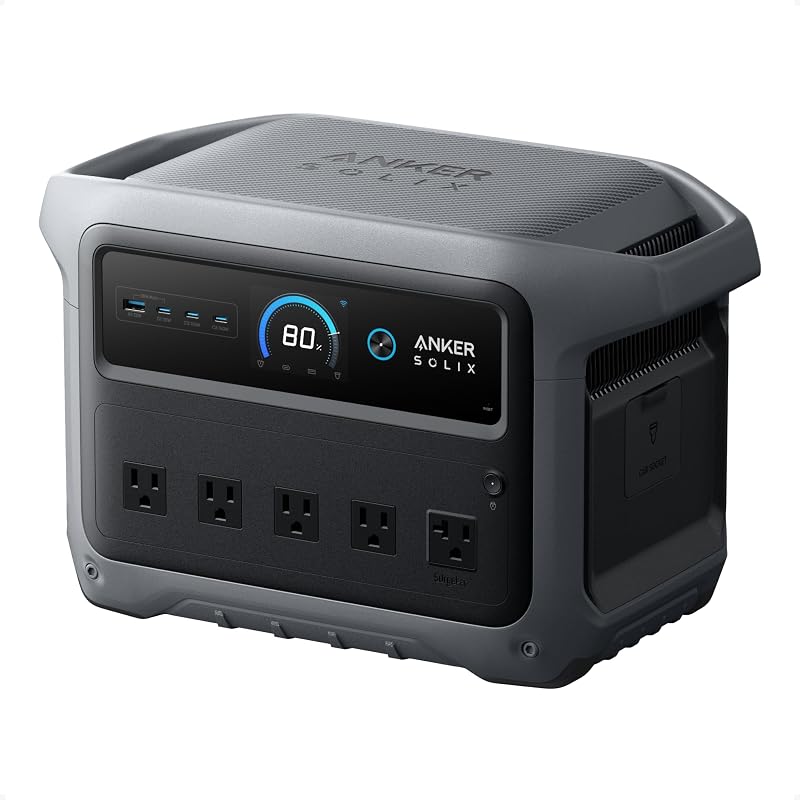
Anker SOLIX C1000 Gen 2 directly meets the 2,000W requirement, pairing that continuous output with a 1,024Wh battery in a station that remains manageable for one person to move short distances. That combination makes it a compelling fit when the priority is running several devices at once rather than maximizing stored energy. Its outlet array is intended for a mix of laptops, phones, lights, fans, and other connected gear, while the 10ms UPS switchover adds continuity for devices that cannot tolerate an interruption. Recharging is a central reason it belongs in a 2,000W roundup. HyperFlash charging accepts 1,600W from a wall outlet and is rated for a full recharge in 49 minutes. For camping or off-grid use, it accepts up to 600W solar input and can fully recharge in 1.8 hours under optimal conditions. The LiFePO4 battery is rated to retain at least 80% capacity after 4,000 cycles. At 15.1 by 8.2 by 9.6 inches and 11.3 kg, with handles on both sides, it favors mobile backup use over bulky generator-style power.
Buy it if you specifically need 2,000W continuous power for a camping setup or portable backup arrangement, need several devices powered at once, and place high value on rapid wall recharging. It is also a strong match for users who need brief UPS-style continuity or plan to use up to 600W of solar input. Skip it if your main requirement is more than 1,024Wh of capacity for extended high-demand use, or if carrying 11.3 kg is unsuitable.
Capacity: 1,024Wh LiFePO4 battery
Output: 2,000W continuous, 3,000W peak
Ports: 10 total outputs
Wall Recharge: 1,600W input, 49 minutes to full
Solar Input: Up to 600W at 60V maximum, 1.8 hours to full
UPS Switchover: 10 milliseconds
Dimensions: 15.1L x 8.2W x 9.6H inches
Weight: 11.3 kg (24.9 lbs)
Battery Cycles: 4,000+ cycles with minimum 80% retention
Warranty: 5 years
Colors Available: Gray
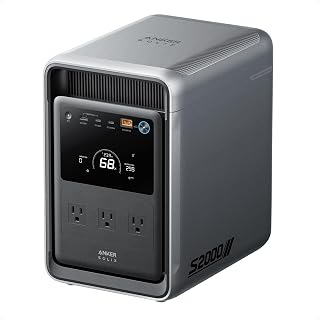
Though the 2010Wh capacity provides substantial energy storage for extended use during power outages and camping trips, the 1500W output falls 25% short of the 2000W target. This gap limits its ability to run higher-wattage appliances that readers specifically seeking 2000W stations would expect to power, despite its lightweight design and versatility across emergency and home backup applications.
Pros
- 2,010Wh battery capacity
- 3,000W starting wattage
- Low 6W idle draw
- LFP battery rated for 10,000 cycles
Cons
- 1,500W continuous output, not 2,000W
- No 12V DC port
The SOLIX S2000 earns attention in a 2,000W buying guide for a different 2,000 figure: it stores 2,010Wh, but provides 1,500W continuous power rather than 2,000W. That distinction makes it a better choice for extended essential-power duty than for loads that specifically demand a 2,000W running rating. Its 3,000W starting wattage can accommodate startup demand, and its 6W idle draw is a notable specification. Anker cites up to 35 hours of refrigerator runtime, though actual runtime changes with refrigerator model, usage, and ambient conditions. For outages and home backup, it combines substantial capacity with eight outlets placed across the front and rear. A sub-10ms UPS switchover can help keep connected equipment running across grid transitions. Six charging methods include AC, generator, car-outlet, and up to 400W solar input, providing several ways to restore power. The LFP battery is rated for 10,000 charge cycles and a 15-year lifespan. At 35.7 pounds and 8.2 by 11.1 by 12.7 inches, it aims to make a 2kWh-class battery more portable. The key trade-off is the lack of a 12V DC port.
Capacity and Output: 2,010Wh LiFePO4 battery, 1,500W continuous output, 3,000W peak output
Battery Technology: 314Ah LFP cells, 10,000 cycle lifespan, 15-year warranty
Dimensions: 8.19L x 11.1W x 12.7H inches
Weight: 35.7 pounds
Outlets: 8 total (front and rear configuration)
Charging Options: AC input, solar (up to 400W), generator, car outlet, alternator charger
UPS Switchover: Less than 10 milliseconds
Idle Power Draw: 6W
Color: Black
Model: AS220
Warranty: 5 years
Buy it if you want around 2kWh of stored energy for a refrigerator, freezer, CPAP machine, or other home essentials during outages, and 1,500W of running power is adequate. Its low idle draw, multiple charging options, and fast UPS transfer suit users prioritizing longer backup over a higher output rating. It is also appropriate for camping where several outlets are useful. Skip it if 2,000W continuous power or a 12V DC port is required.

Pros
- Exceptional build quality with decade-long battery lifespan and full 5-year warranty
- Fastest recharge in its class at 49 minutes, plus solar recharges fully in 1.8 hours
- Compact design weighs significantly less than rivals while powering more devices
- Bifacial solar panel included, eliminating separate purchases
- Reliable UPS function protects medical and sensitive equipment
Cons
- Ships in two separate packages, requiring tracking of multiple deliveries
- Premium price point higher than basic power station alternatives
- 1,024Wh capacity may require multiple charges for extended off-grid trips
The Anker SOLIX C1000 Gen 2 is a premium portable power station engineered for users who refuse to compromise on performance or reliability. It's purpose-built for off-grid camping enthusiasts, RV owners, outdoor event planners, and homeowners seeking dependable backup power during outages. The included 200W bifacial solar panel transforms it into a complete renewable energy solution right out of the box.
What truly sets this unit apart is its speed and output capacity. The HyperFlash charging technology recharges the entire 1,024Wh battery in just 49 minutes from a wall outlet, while solar charging reaches full capacity in 1.8 hours with 600W of connected panels. Powering up to 9 devices simultaneously via 2,000W continuous output (3,000W peak) means you're handling laptops, refrigerators, power tools, and mobile devices without compromise or prioritization.
The engineering reflects thoughtful design throughout. At 15.1 inches by 8.2 inches, it's notably more portable than competitors while being 14% smaller and 11% lighter. The LiFePO4 battery is built to last a full decade of daily use, maintaining 80% capacity even after 4,000 charge cycles, backed by Anker's comprehensive 5-year warranty. The intelligent Time-of-Use app control lets you schedule charging during off-peak hours, directly reducing energy costs.
Two minor considerations: the product ships in separate packages requiring individual tracking, and the 1,024Wh capacity, while substantial, may require mid-trip recharging on extended multi-day expeditions. Additionally, this represents a premium investment compared to lower-capacity alternatives.
The SOLIX C1000 Gen 2 delivers enterprise-grade reliability in a remarkably portable form factor. For anyone who values both dependability and raw performance, this power station justifies its position as a best-seller and represents the mature end of portable power technology.
Power Output: 2,000W continuous, 3,000W peak, 1,024Wh LiFePO4 battery capacity
Ports and Connectivity: 9 total output ports supporting AC, DC, USB, and wireless charging
Charging: 49-minute AC recharge at 1,600W, 1.8-hour solar recharge with 600W solar input (60V max), 10ms UPS switchover
Portability: 15.1 inches L x 8.2 inches W x 9.6 inches H, engineered 14% smaller and 11% lighter than comparable units
Durability: LiFePO4 technology maintains 80% capacity after 4,000 cycles, 5-year warranty, 10-year InfiniPower design lifespan
Included Accessories: 200W bifacial solar panel, dual 2.5m solar charging cables, 0.5m XT60i cable, AC charging cable, quick start guide
Ideal For: Off-grid campers and RV adventurers needing reliable multi-device power, homeowners installing backup power systems, outdoor event planners, medical device users requiring UPS protection, solar enthusiasts, and professionals on remote job sites.
Best Use Cases: Extended camping trips, RV living, emergency home backup during outages, solar energy experimentation, powering CPAP machines and medical equipment, running power tools and laptops simultaneously, festival and event power management.
Consider Alternatives If: You need capacity exceeding 1,024Wh for multi-week expeditions, budget is your primary constraint, or you prefer a compact unit for casual day-trip use without solar integration.

This compact unit delivers 300W of power with a 292Wh capacity, falling well short of the 2000W threshold needed for high-demand appliances like power tools, space heaters, or multiple devices during extended outages. Its 4-hour charge time and portable form factor suit lightweight camping trips, but readers seeking 2000W performance for serious backup power or RV use will find this model underpowered for their requirements.
Pros
- 7.5-pound compact design
- Six-device charging capability
- 100W USB-C PD and dual AC outlets
- LiFePO4 battery rated for 4,000+ cycles
Cons
- 300W output is far below 2000W class
- Not intended for high-wattage appliances
Not every entry considered alongside 2000W portable power stations serves the same role. The Jackery Explorer 300 is a compact 300W model, so it is not a substitute for a 2000W unit when the plan involves appliances, refrigeration, air conditioning, or high-wattage tools. Its value within this comparison is as a much smaller option for the electronics that often accompany larger backup gear. The 292Wh battery, 7.5-pound weight, and integrated handle favor travel, campsites, and grab-and-go emergency use. Two AC outlets, USB-C PD up to 100W, two USB-A ports, and a 120W car port support up to six devices at once, while the display shows remaining capacity. It can recharge in roughly three to four hours through its AC adapter; a compatible 100W solar panel can reach 80% in 2.8 hours. Its LiFePO4 battery is rated for more than 4,000 cycles before falling to 70% capacity. Consider it for keeping small essential electronics running, not for delivering the 2000W-class output this article targets.
Buy the Explorer 300 if a 2000W-class station would be excessive for your actual loads and your priority is a light, compact source for laptops, cameras, drones, phones, tablets, and other small devices. It suits travel, camping, remote work, or short emergency electronics duty. Skip it if this article's 2000W output target is nonnegotiable, or if you need to run refrigerators, air conditioners, high-wattage tools, or several demanding AC devices. Its 300W rated output and 292Wh capacity are intentionally limited.
Capacity: 292Wh (LiFePO4 battery)
Weight: 7.1-7.5 lbs
Dimensions: 15.43in D x 9.92in W x 11.89in H
AC Output: 2 outlets, 110V, 300W continuous (600W peak surge)
USB Ports: USB-C PD 100W, USB-A 2.4A (x2)
Car Port: 120W 12V output
Charging Time: Approximately 4 hours AC, 2.8 hours with 100W solar panel
Battery Cycles: 4,000+ before reaching 70% capacity
Warranty: 2 year manufacturer
Model: JE-300E

This generator provides 1000W of power with 999Wh storage, reaching only half the 2000W output specified in the article focus. While adequate for basic camping electronics and small appliances, it cannot support the simultaneous high-wattage demands like air conditioners, electric kettles, or power-hungry tools that buyers specifically searching for 2000W portable stations typically need to operate.
Pros
- 999Wh capacity in a 17-pound format
- 2000W maximum power specification
- Ten ports, including USB-C PD and wireless charging
- MPPT solar control and pass-through charging
Cons
- 1000W ongoing output rating
- Full-power use drains capacity quickly
A 2000W portable power station category can mean two different things: units with 2000W continuous AC capacity and units whose maximum figure reaches 2000W. The GRECELL EB1000 belongs in the latter group. It is rated at 1000W output, with an engine power maximum of 2000W, so it should be selected for 1000W-level ongoing loads rather than treated as an always-2000W source. Its 999Wh capacity creates more room for camping and emergency electronics than compact 288Wh and 292Wh models, while its 17-pound body and carry handle retain a portable format. Dual AC outlets with pure sine wave output, 60W USB-C PD, three 18W QC3.0 USB-A ports, a 10W wireless pad, and ten ports total make it geared to a mixed collection of devices. An LCD tracks draw and remaining runtime. It also includes pass-through charging, an MPPT solar controller, and dual silent cooling fans. For buyers drawn to a 2000W maximum specification but whose normal demand stays under 1000W, this is a capacity-conscious middle option. Anyone needing 2000W continuously should move on.
Camping and RV travel: Power essential devices and comforts like LED lighting, fans, and phone charging during multi-day trips. The lightweight design fits van conversions and road trip setups better than heavier generators.
Remote work: Keep laptops, monitors, and networking gear running during power outages or while working from off-grid locations. Pure sine wave output protects sensitive electronics.
Medical backup: CPAP machines, oxygen concentrators, and other home medical equipment need clean sine wave power. The 999Wh capacity provides meaningful runtime for essential devices during emergencies.
Solar integration: Use with portable solar panels to extend off-grid capability indefinitely. MPPT tracking optimizes charge speed across varying sunlight conditions.
Emergency preparedness: Deploy rapidly during storms, blackouts, or natural disasters with an ergonomic 17-pound carry handle and pre-tested charge ecosystem.
Power Output: 1000W continuous, 2000W peak burst, pure sine wave 120V AC
Capacity: 999Wh (27Ah at 37V nominal)
Battery Type: Automotive-grade lithium with 2000+ cycle lifespan
Ports: 2x 120V AC outlets, 1x USB-C PD 60W, 3x USB-A QC 3.0 (18W each), 1x 10W wireless charging, 1x 12V car outlet, 2x DC 5.5mm outputs
Charging: AC adapter, solar input (MPPT controller included), 12V car charger
Weight: 16-17 pounds (7.7 kg)
Dimensions: 9.61in x 9.61in x 6.97in (24.4cm x 24.4cm x 17.7cm)
Additional Features: Real-time LCD display, pass-through charging, SOS LED light, dual silent cooling fans
Warranty: 24 months

At 600W output and 288Wh capacity, this generator delivers less than one-third of the 2000W power needed for the use cases highlighted in the title. While the LFP chemistry and multiple charging options suit light outdoor activities and road trips, readers looking for 2000W capability to run heavy-duty equipment or sustain household loads during emergencies will find this model insufficient.
Pros
- 9.4-pound, 288Wh portable format
- 600W AC output with 1500W Lifting Power
- ≤10ms UPS backup switching
- 0 to 80% charge in 45 minutes via 380W wall adapter
Cons
- Not a 2000W unit
- 288Wh capacity limits extended high-demand use
At a 600W standard output, the BLUETTI Elite 30 V2 is not a 2000W portable power station and should not be chosen by buyers who need that level of capability. Even its Power Lifting Mode is specified at 1500W, placing it below the article's target. Its reason for consideration is different: it offers a highly portable backup and electronics solution in a 288Wh, 9.4-pound package. The nine outlets, 140W PD fast charging, and 600W AC output provide connection flexibility for camping, road trips, and small-scale emergency backup. A ≤10ms UPS backup switch is positioned for CPAP machines, routers, and laptops during outages, and UltraCell technology lowers idle draw to 4.5W. Recharging can reach 0 to 80% in 45 minutes via a 380W wall adapter. Eight charging modes cover AC, solar, car, and generator sources; the listed power sources also include lead-acid. That broad charging setup and compact 9.8 by 7 by 6.6-inch dimensions make it an easy supplementary station. It is a credible pick only for portable low-to-moderate demand, not the 2000W core role defined by this guide.
Power Output: 600W continuous, 1500W surge (Power Lifting Mode)
Capacity: 288Wh with LFP battery chemistry
Charging Speed: 0-80% in 45 minutes via 380W AC adapter, 0-100% in 70 minutes
Charging Modes: 8 modes including AC wall (380W/200W adjustable), solar input, car charging, and generator compatible
UPS Response: 10ms ultra-fast switch for critical device protection
Outlets: 9 total ports including AC, USB-C with 140W PD fast charging, and DC outputs
Weight: 9.5 lbs (9.4 lbs stated in marketing)
Dimensions: 9.8 inches long by 7 inches wide by 6.6 inches high
Standby Power Draw: 4.5W AC mode, 5W DC mode, 8W standby
Warranty: 60 months manufacturer coverage
Battery Technology: UltraCell LFP with enhanced thermal management
Recommended Uses: Camping, road trips, emergency home backup, outdoor recreation, and event power
Buy the Elite 30 V2 if you need a 9.4-pound station for camping, road trips, laptops, routers, CPAP machines, and other lighter backup or outdoor loads, and its 600W standard output fits your plan. Its fast wall recharge, UPS function, and multiple charging sources strengthen that role. Skip it if you are shopping this article specifically for 2000W power, want a 2000W-class continuous output, or expect to run high-demand appliances for extended periods. Its 288Wh capacity and 600W rating set clear limits.

Pros
- Fastest charging in its class at 36 minutes to 80% via AC alone, saving significant time compared to conventional power stations
- Modular expansion capability scales power needs without requiring new inverters or complex rewiring, ideal for growing requirements
- Exceptional value for features including LiFePO4 battery, UPS mode, app control, and MPPT solar charging at this price point
- Durable LiFePO4 architecture delivers consistent performance across thousands of charge cycles with minimal capacity degradation
- Intelligent power management system automatically balances cells and maintains optimal temperatures for maximum longevity
Cons
- Weight of 27.8 pounds may be challenging for frequent relocation, though handles make transport manageable for occasional moves
- 1024Wh base capacity may require expansion for larger continuous power needs, adding to overall cost
- Runtime of approximately 1 hour at full 2000W output limits extended use without recharging
The OUPES Mega 1 is a portable power station designed for users who need reliable backup power without breaking the bank. Whether you are dealing with emergency outages at home, powering devices during camping trips, or supporting off-grid work, this 1024Wh LiFePO4 system delivers professional-grade performance in a reasonably portable format. The target audience includes homeowners, outdoor enthusiasts, RV owners, and professionals who require dependable power on demand.
What sets the Mega 1 apart is its remarkable 36-minute fast charging to 80% capacity via standard AC input, or an impressive 26 minutes when combining AC and solar inputs simultaneously. This speed advantage cuts recharge time to roughly one-third compared to conventional power stations. The 2000W continuous output with 4500W surge capacity handles everything from laptops and refrigerators to power tools without voltage fluctuation issues thanks to pure sine wave technology. The expandable architecture lets you scale up to 5120Wh by adding batteries, a flexibility rarely offered at this price tier.
Build quality is solid throughout. The LiFePO4 battery is rated for 3,500+ lifecycle cycles and maintains 80% capacity even after years of heavy use. The intelligent battery management system automatically balances cells, prevents overcharging, and maintains optimal operating temperatures. Real-time app control via Bluetooth adds convenience, letting you monitor consumption and adjust settings remotely. The unit includes professional-grade UPS capability with sub-20ms transfer time for protecting critical equipment like servers and medical devices.
The main limitations are weight at 27.8 pounds, which is manageable but worth considering if you move it frequently, and the 1024Wh base capacity, which may require expansion for larger continuous power demands. At full 2000W output, runtime runs approximately one hour before requiring recharge. These constraints are realistic trade-offs given the price and form factor.
For the asking price, the OUPES Mega 1 delivers exceptional value. It combines industry-leading charging speeds, expandable capacity, professional features like UPS mode, and genuine LiFePO4 durability in one capable unit. If you need reliable portable power without premium pricing, this power station warrants serious consideration.
The Mega 1 achieves industry-leading recharge speeds through multiple charging pathways. Standard AC charging reaches 80% capacity in just 36 minutes, while simultaneous AC and solar input reduces that to 26 minutes. The unit supports bypass charging, allowing solar input to charge batteries while simultaneously powering connected devices without draining the battery itself.
Power delivery combines 2000W continuous output with 4500W surge capacity, sufficient for most household and professional applications. Output includes dual 100W USB-C Power Delivery ports for laptops and tablets, four QC3.0 USB-A ports for phones and accessories, 12V DC output for specialized devices, and premium AC outlets with pure sine wave technology. The built-in MPPT solar controller optimizes solar panel charging efficiency. UPS mode with sub-20ms transfer time activates automatically during grid power interruptions, protecting sensitive equipment.
Battery capacity scales from the base 1024Wh to 2048Wh, 3072Wh, 4096Wh, or maximum 5120Wh by connecting one or two B2 Extra Battery modules. This modular approach lets you expand capacity as needs grow without purchasing a new system. The LiFePO4 chemistry provides superior thermal stability and cycle life compared to lithium-ion alternatives, with 3,500+ rated cycles maintaining consistent performance throughout the battery's lifespan.
The OUPES Mega 1 suits several distinct user categories. Homeowners facing frequent outages or unreliable grid power benefit from its UPS capabilities and capacity to run essential devices for extended periods. The fast charging means you can restore backup power capacity quickly once AC power returns.
Outdoor enthusiasts including campers, RV travelers, and remote site workers appreciate the portability, multiple charging options including solar, and comprehensive device compatibility. The 27.8-pound weight is reasonable for vehicle mounting or weekend trips. Professional users in film production, mobile offices, and emergency response scenarios value the reliable 2000W continuous output and ability to power sensitive equipment safely.
Off-grid property owners planning long-term backup power solutions benefit from the modular expansion capability. Starting with the base 1024Wh and adding batteries as budget allows avoids a large upfront investment while providing a clear upgrade path. The 3,500+ cycle rating and intelligent power management ensure years of reliable service even with frequent charging cycles.
How to Choose a 2000W Portable Power Station
Match continuous output to your real appliance load
A 2,000W rating describes the continuous AC load a station can supply, not the amount of energy stored inside. It is enough for many microwaves, coffee makers, hair dryers, power tools, and kitchen appliances, but you still need to total the watts of everything operating at once.
Look at both continuous and surge ratings before connecting compressor-driven appliances. The ABOK Ark2000, Anker SOLIX C1000 Gen 2, OUPES Mega 1 Lite, and OUPES Mega 1 offer 2,000W continuous output, while their stated surge limits provide additional headroom for motor startup.
Prioritize watt-hours for the runtime you need
Watt-hours, shown as Wh, are the fuel tank of a power station. A 1,024Wh model can handle the same kind of high-draw appliance as a larger unit for a short period, while a 1,536Wh or 2,010Wh model is better suited to longer backup duties and several lower-draw devices.
The ABOK Ark2000 can expand from 1,536Wh to 4,608Wh, and the OUPES Mega 1 can scale to 5,120Wh with extra batteries. For home offices with network storage, pair your backup plan with dependable drives from our best NAS hard drive guide, then account for the inverter loss and idle power draw that reduce real-world runtime.
Compare wall and solar recharging options
Fast AC charging is especially useful when an outage warning is short. OUPES lists a 46-minute full wall recharge for the Mega 1 Lite, Anker lists a 49-minute full recharge for the C1000 Gen 2 with its app-enabled mode, and Jackery lists a one-hour emergency charge mode for the Explorer 1000 v2.
Solar capability matters more for camping and prolonged grid outages. The OUPES Mega 1 Lite supports up to 800W of solar input, while the Anker C1000 Gen 2 supports up to 600W and is also available in a package with a 200W bifacial panel. If your field setup includes game captures and media files, keep them protected with one of the best external SSDs for gaming.
Check UPS response, ports, and carry weight
A UPS feature allows a station to switch to battery power during an outage while connected equipment remains plugged in. Anker, ABOK, and BLUETTI specify 10ms transfer times on select models, while OUPES specifies under 20ms. Confirm the requirements of sensitive equipment, especially medical devices and desktop computers, before depending on any backup system.
Port layout can be as important as raw wattage. The OUPES Mega 1 Lite includes dual 140W USB-C ports, the GRECELL 999Wh unit adds wireless charging, and the Anker SOLIX S2000 omits a 12V DC port in favor of a cleaner outlet arrangement. For a mobile desk, consider how your display fits the plan with our guides to the best 32 inch 4K monitors and best 500Hz monitors.
Final Thoughts
Choose the ABOK Ark2000 1536Wh 2000W Portable Power Station when expandable capacity and strong solar input matter most for a growing backup plan. For frequent travel or a compact home backup solution, the Anker SOLIX C1000 Gen 2 Portable Power Station offers a lighter 1,024Wh format with fast charging and a responsive UPS feature.
Frequently Asked Questions
What can a 2000W portable power station run?
A 2,000W portable power station can run many household essentials, including a refrigerator, microwave, coffee maker, TV, lights, laptop chargers, and many power tools. You must keep the combined continuous draw below the station’s stated output limit. Appliances with motors can require a higher surge when they first start, so check both running and startup wattage.
How long will a 2000W power station run a refrigerator?
The 2,000W figure does not determine refrigerator runtime, because capacity in watt-hours and the refrigerator’s actual power draw are more important. A larger battery such as the 2,010Wh Anker SOLIX S2000 will generally support a fridge longer than a 1,024Wh station under comparable conditions. Compressor cycles, room temperature, inverter efficiency, and the station’s idle draw all affect the final result.
Is a 2000W solar generator suitable for a CPAP machine and laptop?
Yes, many models use pure sine wave AC output that is appropriate for laptops, CPAP machines, routers, and other sensitive electronics. A fast UPS transfer feature can help during a sudden outage, but you should confirm compatibility with your device manufacturer and use the normal charging equipment. For protecting a larger offline data library as part of the same emergency plan, see our picks for the best 8TB hard drives.
Do I need a 2000W power station for camping in 2026?
You need a 2,000W class unit if you plan to use high-draw cooking appliances, power tools, an RV setup, or several devices at once. For phones, cameras, drones, small lights, and a laptop, a lighter option such as the Jackery Explorer 300 or BLUETTI Elite 30 V2 may be easier to carry. Choose capacity based on the number of days between charging opportunities, then select solar input that matches your off-grid plans.



Write Your Review
No reviews yet. Be the first to share your experience!