

During a multi-hour outage, a basic battery pack will not keep a refrigerator, router, medical device, or work setup running for long. A solar-ready power station gives you a quieter, fuel-free way to recharge while protecting the essentials you rely on.
This guide covers the best power station with solar input options for campers, RV travelers, remote workers, and homeowners building practical emergency power. If an outage could also put important files at risk, pair your plan with an external hard drive backup guide for more complete preparedness.
Quick answer
This guide compares 10 picks, with UDPOWER S1200 Portable Power Station 1200W Pure Sine ranked first. Anker SOLIX S2000 2010Wh Portable Power Station, 1500W holds the highest customer rating among them. Jackery Explorer 300 Portable Power Station 292Wh has the most customer reviews.

The 400W max solar input stands out for fast recharge speed when paired with high-wattage panels, cutting downtime between uses. UL2743 certification adds safety assurance for home backup applications, and the 1800W surge capacity handles brief motor startups from tools or appliances you might run during extended solar-supported operation.
Pros
- Accepts up to 400W of solar input
- 1,200W running output with 1,800W surge capacity
- 14-port hub with five AC outlets
- LiFePO4 battery rated for more than 4,000 cycles
Cons
- 25.8-pound weight makes repeated transport harder
- Multiple panels may be needed to use the full solar input
Solar input is a central strength of the UDPOWER S1200 for users building a more capable outage or RV setup. It accepts up to 400W of solar input, while its 1,200W continuous output and 1,800W surge capacity are designed for essential appliances such as refrigerators, CPAP machines, and air fryers. This makes the solar capability more useful during an extended interruption, when merely charging phones is not enough. The output arrangement also suits a shared power load. Five AC outlets and dual 100W USB-C Power Delivery ports are part of a 14-port charging hub, so laptops, drones, power tools, and phones can charge alongside AC equipment. Its LiFePO4 battery is rated for more than 4,000 cycles while retaining 80% capacity, and the protection system addresses overloads, short circuits, and overheating. A digital display provides status information, and the cooling system is rated below 25dB. At 25.8 pounds, however, this is better treated as a two-handed carry than a casual grab-and-go station. Multiple panels may be needed to make full use of its 400W input ceiling.
Power Output: 1200W continuous, 1800W surge capacity with pure sine wave AC generation at 60Hz and 110V.
Battery: LiFePO4 chemistry with 4,000+ cycle lifespan and 80% capacity retention. Operates from -4°F to 140°F (-20°C to 60°C) in extreme temperatures.
Charging Ports: 14 total ports including 5 AC outlets, 2x 100W USB-C Power Delivery, plus additional USB and auxiliary inputs. Car charging cable and fast-charge cable included.
UPS Function: Less than 0.01 second switchover time protects connected devices from power interruption. 0.3W idle power consumption with 12-month standby capability.
Physical: 25.8 pounds, 13.7 inches long x 9.53 inches wide x 9.72 inches high. ABS and polycarbonate casing in grey color. Includes digital display for status monitoring.
Certification: UL2743, FCC approved with military-grade safety triple protection. 5-year manufacturer warranty.
Choose the S1200 for a home, RV, or camping plan where solar replenishment needs to support essential appliances as well as personal devices. It is especially relevant for buyers who can use its five AC outlets, 14-port hub, and 1,200W running output across several loads. Skip it if carrying a 25.8-pound station is a recurring concern, or if a 400W solar input ceiling does not meet your charging plan. It is also excessive for a phone-and-laptop-only kit.

The 1536Wh LiFePO4 battery provides thousands of charge cycles, essential when solar is your primary recharge method over years of use. Dual power source support confirms native solar input, and the 2000W output accommodates heavier loads like portable coolers or power tools during outdoor projects where grid access is unavailable.
Pros
- Up to 1200W solar input
- 1536Wh capacity expands to 4608Wh
- 2000W output with 3500W peak
- 10ms UPS and remote app monitoring
Cons
- 29.8-pound unit is not suited to hiking
- Expansion batteries are needed for maximum capacity
For a solar-input power station, recharge speed and usable capacity matter more than outlet count alone, and the Ark2000 covers both. Its 1536Wh LiFePO4 battery accepts up to 1200W of solar input, with a stated 1.2-hour solar recharge time. That makes it a sensible option for campers, RV travelers, or households that expect to replenish the battery between uses rather than rely only on wall charging. It supplies 2000W of continuous pure sine wave output, with A-Boost compatibility up to 2400W and 3500W peak capacity for brief surges. The eight-port layout includes three AC outlets, two USB-A QC ports, and two USB-C PD ports, including one rated at 100W, so it can divide power among appliances and personal electronics. Capacity can grow from 1536Wh to 3072Wh or 4608Wh using matching expansion batteries. A 10ms UPS function, app-based remote monitoring, and off-peak charge scheduling broaden its home-backup appeal. At 29.8 pounds, it travels more easily by vehicle than on foot. Its EVE LiFePO4 cells are rated for more than 4,000 cycles and a 10-year service life.
Power Output: 2000W continuous, 2400W A-Boost, 3500W peak
Battery: 1536Wh LiFePO4 (expandable to 3072Wh or 4608Wh), 4000+ cycle rating, 10+ year lifespan
Input Charging: 1500W AC (55 min to 80%), 1200W solar (1.2 hours to 80%)
Output Ports: 3 AC outlets, 2 USB-A QC 18W, 1 USB-C PD 20W, 1 USB-C PD 100W, 1 12V car port
Dimensions/Weight: 15.91L x 8.58W x 8.07H inches, 29.8 lbs
Protection: 10ms UPS, 3W emergency LED with multiple modes, UL94 V-0 fire-resistant shell
Smart Features: ABOK mobile app for monitoring and scheduling, 2+3 year warranty and service support
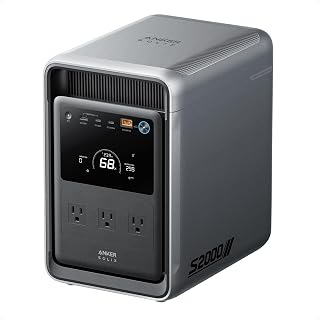
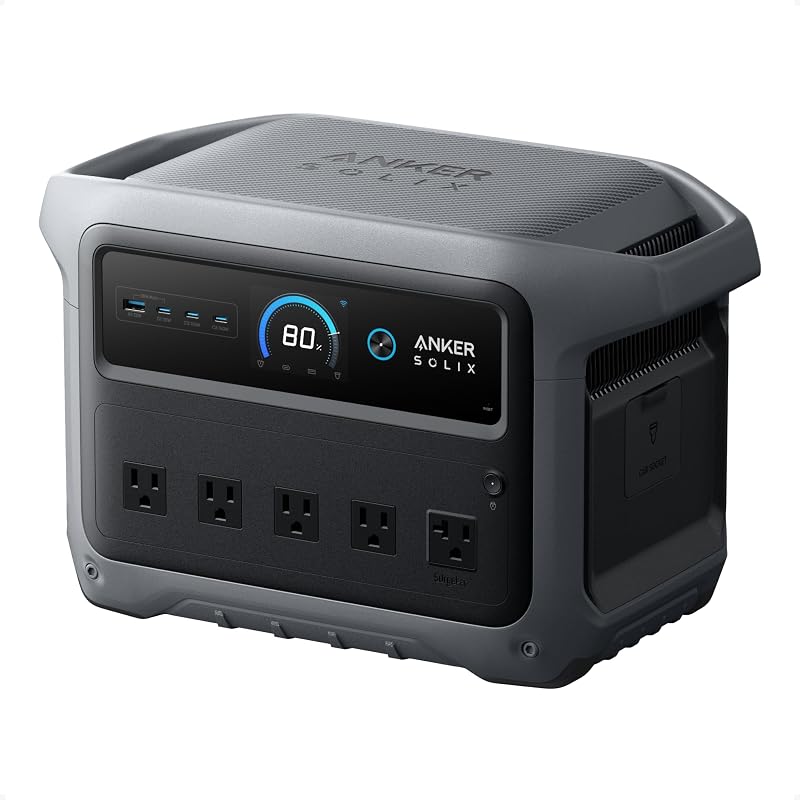
The 2,010Wh capacity combined with 1,500W output provides serious reserve power for extended solar recharging cycles during outages or off-grid use. Anker's lightweight design reduces the usual penalty of high-capacity stations, and the watt-hour rating supports multiple device recharge rounds before you need another solar session, making it practical for multi-day scenarios.
Pros
- 400W solar input
- 2,010Wh battery capacity
- Eight outlets
- Low 6W idle draw
Cons
- No 12V DC port
- Refrigerator runtime varies by conditions
Solar input is most valuable on a larger power station when the stored energy can carry household essentials long enough for the next recharge window. The Anker SOLIX S2000 combines a 2,010Wh battery with 400W solar input, so it is better suited to extended outage planning and substantial off-grid loads than a compact phone-charging station. Its 1,500W running output and 3,000W starting output are intended for essential appliances, while the eight outlets give a home or camp setup room for several connected devices. The 6W idle draw is particularly relevant for solar backup because it helps preserve stored energy between charging opportunities. Anker states this can provide a 35-hour refrigerator runtime, though real runtime changes with the refrigerator, usage, and ambient conditions. At 35.7 pounds, with dimensions of 8.2 by 11.1 by 12.7 inches, it is notably compact for its capacity. It can recharge through six methods, including solar, AC, generator input, and a car outlet. The LFP battery is rated for 10,000 cycles and a 15-year lifespan, and its sub-10ms UPS switchover supports connected equipment through grid transitions. The absence of a 12V DC port is a real limitation for certain RV appliances and specialized gear.
Capacity and Output: 2,010Wh LiFePO4 battery, 1,500W continuous output, 3,000W peak output
Battery Technology: 314Ah LFP cells, 10,000 cycle lifespan, 15-year warranty
Dimensions: 8.19L x 11.1W x 12.7H inches
Weight: 35.7 pounds
Outlets: 8 total (front and rear configuration)
Charging Options: AC input, solar (up to 400W), generator, car outlet, alternator charger
UPS Switchover: Less than 10 milliseconds
Idle Power Draw: 6W
Color: Black
Model: AS220
Warranty: 5 years
Buy the S2000 if your solar plan centers on a larger reserve for refrigerator backup, extended outages, or an off-grid setup with several devices. It suits users who value 400W solar input, eight outlets, compact dimensions for a 2,010Wh unit, and UPS-style switchover. Skip it if you rely on a 12V DC port for RV or specialized equipment, need a lighter station, or expect fixed runtime results regardless of appliance model, usage, and temperature.

The 292Wh capacity and compact form factor make this a reliable entry point for solar charging setups where portability matters more than raw output. The 4-hour battery charge time means you can top it off quickly during peak sun hours, and the 300W maximum power handles essentials like phones, laptops, and small appliances without the bulk of larger units.
Pros
- 80% solar recharge in 2.8 hours with a compatible 100W panel
- 7.5-pound, 292Wh compact design
- Six-device charging capability
- LiFePO4 battery rated for more than 4,000 cycles
Cons
- 300W rated output limits appliance use
- Solar recharge claim depends on a compatible 100W panel
For solar-based power that stays easy to pack, the Jackery Explorer 300 prioritizes modest capacity and low carry weight over appliance-level output. Its 292Wh battery and 7.5-pound body make sense when the solar setup is intended to keep phones, tablets, cameras, drones, and a laptop supplied rather than provide household-level backup. With a compatible 100W panel, it can reach 80% charge in 2.8 hours, a useful recovery rate for daylight charging. The unit can also reach full charge in roughly three to four hours with its AC adapter. Power delivery is centered on a 300W rated output, with 600W available briefly for surges. Two AC outlets, a 100W USB-C PD port, two USB-A ports, and a 120W car port support up to six devices at once. The digital display helps track remaining capacity, while the integrated handle supports frequent moves between a vehicle, tent, or work spot. Its LiFePO4 battery is rated for more than 4,000 cycles before reaching 70% capacity. This is a compact solar companion, not a substitute for refrigerator, air-conditioner, or high-wattage-tool power.
Buy it if solar charging is meant to support lightweight travel, weekend camping, camera gear, or occasional laptop work, and you value a 7.5-pound station that can serve several small devices. It also fits emergency kits focused on communication and personal electronics. Skip it if your solar plan must operate a refrigerator, air conditioner, high-wattage tools, or other demanding appliances. Buyers needing a larger energy reserve for prolonged household backup should look beyond its 292Wh capacity.
Capacity: 292Wh (LiFePO4 battery)
Weight: 7.1-7.5 lbs
Dimensions: 15.43in D x 9.92in W x 11.89in H
AC Output: 2 outlets, 110V, 300W continuous (600W peak surge)
USB Ports: USB-C PD 100W, USB-A 2.4A (x2)
Car Port: 120W 12V output
Charging Time: Approximately 4 hours AC, 2.8 hours with 100W solar panel
Battery Cycles: 4,000+ before reaching 70% capacity
Warranty: 2 year manufacturer
Model: JE-300E

With 1024Wh of LiFePO4 storage and explicit solar power source support, this station balances mid-tier capacity with the long cycle life solar users depend on for repeated charge cycles. The 1000W output covers most residential and camping loads, and the electric fuel type confirms compatibility with standard solar panel configurations without proprietary adapters.
Pros
- 1,024Wh LiFePO4 battery
- Accepts up to 300W of solar input
- 1,000W continuous output and 2,000W starting wattage
- Five-device charging capability
Cons
- 27.7-pound body is substantial to carry
- Lacks UPS functionality and needs manual output shutdown
The Staryline 1000W is aimed at solar users who need enough stored energy for more than device charging. Its 1,024Wh LiFePO4 battery, 1,000W continuous output, and 2,000W starting wattage give it the scope to support items named for home and camp use, including Wi-Fi routers, mini fridges, CPAP machines, and home entertainment systems. Solar input reaches 300W, and an optional 200W panel can fully recharge the station in six to eight hours of sunny conditions. That combination makes it a practical choice when daylight needs to restore a meaningful reserve rather than simply top up a small pack. For distribution, the station has dual 110V AC outlets, a 60W USB-C Power Delivery port, and two USB-A ports, allowing five devices to charge at the same time. Its automotive-grade LiFePO4 battery is paired with a six-layer smart battery management system that guards against overcharge, overload, and temperature extremes. The battery is rated to retain 80% capacity after more than 3,000 cycles. The main solar-use compromise is transport: at 27.7 pounds, it is substantial to move. It also requires manual output shutdown to prevent drain when it is not in use.
Power Output: 1000W continuous, 2000W peak surge capacity
Battery: 1024Wh LiFePO4 with automotive-grade cells and six-layer smart BMS protection
Charging Ports: 2x 110V AC outlets, 1x 60W USB-C PD port, 2x USB-A ports
Solar Input: Up to 300W maximum, compatible with standard monocrystalline panels
Durability: 3000+ charge cycles with 80% capacity retention, approximately 6-year lifespan
Physical: 27.7 lbs, dimensions 18L x 12W x 16H inches, three colors available (Gray, Blue, Yellow)
Included: Power station, car charging cable, AC charging cable, user manual
Buy this model if your solar-backed plan includes residential essentials or a longer camping stay and you want a 1,024Wh battery with 1,000W continuous output. It is a better fit for those who can recharge with up to 300W of solar input and can manage its 27.7-pound weight. Skip it if seamless power switching is required, since it lacks UPS functionality, or if you need a lighter station for frequent carrying. It is unnecessary for very small device loads.

At 3840Wh and 3600W output, this handles whole-home essentials or job-site equipment during multi-day solar recharge scenarios where capacity directly limits uptime. The LiFePO4 chemistry endures the repeated deep discharge and recharge cycles common in off-grid solar setups, and the watt-hour reserve supports sustained use between charging windows.
Pros
- 3840Wh capacity expands to 11,520Wh
- 3600W rated output and 7200 starting watts
- 15 versatile output ports
- Wheels, telescoping handle, and Bluetooth app
Cons
- 92-pound weight limits portability
- Built for larger setups rather than lightweight camping
Rather than prioritizing lightweight portability, the Ark3600 is built around a large battery bank for solar-supported backup. Its 3840Wh LiFePO4 battery can be expanded to 11,520Wh, creating a more substantial reserve for home outages, RV stays, or off-grid use. Since it works from battery and solar power, it fits buyers who want to pair solar charging with longer-running power needs. The station delivers 3600W rated output, 4500W peak power, and 7200 starting watts. That level is intended for a broad range of gear, from phones to power tools, while 15 output ports, including 30A AC, USB-C, USB-A, and DC5521 connections, make it easier to run varied devices at once. Bluetooth app connectivity supports remote monitoring, control, and energy optimization. Its LiFePO4 battery is rated for 4,000 cycles and a 10-year lifespan. The tradeoff for its capacity is mass: it weighs 92 pounds, though wheels and a telescoping handle help with movement. For a solar-equipped home or RV backup setup, its expandability is the central advantage rather than easy one-person carrying.
Power Output: 3600W continuous, 4500W peak, 7200W starting wattage
Battery Capacity: 3840Wh base, expandable to 11520Wh. LiFePO4 chemistry with 4000+ cycles and up to 10-year lifespan
Charging Input: AC at 1500W, Solar (PV) at 2000W, Car charging at 120W. Full charge achievable in 1.29 hours with combined AC plus solar, or 3 hours AC only
Output Ports: 1x AC 30A, 4x AC 20A, 2x USB-A QC3.0, 3x USB-C PD 20W, 1x USB-C PD 100W, 2x DC5521 12V/3A, 1x XT60 12V/25A, 1x Cigarette Lighter 12V/10A
Dimensions and Weight: 21.6 inches L by 12.6 inches W by 18.5 inches H, weighs 92 pounds. Features extendable telescoping handle and durable wheels
Smart Features: Bluetooth app for remote monitoring, 10ms UPS response for seamless power switching
Warranty: 2 years plus 3 years extended coverage. Manufactured by Shenzhen SYD Network Technology Co., Ltd
Choose the Ark3600 for a home, garage, RV, job-site, or off-grid setup that needs solar-capable backup with high output, many connections, and room to expand beyond 3840Wh. It is particularly appropriate for users who expect to power larger appliances or tools alongside smaller electronics, and who can position it in one place or roll it as needed. Skip it if frequent lifting, compact packing, or lightweight camping portability is essential, because the unit weighs 92 pounds.
Pros
- Included 40W solar panel
- 7.5-pound portable design
- 100W USB-C charging
- More than 4,000 rated cycles
Cons
- 40W panel takes 7.5 hours to reach 80%
- 292Wh capacity needs careful load management
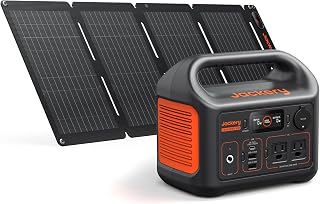
For solar users whose priority is keeping a compact camp setup supplied rather than running large appliances, the Jackery Solar Generator 300 is a practical starting point. The 292Wh battery and 300W AC output are sized for phones, tablets, laptops, lights, drones, and similar lower-demand gear, while the 7.5-pound body and integrated handle make moving the station simple. Its port selection includes two AC outlets, a 100W USB-C port, two USB-A ports, and a 120W car port, so a small solar-powered base camp can charge several device types without extra hubs. The included 40W panel gives this package an immediate solar charging route, and the station can also recharge from a wall socket or car charger. That flexibility matters when sunlight is inconsistent. A real-time wattage display helps monitor consumption, and pure sine wave AC is designed for sensitive electronics. The LiFePO4 battery is rated for more than 4,000 cycles before reaching 70% capacity. Solar replenishment is the tradeoff: the 40W panel needs 7.5 hours to bring the battery to 80%, so this is best approached as an overnight or low-load solar solution, not a rapid daytime refill.
Buy this bundle if you want a lightweight, solar-ready station for weekend camping, car-based trips, or a small emergency kit centered on personal electronics and lights. It also suits people who value USB-C charging and want a car or wall charging fallback when the weather changes. Skip it if your solar plan depends on quickly restoring capacity during one afternoon, or if you need to operate high-draw appliances. The 292Wh capacity and 300W output call for conservative load planning on longer trips.
AC Wall Charging: Full charge via included AC adapter in approximately 6-8 hours
Car Charging: Via included car charger cable through 12V outlet, rate varies with vehicle charging capability
Solar Charging: 40W included panel reaches 80% capacity in 7.5 hours under optimal conditions; 100W panel (sold separately) reaches 80% in 2.8 hours
Battery Specs: 292Wh capacity, LiFePO4 chemistry, 4,000+ charge cycles to 70% capacity, supports 500+ full cycles yearly for 8+ years
Pros
- 200W solar reaches 80% in six hours
- 1,070Wh LFP battery
- 1,500W output with 3,000W surge
- Fast wall-charging options
Cons
- Panel and station need considerable storage room
- Not suited to every high-draw appliance combination
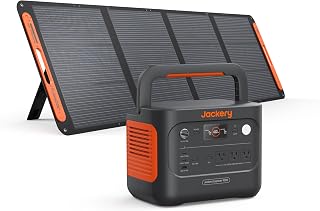
A solar generator earns its place on longer trips when its battery is large enough to carry a night of essentials and its panel can restore a useful share the next day. The Jackery Solar Generator 1000 v2 pairs a 1,070Wh LFP battery with a 200W solar panel, giving it a more substantial solar setup than small-device stations. In clear conditions, solar charging can reach 80% in six hours, which supports a practical day-to-night rhythm for camping, road trips, and selected home backup needs. Its 1,500W continuous AC output, 3,000W surge capability, and three AC outlets broaden the range of equipment it can support. The output selection also includes two 100W USB-C ports, USB-A, and a DC car outlet. At 23.8 pounds, it remains a portable option, with a foldable ergonomic handle to aid transport. When solar is unavailable, wall charging can fully recharge it in 1.7 hours, or in one hour using emergency mode. The LFP battery is rated to retain over 70% capacity after 4,000 cycles. The main solar-use caveat is storage: pairing the station with its 200W panel demands more room than a compact system, and 1,500W will not cover every combination of high-draw household appliances.
Choose this model if solar is meant to do meaningful recharging between nights away from the grid and you need more than phone-and-light capacity. It fits campers, road trippers, RV users, and homeowners who want a portable unit for essentials such as a refrigerator, CPAP machine, or low-draw home-theater setup. Pass if panel storage space is tight, lifting 23.8 pounds is impractical, or your backup plan requires simultaneous operation of several high-wattage appliances.
Battery: 1070Wh LFP (Lithium Iron Phosphate) with 4000+ cycle lifespan
AC Output: 1500W continuous, 3000W surge peak at 120V, 60Hz
Solar Input: 200W panel included, reaches 80% charge in 6 hours (clear conditions)
AC Charging: 1.7 hours standard, 1 hour emergency mode via app
Alternator Charging: 3 hours with 600W charger (sold separately)
Ports: 3x pure sine wave AC outlets, 2x USB-C (100W PD max), 1x USB-A, 1x DC car outlet, LED lights
Weight: 23.8 lbs with foldable handle
Dimensions: 12.87"L x 8.82"W x 9.72"H
Warranty: 2-year manufacturer coverage, 5-year coverage included with purchase
Model: JE-1000D (E1000v2+200W bundle)

Pros
- Exceptional real-world runtime tested by users powering multiple devices simultaneously for 2-3 days
- Ultra-fast charging significantly reduces downtime between trips and outdoor adventures
- Dual solar inputs with no extra MPPT management lower upgrade costs for RV owners
- Quiet operation and excellent thermal management under sustained loads
- Reliable UPS switching protects CPAP machines and sensitive home electronics
Cons
- Heavy at 44 pounds, requiring vehicle transport or purchasing optional DC cart converter
- Initial app setup involves privacy permission requests that concern some users
- Rare warranty issues reported with some units failing to charge to full capacity
The AFERIY P280 is a versatile portable power station designed for outdoor enthusiasts, RV travelers, and homeowners seeking dependable backup power. With its 2048Wh capacity and 2800W output, it handles everything from camping trips to home energy storage, delivering practical power in a compact 44-pound package.
Performance is the P280's strongest suit. The 38-minute rapid charge eliminates waiting, while the <10ms UPS response time seamlessly protects sensitive equipment during power transitions. Real-world users report excellent runtime powering multiple devices simultaneously, with one user achieving three-day camping trips on a single charge. The dual solar inputs with integrated MPPT management make solar expansion cost-effective without complex configuration.
Build quality reflects the LiFePO4 advantage: the battery achieves 4000+ cycles and 10-year durability. Pure sine wave output protects high-end electronics, and the industrial NEMA outlet accommodates serious appliances. The expandable architecture lets you scale from 2kWh to 10kWh as needs grow, adding long-term value.
Weight is the primary tradeoff. At 44 pounds, regular transportation requires either a cart or vehicle access. The companion app demands extensive permissions during setup, which some users find intrusive, though customer service responses have been responsive to concerns.
The P280 represents strong value for serious users who prioritize reliability and performance over ultra-portable profiles. It excels for pellet grill owners, RV adventurers, and homes needing substantial backup capacity, backed by proven durability and exceptional real-world performance metrics.
Outdoor Cooking: Pellet grill owners eliminate extension cord limitations and power grills anywhere on property with consistent, quiet operation that handles startup surge and steady-state power demands.
RV and Camping: Multi-day trips with diverse loads (refrigeration, cooking, charging) deliver proven 2-3 day runtimes, with solar panels offering affordable recharge during extended adventures without fuel dependency.
Home Backup Power: Dual solar input enables gradual grid-tied expansion for whole-home coverage, protecting critical systems like CPAP machines and internet equipment during outages with near-instant UPS switching.
Off-Grid Living: Expandable architecture scales from weekend cabin applications to full 10.24kWh systems, supporting home energy storage strategies with durable LFP chemistry and cost-effective solar integration.
Battery: 2048Wh LiFePO4, expandable to 10.24kWh with additional batteries, 4000+ cycle life, 10-year warranty
Power Output: 2800W continuous (5600W peak), pure sine wave AC, <10ms UPS response time
Charging Inputs: 1800W AC input, 1200W dual PV inputs with integrated MPPT, charging time 38 minutes (0-80% AC)
Outlets: NEMA TT-30 industrial outlet for high-wattage appliances, multiple AC and DC ports for diverse devices
Physical: 15.43L x 11W x 12.72H inches, 44 pounds, ABS construction
Warranty: 5-year primary + 2-year extended coverage, customer support responsive to technical issues

At 89.6Wh with LiFePO4 chemistry, this ultra-compact unit prioritizes cycle longevity and weight savings for minimal solar setups. The 100W input capacity allows pairing with a small foldable panel, and the digital display gives real-time feedback on charging progress. It suits users who need occasional device top-ups rather than sustained appliance runtime.
Pros
- Exceptional portability with flagship power, outperforming heavier models in the same price range
- LiFePO4 battery provides superior longevity and thermal stability compared to standard lithium
- Fast charging capabilities make it practical for quick top-ups before travel or outdoor trips
- Multiple simultaneous output ports let you charge phones, laptops, and cameras at once
- Quiet operation and built-in flashlight add genuine utility beyond basic power delivery
Cons
- 100W continuous output limits use to smaller devices; larger appliances and mini-fridges may exceed capacity
- Solar panel sold separately, reducing value proposition for off-grid sustainability seekers
- LED display requires protective film removal, suggesting quality control inconsistencies in manufacturing
The Daran Portable Power Station is a pocket-sized power solution designed for digital nomads, outdoor enthusiasts, and anyone preparing for emergency power outages. At 2.54 pounds and roughly the size of a smartphone, it delivers surprising capability without the bulk of traditional generators or heavier power banks. Whether you're backpacking, working remotely from cafes, or keeping essential devices charged during a blackout, this unit bridges the gap between convenience and real-world usability.
The standout technical feature is the LiFePO4 battery chemistry, which offers 3500+ charge cycles compared to 500-1000 for standard lithium batteries. This means the Daran effectively lasts three times longer and handles repeated charging with minimal degradation. Paired with its 100W continuous output and seven output ports (including dual USB-C with 45W and 15W options), you can charge a laptop and phone simultaneously, then switch to AC devices without unplugging. The 0-80% charge time of 1.5 hours is genuinely fast, and the dual-input system means AC and solar or car charging can work at the same time.
Build quality reflects a practical approach: the fanless design stays completely silent, the soft-grip handle is comfortable, and the LED display clearly shows power status. The emergency LED flashlight with SOS mode adds unexpected value for camping or disaster scenarios. The accidental-touch-proof design for power activation prevents battery drain from being jostled in a backpack. However, the 100W limit means high-draw appliances like portable heaters or high-wattage hairdryers won't work, and the solar panel is sold separately despite being mentioned prominently in marketing materials.
Real-world performance aligns with specifications based on user feedback. The compact form factor genuinely feels pocketable, and the variety of ports handles most devices people actually carry. Battery chemistry and safety systems appear robust, supported by the 4.2-star rating across over 1000 reviews. The main compromise is power ceiling: this excels at topping up devices during a day away, less so at running multiple high-demand appliances.
For its price point and portability class, the Daran Portable Power Station delivers solid value. It's the right choice if you prioritize compactness, need frequent charging cycles over years, and have realistic expectations about power limits. It's less suitable if you regularly need to power devices above 100W or expect to go weeks without recharging.
Battery: 89.6Wh LiFePO4 (3500+ life cycles)
Continuous Output: 100W (200W peak)
AC Outlets: 2 sockets (100W total)
USB-C Ports: 2 ports (45W + 15W)
USB-A Ports: 2 ports (18W + 15W)
DC Output: DC5521 (60W)
Dimensions: 6.5 x 3.3 x 4 inches
Weight: 2.54 pounds
Charging Methods: AC wall, USB-C PD, car, solar panel (optional)
Fast Charge Time: 0-80% in 1.5 hours
Safety Features: 12-level BMS protection, LED flashlight with SOS mode
Color: Dark Gray
Warranty: Included (check manufacturer details)
Best For: Remote workers, campers, travelers, emergency backup power, multi-device charging on the go.
Not Ideal For: High-power appliances (above 100W), long-term off-grid living without solar, users requiring massive capacity for extended trips.
Comparison: Lighter and cheaper than most 100Wh+ competitors while offering LiFePO4 durability typically found in premium models. Trade-off is lower peak wattage than some rivals and no included solar panel.
Setup Tip: Remove the protective film from the LED display before first use. Charge and fully discharge twice during initial setup to optimize battery performance, as recommended by the manufacturer.
Consider Adding: Daran's optional solar panel (sold separately) to unlock off-grid charging capability and extend independence during extended outdoor trips.
How to Choose a Power Station With Solar Input
Match Battery Capacity to Your Real Runtime Needs
Capacity, measured in watt-hours, tells you how much stored energy a station has. A compact 292Wh model such as the Jackery Explorer 300 Portable Power Station,292Wh is suited to phones, cameras, a laptop, and modest CPAP use, while a 2,010Wh unit like the Anker SOLIX S2000 Portable Power Station, 2,010Wh is built for longer backup sessions.
Start by listing the devices you cannot comfortably lose, then add their wattage and expected hours of use. For a home office or network setup, include your modem, router, and storage equipment, especially if you use a dedicated NAS. Our NAS hard drive guide can help you plan the storage side of that setup.
Look at Solar Input, Not Just Panel Size
A panel’s advertised wattage is only part of the equation. The station must accept enough solar input to make meaningful progress during the available daylight, and real-world production changes with sun angle, weather, temperature, and panel placement.
The Jackery Explorer 300 Portable Power Station,292Wh works with a 100W panel for light-duty off-grid use, while the UDPOWER S1200 Portable Power Station 1200W accepts up to 400W. For faster replenishment of larger batteries, the ABOK Ark2000 1536Wh 2000W Portable Power Station and AFERIY P280 Portable Power Station 2800W each support up to 1200W of solar input, and the ABOK Ark3600 Portable Power Station 3600W reaches 2000W.
Confirm Output Wattage and Backup Switching
Battery capacity determines duration, but AC output determines what you can run at all. A 300W inverter is appropriate for personal electronics, while appliances with heating elements, compressors, or motors usually need far more headroom for startup surges.
For demanding backup, the AFERIY P280 Portable Power Station 2800W offers 2800W of AC output and a TT-30 outlet, while the ABOK Ark3600 Portable Power Station 3600W has a 3600W rated inverter. If uninterrupted office equipment matters, prioritize a model with a fast UPS function, such as the ABOK Ark2000 or Anker SOLIX S2000, rather than assuming every station handles transfer power equally well.
Balance Portability, Ports, and Room to Expand
Large capacity is useful only if you can move and store the station comfortably. The Daran Portable Power Station 89.6Wh LiFePO4 fits easily in a daypack for low-wattage gear, while the Jackery Solar Generator 1000 v2 and 200W Solar keeps a more capable 1070Wh setup manageable with a foldable handle.
Also count the ports you will genuinely use. The Staryline 1000W Portable Power Station 1024Wh LiFePO4 includes AC outlets, USB-C, and USB-A charging, while the Anker SOLIX S2000 places outlets on both sides for a tidier desk or campsite. If you travel with compact creative gear, consider your portable SSD for Mac options and charger needs before choosing a port layout.
Final Thoughts
For expandable home backup with rapid solar replenishment, the ABOK Ark2000 1536Wh 2000W Portable Power Station is a strong fit, while the Jackery Solar Generator 1000 v2 and 200W Solar makes more sense if you want a capable, ready-to-use camping package. Choose based on your real loads, solar conditions, and how often you will need to carry the unit.
Frequently Asked Questions
How much solar input do I need for a portable power station?
For phones, lights, cameras, and a laptop, 100W to 200W of solar input can be practical when you have a full day of sun. For refrigerator backup or frequent off-grid use, 400W to 1200W input can restore usable energy far more quickly. Choose based on the battery capacity, not the panel rating alone.
Can a solar power station run a refrigerator during an outage?
Yes, provided the station has enough AC output for the compressor’s startup demand and enough stored energy for your target runtime. A larger LiFePO4 model with roughly 1kWh to 2kWh or more is generally more appropriate than a pocket-size unit. Keep the refrigerator closed as much as possible and use solar to extend runtime when conditions allow.
Is LiFePO4 worth choosing in a power station in 2026?
LiFePO4 is a compelling option for regular use because it is associated with long cycle life and strong thermal stability. Many stations in this guide list 3,000 to 10,000 charge cycles, making them suitable for both preparedness and repeated travel. Check the maker’s warranty, operating-temperature guidance, and capacity-retention terms before deciding.
Can I use a power station for gaming and computer storage?
You can, but calculate the combined draw of the PC, monitor, networking gear, and drives before relying on battery power. High-refresh displays can add meaningful demand, so factor in your 500Hz monitor recommendations if competitive gaming is part of your plan. For valuable local archives, a separate copy on one of these 8TB hard drive options provides useful protection beyond temporary power.



Write Your Review
No reviews yet. Be the first to share your experience!