

A small power station can make the difference between a connected campsite and a dead phone, or between a calm outage and a lost work session. The right size should be easy to carry while still supplying enough watt-hours and outlet power for the gear you genuinely rely on.
This guide narrows down the best small power station options for campers, road trippers, remote workers, and homeowners who want practical backup power. If your travel kit includes storage for photos or projects, pair your setup with a portable SSD for Mac so your files stay accessible wherever you work.
Quick answer
This guide compares 10 picks, with Jackery Explorer 1000 v2 Portable Power Station ranked first. Jackery Explorer 300 Portable Power Station 292Wh has the most customer reviews.

With 1070Wh capacity and 1500W output, this station bridges the gap between lightweight portability and serious backup power. It can run a refrigerator during a blackout or power multiple devices at a campsite for days. The dual fuel capability (battery and solar) gives you flexibility to recharge in the field or at home, fitting both camping and emergency scenarios.
Pros
- 1,070Wh capacity with 1,500W output
- One-hour emergency recharge option
- 23.8-pound design with foldable handle
- Seven outlets, including 100W USB-C
Cons
- Full 1,500W load lasts about 42 minutes
- Compatible solar panels are separate
For a camping setup that must also cover basic household needs during a blackout, the Explorer 1000 v2 balances capacity, portability, and appliance-level output. Its 1,070Wh battery and 1,500W continuous output, with 3,000W surge capacity, provide considerably more headroom than a personal power bank while remaining a 23.8-pound unit with a foldable handle. That makes it useful for moving from vehicle to campsite or from storage to a room during an emergency. The connection mix suits shared charging: three AC outlets, two 100W PD USB-C ports, and seven total outlets can keep lights, phones, laptops, and other compatible gear connected at once. When an outage is approaching or a trip comes together quickly, emergency charging can refill it in one hour; the usual 1.7-hour mode is intended to prioritize battery longevity. Its LFP battery is rated to retain over 70% capacity after 4,000 cycles. Plan loads carefully, however. A constant full 1,500W draw runs for about 42 minutes, and solar recharging requires separately purchased Jackery-compatible panels.
Capacity and Power Output: 1070Wh battery capacity, 1500W continuous AC output, 3000W surge peak, 7 total power outlets
Charging: 1-hour emergency fast charge or 1.7-hour standard charge, 100W USB-C PD output, ChargeShield 2.0 technology
Battery Technology: LFP battery with 4000+ charge cycles, maintains 70%+ capacity after 4000 cycles, 10+ year lifespan
Ports and Connectivity: 2x USB-C (100W PD), 1x USB-A, 1x DC car port, 3x pure sine wave AC ports, LED lights, smart app control
Physical Specifications: Weight: 23.8 lbs, Dimensions: 12.87in (L) x 8.82in (W) x 9.72in (H), Foldable handle for portability
Additional Features: Smart app control with three charging modes, 30 dB quiet mode, energy efficiency mode, compatible with Jackery solar panels
The 2000W output stands out for campers who bring high-draw gear like electric grills or power tools, and for home backup where you need to run larger appliances briefly. Solar fuel support aligns with extended camping trips where you can recharge during the day. At 120VAC, it handles standard household devices without adapters or converters.
Pros
- 2,000W continuous output
- 49-minute wall recharge rating
- Up to 600W solar input
- 10ms UPS switchover
Cons
- 11.3 kg is best for short-distance carrying
- Solar recharge timing is quoted under optimal conditions
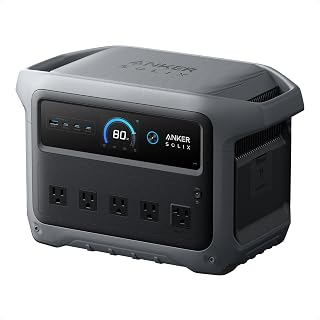
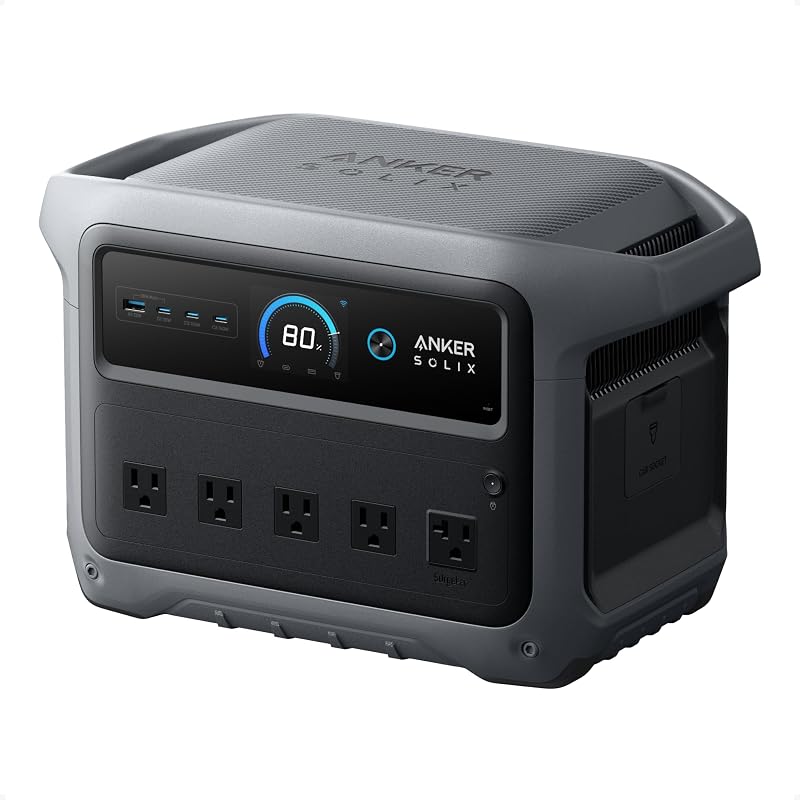
Fast turnaround is the central advantage of the SOLIX C1000 Gen 2 for campers who may return home to an outage. The 1,024Wh capacity and 2,000W continuous output give it more scope than a compact device charger, while its 15.1 by 8.2 by 9.6 inch footprint and 11.3 kg weight keep it manageable for one person over short distances. Solid handles and a metal-frame housing with durable plastic casing further support shuttling it between a vehicle, tent area, and home. At a wall outlet, HyperFlash accepts 1,600W input and is rated for a complete recharge in 49 minutes. Off-grid replenishment is also part of the appeal: it supports up to 600W solar input and can recharge fully in 1.8 hours under optimal conditions. Its nine outlets provide room for a mix of camping and household devices. For backup duty, the 10ms UPS switchover is relevant for equipment that cannot tolerate an interruption. The LiFePO4 battery is rated to retain at least 80% capacity after 4,000 cycles, making repeated use more practical.
Choose the C1000 Gen 2 if you want a comparatively compact station for car camping, charging multiple devices, and maintaining a more interruption-sensitive item when utility power fails. It is especially appropriate for people who value quick wall recharging and have a solar setup that can use its 600W input. Skip it if one-person carrying means long walks rather than short moves, or if your needs exceed its 1,024Wh capacity. It is portable, but it is not a pocket-size battery.
Capacity: 1,024Wh LiFePO4 battery
Output: 2,000W continuous, 3,000W peak
Ports: 10 total outputs
Wall Recharge: 1,600W input, 49 minutes to full
Solar Input: Up to 600W at 60V maximum, 1.8 hours to full
UPS Switchover: 10 milliseconds
Dimensions: 15.1L x 8.2W x 9.6H inches
Weight: 11.3 kg (24.9 lbs)
Battery Cycles: 4,000+ cycles with minimum 80% retention
Warranty: 5 years
Colors Available: Gray
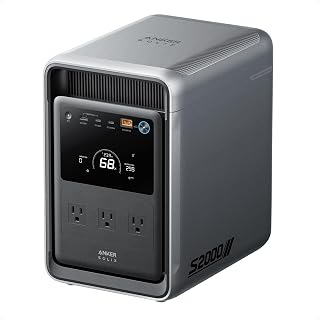
This 2010Wh station offers enough runtime to keep essential home systems online during multi-hour outages, while the lightweight and portable design noted in its features means you can still move it to a campsite or vehicle. The 1500W output covers refrigerators, medical devices, and communication equipment. Its explicit rating for power outages and emergencies makes it a direct fit for backup duty.
Pros
- 2,010Wh capacity
- 35-hour refrigerator runtime rating
- Six recharge methods
- 10,000-cycle LFP battery rating
Cons
- No 12V DC port
- 35.7-pound weight
When an outage lasts beyond a night, capacity becomes more important than the smallest possible package. The SOLIX S2000 brings 2,010Wh to a camping-and-backup role, paired with 1,500W running output and 3,000W starting wattage. That combination is aimed at essential appliances and campsite equipment that need more reserve than a small battery can supply. Despite the larger capacity, it weighs 35.7 pounds and measures 8.2 by 11.1 by 12.7 inches, so it is described as 30% smaller and 25% lighter than comparable 2kWh competitors. Its 6W idle draw is a particular advantage for backup planning. Anker rates it for a 35-hour refrigerator runtime, 20% longer than other systems in its class. Eight outlets across the front and rear help separate connected gear. Recharging can use six methods, including 400W solar input, AC, generator input, and a car outlet. A sub-10ms UPS switchover supports sensitive connected equipment during grid transitions. Its LFP battery is rated for 10,000 charge cycles and a 15-year lifespan. The tradeoff for RV-oriented users is no 12V DC port.
Capacity and Output: 2,010Wh LiFePO4 battery, 1,500W continuous output, 3,000W peak output
Battery Technology: 314Ah LFP cells, 10,000 cycle lifespan, 15-year warranty
Dimensions: 8.19L x 11.1W x 12.7H inches
Weight: 35.7 pounds
Outlets: 8 total (front and rear configuration)
Charging Options: AC input, solar (up to 400W), generator, car outlet, alternator charger
UPS Switchover: Less than 10 milliseconds
Idle Power Draw: 6W
Color: Black
Model: AS220
Warranty: 5 years
Buy the S2000 if camping trips and home outages call for a substantial 2,010Wh reserve, especially if keeping a refrigerator going is part of the backup plan. It also fits buyers who value a low idle draw, flexible recharging, and a UPS function for connected sensitive equipment. Skip it if a 12V DC port is essential for your RV setup or specialized gear. At 35.7 pounds, it is also less suited to anyone who must carry the station long distances repeatedly.

This 292Wh unit delivers a practical balance for weekend camping trips and brief outages. The 4-hour recharge time means you can top it up quickly between uses, and the compact form factor makes it easy to stow in a trunk or closet. With 300W output and multiple current options including 2.4A USB, it handles phones, laptops, and small appliances without the bulk of larger stations.
Pros
- 292Wh capacity in a 7.5-pound package
- Powers up to six devices at once
- 100W USB-C PD and two AC outlets
- LiFePO4 battery rated for 4,000+ cycles
Cons
- 300W output is unsuitable for major appliances
- 292Wh capacity limits extended backup runtime
Small power stations earn their place when they can move easily from a campsite to an outage kit, and the Explorer 300 is built around that role. Its 292Wh capacity and 7.5-pound weight keep it focused on modest but useful jobs: charging phones, tablets, cameras, drones, and laptops rather than attempting to support an entire household. The 300W rated output, with a 600W peak for brief spikes, likewise suits electronics and small devices, not refrigerators, air conditioners, or high-wattage tools. For a shared tent or a short blackout, its connection mix is the practical advantage. Two AC outlets, two USB-A ports, a 100W USB-C PD port, and a 120W car port can supply up to six devices at once. A digital display reports remaining capacity, while the integrated handle helps it travel. Full AC charging takes about three to four hours. Its LiFePO4 battery is rated for more than 4,000 cycles before reaching 70% capacity, supporting regular use over many camping seasons and backup events. It is a compact reserve for personal essentials, not a replacement for larger home backup equipment.
Buy the Explorer 300 if your camping setup centers on phones, camera gear, a drone, tablets, or a laptop, and you also want a lightweight unit ready for short emergency use. The 7.5-pound form and six-device output capacity favor car campers, weekend travelers, and households that prioritize communication and personal electronics. Skip it if your backup plan must run a refrigerator, air conditioner, high-wattage tools, or other demanding appliances. It is also not the right capacity for extended household power without recharging.
Capacity: 292Wh (LiFePO4 battery)
Weight: 7.1-7.5 lbs
Dimensions: 15.43in D x 9.92in W x 11.89in H
AC Output: 2 outlets, 110V, 300W continuous (600W peak surge)
USB Ports: USB-C PD 100W, USB-A 2.4A (x2)
Car Port: 120W 12V output
Charging Time: Approximately 4 hours AC, 2.8 hours with 100W solar panel
Battery Cycles: 4,000+ before reaching 70% capacity
Warranty: 2 year manufacturer
Model: JE-300E

Pros
- Compact 2.8kg build that is genuinely portable, not just car-bound
- Seven ports let you charge multiple devices at once
- Fast recharge to 80% in about an hour via USB-C or solar
- Car socket adds flexibility for road trips and vehicle accessories
Cons
- 288Wh capacity limits use with power-hungry appliances
- No shoulder strap included for carrying
When you're packing for a campsite or prepping a backup kit for outages, size and weight matter as much as power. The SOLIX C300 DC earns its spot on this list because it strikes a real balance between the two. At 2.8kg with a compact footprint, it slips into a camping pack or a car trunk without eating up space, yet it still delivers 300W of sustained output across seven ports, enough for laptops, phones, tablets, cameras, and small devices during a weekend trip or an unexpected power outage at home. The dual 140W USB-C ports mean fast top ups between hikes or before bed, and recharging to 80% in about an hour via USB-C or solar keeps downtime short when you need power back quickly. A built-in car socket adds flexibility for road trips, letting you run accessories straight from the station. For campers and backup-power shoppers who want something they will actually carry rather than leave in the car, this is a strong fit.
Battery and Power: 288Wh capacity, 300W sustained output, LiFePO4 battery chemistry with 3-year limited warranty. Recharge time: 1.5 hours to full via dual USB-C fast charging.
Ports and Connectivity: 7 total outlets including 1x car socket (120W), 2x USB-C (140W each), 1x USB-C (100W), 1x USB-C (15W), and 2x USB-A (12W each). Includes 60cm 140W USB-C to USB-C charging cable.
Physical Specifications: Weight 2.8kg (6.2 lbs), dimensions 4.89 inches length by 7.87 inches width by 4.72 inches thickness. Battery weight: 1,740g. 30% smaller footprint than competing midrange power stations.
Compatibility: Compatible with 100W or 60W Anker solar panels for sustainable charging. Not compatible with Anker SOLIX PS30, PS200, or PS400 solar panels.
Good for campers, weekend road trippers, and anyone building a compact backup kit for short outages who prioritizes portability and fast recharging. Also suits remote workers who need to keep a laptop and phone running away from outlets. Skip it if you need to power space heaters, air compressors, or other high-draw appliances, or if you want multi-day backup capacity for a whole household during extended outages.

The 288Wh capacity keeps this station light enough for backpacking or car camping, while the 600W output punches above its size class for running small heaters, fans, or cooking appliances. LFP chemistry improves safety and longevity for long-term storage between emergencies. Multiple recharge options including car and generator ensure you can refuel no matter where you are.
Pros
- 600W continuous output
- 1,500W Power Lifting Mode
- Stated 10ms UPS switchover
- Reaches 80% in 45 minutes with a 380W adapter
Cons
- 288Wh capacity limits runtime on demanding loads
- No verified customer reviews are available
The Elite 30 V2 takes a more output-oriented approach to the small-station category. Its 288Wh battery remains compact enough for a campsite, road trip, or emergency shelf, while the 600W continuous output gives it more headroom than a typical 300W unit. Power Lifting Mode raises available power to 1,500W for appliances such as kettles, toasters, and small microwaves. Capacity still sets the boundary: a 288Wh station is best viewed as a short-duration source, especially when powering energy-hungry equipment. For backup duty, the stated 10ms UPS switch is particularly relevant for routers, laptops, and CPAP machines during a sudden blackout. Nine outlets and a 140W PD fast-charging capability give a group several ways to keep essential devices connected. Recharging flexibility also matters away from a wall outlet, with eight charging modes and support for AC, solar, car, lead-acid battery, and generator power. It can reach 80% in 45 minutes using a 380W wall adapter. At 9.4 pounds, it is portable enough to transfer from the car to camp, but it is primarily a compact electronics and intermittent-appliance solution, rather than a long-running household power reserve.
Power Output: 600W continuous, 1500W surge (Power Lifting Mode)
Capacity: 288Wh with LFP battery chemistry
Charging Speed: 0-80% in 45 minutes via 380W AC adapter, 0-100% in 70 minutes
Charging Modes: 8 modes including AC wall (380W/200W adjustable), solar input, car charging, and generator compatible
UPS Response: 10ms ultra-fast switch for critical device protection
Outlets: 9 total ports including AC, USB-C with 140W PD fast charging, and DC outputs
Weight: 9.5 lbs (9.4 lbs stated in marketing)
Dimensions: 9.8 inches long by 7 inches wide by 6.6 inches high
Standby Power Draw: 4.5W AC mode, 5W DC mode, 8W standby
Warranty: 60 months manufacturer coverage
Battery Technology: UltraCell LFP with enhanced thermal management
Recommended Uses: Camping, road trips, emergency home backup, outdoor recreation, and event power
Choose the Elite 30 V2 if you need a compact station that can cover campsite electronics and provide fast switchover support for a router, laptop, or CPAP during an outage. Its 600W output, nine outlets, and flexible charging methods suit people who value connection options and occasional use of higher-draw appliances. Skip it if your priority is extended runtime for continuous high-power loads. The 288Wh capacity is limited, regardless of the 1,500W Power Lifting Mode.

The LiFePO4 chemistry gives this 256Wh station a longer cycle life than standard lithium-ion, ideal for campers who recharge frequently or keep a unit on standby for emergencies. At 300W output, it covers essentials like LED lighting, portable fridges, and CPAP machines. Solar compatibility makes it practical for extended off-grid trips where wall outlets aren't available.
Pros
- Light 6.4-pound design
- LiFePO4 battery rated for 3,000 cycles
- 60W USB-C PD and six output ports
- Three-level LED light with SOS mode
Cons
- 256Wh capacity limits longer backup use
- No verified customer reviews are available
For campers and households building a modest outage kit, the ALLWEI 300W is designed around essential power rather than large-appliance backup. The 256Wh LiFePO4 battery and 300W pure sine wave inverter make it appropriate for electronics such as laptops, drones, and CPAP machines, with 600W peak output for short surges. It can also run a mini fridge, though its modest capacity means runtime will depend strongly on the load and could require recharging during longer trips or interruptions. Portability is a core reason it fits this category. At 6.4 pounds and with pocket-sized dimensions, it is easier to pack for camping or relocate when the power goes out. Its six output ports include 60W USB-C PD, dual USB connections, and an AC outlet, allowing essential gear to charge together. A three-level LED light with an SOS mode adds campsite and blackout utility. Recharging through AC, a car, or solar power with MPPT optimization gives it ways to refill between uses. The battery is rated for 3,000 charge-discharge cycles, while the BMS has six layers of safety checks. This is a portable essentials station, not a high-capacity household solution.
Power Output: 300W continuous, 600W peak surge with pure sine wave
Battery: 256Wh LiFePO4 with 3000 charge-discharge cycles
Voltage: 120V AC at 60Hz
Output Ports: 1x AC outlet, 1x USB-C PD 60W, 1x USB-A 18W fast charge, 2x DC5521, 1x car lighter socket
Charging Time: 3.5-4 hours AC or car charging, 4-5 hours solar (100W panel), 2-2.5 hours dual charging
Weight: 6.4 lbs
Dimensions: 9.25x5x6.8 inches
Runtime: 1500 hours
Warranty: 5-year manufacturer coverage
Buy the ALLWEI 300W if you want a light, small station for a tent, car campsite, or home emergency kit focused on personal electronics, a CPAP machine, drone equipment, and a mini fridge. The LED light and SOS mode are useful additions when lighting is needed away from the grid. Skip it if you need prolonged power for demanding appliances or a large home-backup reserve. Its 256Wh capacity will call for recharging as loads or outage duration increase.
Pros
- Exceptional charging speed reaches 80% capacity in 1.3 hours, fastest in its class
- Multiple high-output USB-C ports eliminate need for separate chargers on trips
- Durable LFP battery maintains performance over thousands of charge cycles
- Lightweight and portable design without sacrificing meaningful power output
- Solar compatible with up to 100W input for off-grid sustainability
Cons
- Shoulder strap sold separately, adding to total cost for convenient carrying
- Limited solar panel compatibility, incompatible with some Anker SOLIX models
- 192Wh capacity may not sustain power-hungry devices for extended periods
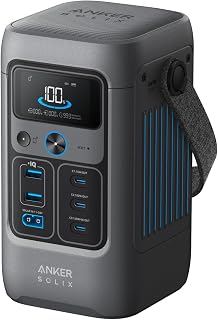
The Anker SOLIX C200 DC is a portable power station designed for outdoor enthusiasts, remote workers, and travelers who need reliable backup power without excessive weight. With 192Wh capacity and 200W output, it sits in the sweet spot between portability and real-world utility, capable of charging laptops, tablets, drones, and camping equipment multiple times over.
Its standout feature is the 1.3-hour charge time to 80%, powered by a 140W USB-C PD 3.1 port that's genuinely fast compared to competitors. The station includes five charging ports total, allowing you to charge multiple devices simultaneously. The dual high-output USB-C ports (100W and 140W) mean you won't be juggling cables or choosing between devices, a practical advantage for real travel scenarios.
Build quality reflects Anker's reputation, with LFP lithium-phosphate battery technology that survives 3,000 charge cycles, roughly five years of daily use. The compact form factor at just 1.9 kg and 39% smaller footprint than similar stations makes it genuinely portable, with a rubberized design that suggests durability. The included USB-C cable is a nice touch, though the shoulder strap requires a separate purchase, which feels like a missed opportunity.
The main limitations center on capacity and solar compatibility. The 192Wh battery won't power a full day of heavy laptop use or run power-hungry tools for extended periods. Solar recharging is limited to 100W input and incompatible with certain Anker solar panels, requiring careful model matching if you plan off-grid charging.
Verdict: The SOLIX C200 DC is a solid choice for camping trips, weekend travel, and emergency backup, with standout charging speed and practical multi-port design. It's not a workhorse for continuous high-power use, but at its price point, it delivers excellent value and reliability for occasional outdoor power needs.
Power Capacity: 192Wh (60,000 mAh) with 200W continuous output
Charging Ports: 1x USB-C 140W, 1x USB-C 100W, 1x USB-C 15W, 2x USB-A 12W (5 ports total)
Recharge Speed: 80% in 1.3 hours via 140W USB-C, 1.7 hours full charge
Solar Input: Up to 100W compatible with Anker 100W and 60W solar panels
Battery Type: Lithium Iron Phosphate (LFP) with 3,000-cycle lifespan
Dimensions: 3.94in L x 7.28in W x 4.33in H
Weight: 1.9 kg (4.2 lbs)
Warranty: 3 years manufacturer coverage
Model: A1727
Best For: Campers, hikers, van lifers, digital nomads, and anyone needing portable backup power. Ideal for charging laptops, phones, tablets, and camping electronics during day trips or weekend adventures.
Who Should Skip: Users requiring continuous high-power output for power tools, large refrigerators, or full-day laptop work. Those needing 500Wh+ capacity should consider larger Anker models.
Solar Setup Tips: This unit pairs well with Anker 100W or 60W solar panels for true off-grid capability. Check compatibility before purchasing additional solar equipment, as some Anker solar panels are not compatible.
Accessory Note: The shoulder strap is sold separately. We recommend purchasing it if portability is important, as the carry handle alone isn't ergonomic for extended periods.
Real-World Performance: Expect multiple full phone charges, 1-2 laptop charges depending on model, or 4-6 hours of CPAP machine runtime. Perfect for a weekend away, not suitable as a primary home backup for extended outages.

Pros
- Exceptionally portable and lightweight for a true power station, with genuine AC outlet capability
- Fast 70-minute AC recharge from empty makes it practical for emergency use at home or on the go
- UPS functionality with 350W bypass output provides meaningful protection beyond standard power banks
- Excellent value compared to larger generators, with strong 4.3-star rating from over 1,200 verified buyers
- Multiple charging options including solar compatibility gives you flexibility in any environment
Cons
- 128Wh capacity limits runtime to roughly 2 hours at full 200W draw, requiring frequent recharges for extended use
- No expandable battery options or stacking capability if you need more capacity later
- Solar charging maxes out at 100W, meaning slower recharge times unless paired with larger BLUETTI panels
The BLUETTI Elite 10 is a bridge between standard power banks and full-sized portable power stations. With 128Wh capacity and genuine 200W AC output, it's designed for professionals, travelers, and outdoor enthusiasts who need real backup power without the bulk. This is the device to choose if you want something that fits in a backpack but actually powers laptops and cameras, not just phones.
What truly sets the Elite 10 apart is its combination of features typically found in much larger units. The 10ms UPS backup with 350W bypass output keeps your laptop and Wi-Fi router running seamlessly during outages, protecting against data loss and disconnections. The 200W AC outlet pairs with 100W USB-C charging to handle multiple devices simultaneously. Triple charging options, including 150W AC recharge in just 70 minutes, mean you're never stuck waiting for power in a real emergency.
The design philosophy here is practical minimalism. At just 4 pounds with an ergonomic handle, this fits genuinely into travel packs and bags. The TSA-friendly capacity falls within airline carry-on limits for most major carriers. Build quality reflects BLUETTI's reputation, with a durable LiFePO4 battery rated for 3000+ cycles and comprehensive BMS protection against overcharge and thermal issues.
The main limitation is capacity. Two hours of runtime at full 200W draw means this won't power a desktop setup all day, and extended camping trips will require careful power management or solar panels. The LED lighting modes and Bluetooth app are thoughtful additions, but ultimately secondary to core backup functionality. For what it is, the Elite 10 delivers dependable performance.
The BLUETTI Elite 10 is the right choice if you need trustworthy AC power in a genuinely portable package. It's not a replacement for larger generators on extended trips, but as emergency backup at home or reliable travel power, it delivers real value and genuine peace of mind.
Choose the Elite 10 if you travel frequently, work from coffee shops or co-working spaces, or want lightweight emergency backup for your home. It's particularly suited for digital nomads, outdoor photographers, and professionals who depend on laptops staying powered during outages.
Consider a larger BLUETTI model if you need to run power tools, multiple appliances simultaneously, or power devices for more than a few hours. If you're planning extended off-grid camping, pair the Elite 10 with BLUETTI's 60W or 100W solar panels to extend runtime indefinitely.
The Elite 10 pairs exceptionally well with laptops rated under 100W, mirrorless cameras, drones, Wi-Fi equipment, and gaming consoles. Keep in mind that high-wattage devices like hair dryers or electric kettles will drain the battery quickly, so plan accordingly for your specific use case.

At just 2.3 pounds, this is the lightest option here and slots into a backpack without penalty. The 120W continuous output (240W peak) suits ultralight campers charging phones, headlamps, and cameras rather than running appliances. For minimalist trips or as a personal backup for communication devices during brief outages, the weight advantage is decisive.
Pros
- 2.3-pound portable design
- Eight output ports for device charging
- Three recharge options: AC, solar, or car
- Steady, flash, and SOS lighting
Cons
- 88Wh capacity is limited for extended use
- 120W output will not suit power-hungry gear
For camping and short household interruptions, the HOWEASY 88Wh power station prioritizes grab-and-go size over running large equipment. At 2.3 pounds, it is easy to reserve for a campsite electronics kit or keep available when the lights go out. Its 120W output, with 240W peak capacity, is intended for lower-draw gear: phones, tablets, cameras, and most USB devices rather than power tools or other demanding appliances. The port selection makes this small unit more useful than a basic battery bank. It has two AC sockets, an 18W USB-C fast-charging port, two QC 3.0 ports, a standard USB port, and DC outputs, for charging several compatible devices at once. An LED display shows power status, while independent AC and DC buttons simplify managing the outputs. For a tent or an outage, its integrated light offers steady, flashing, and SOS modes. Recharging can come from an AC wall outlet, a compatible solar panel, or 12V/24V vehicle power. The panel is not included, and the modest capacity suits brief trips and essential-device backup best.
Power Capacity: 88Wh rechargeable battery with 1500+ cycle life
Output Power: 120W continuous, 240W peak
AC Output: 2 ports at 110V
USB Ports: 1 USB-C (18W), 2 QC 3.0, 1 standard USB (5V 2.4A)
DC Ports: 2 ports (12V/10A)
Dimensions: 6.6 x 4 x 3 inches
Weight: 2.3 pounds
Charging: AC outlet (adapter included), solar compatible (15V-24V, panel not included), 12V/24V car charger (included)
Features: LED display, emergency lighting with SOS mode, simultaneous charging support
Warranty: 24 months with 24/7 customer support
Buy this HOWEASY model if your camping power list centers on phones, cameras, tablets, and USB accessories, and you want a very light station that can also cover basic devices during a short outage. It is especially sensible for people who value multiple port types, vehicle charging, and the built-in emergency light. Skip it if your backup plan requires runtimes, a solar panel in the box, or support for high-demand equipment. Its 88Wh capacity and 120W continuous output are better matched to essentials than to full-size laptops or power tools.
Buying Guide: What Matters in a Small Power Station
Match Battery Capacity to Your Actual Runtime Needs
Watt-hours, shown as Wh, indicate the amount of energy stored in the station. Divide the battery capacity by your device’s power draw for a rough runtime, then allow extra room for conversion losses when you use AC outlets.
A 128Wh unit such as the BLUETTI Elite 10 Mini suits phones, cameras, and a laptop top-up, while 250Wh to 300Wh models offer more flexibility for a full evening away. If you travel with a reliable external hard drive for backup, choose enough capacity to run both your computer and drive without draining the station too quickly.
Check Continuous Wattage, Not Just Peak Output
Battery capacity determines duration, but output wattage determines what you can plug in. A 200W or 300W station handles personal electronics, lights, cameras, and many compact appliances, while a 600W model such as the BLUETTI Elite 30 V2 gives you more headroom for a CPAP machine, car fridge, or small kitchen device.
Appliances with compressors and heating elements can demand a brief startup surge, so read the label before connecting them. The Anker SOLIX C200 DC and C300 DC are particularly handy for USB-C-centered gear, but their DC-focused designs are not substitutes for an AC outlet when you need to power equipment in a home NAS storage setup.
Consider Recharging Speed and Solar Flexibility
Fast wall charging matters when an outage is approaching or your next departure is close. The Anker SOLIX C1000 Gen 2 can reach a full charge in 49 minutes with its app-enabled HyperFlash mode, while the Jackery Explorer 1000 v2 offers an emergency charging mode that can fill the battery in about an hour.
For longer trips, look at solar input limits and panel compatibility before buying a panel. The Anker SOLIX C1000 Gen 2 supports up to 600W of solar input, whereas the compact Anker C200 DC and C300 DC support up to 100W, a more sensible match for lightweight travel. This planning is especially useful when you are managing a large 8TB hard drive archive away from a wall outlet.
Balance Carry Weight, Ports, and Long-Term Battery Design
Small means different things depending on your trip. The BLUETTI Elite 10 Mini weighs about four pounds, the ALLWEI 300W weighs 6.4 pounds, and the Jackery Explorer 300 weighs 7.5 pounds, so each is realistic for a car, tent, or short walk from the trailhead.
LiFePO4 batteries are a strong choice for regular use because they support thousands of charge cycles. Also consider port selection: USB-C PD is valuable for modern laptops, multiple AC outlets help with traditional plugs, and a 10 ms UPS function can protect always-on desk gear. A portable station can also support an external SSD for gaming when you need a compact travel setup.
Final Thoughts
The Jackery Explorer 300 Portable Power Station,292Wh is a practical choice when you want a light, AC-equipped companion for camping and everyday devices. For longer home backup, higher-demand appliances, and fast recharge capability, the Anker SOLIX C1000 Gen 2 Portable Power Station brings substantially more capacity and output without becoming difficult to move.
Frequently Asked Questions
What size small power station do I need for camping?
For phones, headlamps, cameras, and occasional laptop charging, 88Wh to 192Wh can be enough for a short trip. Choose roughly 250Wh to 300Wh if you also want to run a car fridge, CPAP machine, or several devices at once. A 1,000Wh-class model makes more sense for multi-day trips with larger appliances or several people sharing the battery.
Can a small power station run a mini fridge?
Many can, provided the fridge’s running watts and startup surge stay below the station’s output rating. A 300W unit may work with an efficient compact fridge, but runtime depends heavily on ambient temperature and how often the compressor cycles. For reliable overnight cooling, a larger battery such as a 1,000Wh or 2,000Wh unit gives you a more comfortable margin.
Is a LiFePO4 power station worth choosing in 2026?
LiFePO4 chemistry is a smart choice if you expect to recharge your station frequently over several years. Many models in this guide are rated for 3,000 to 10,000 cycles, which can support regular camping, emergency readiness, and home-office use. Store the unit in a dry, moderate-temperature location and recharge it periodically when it is not in use.
Can a portable power station work as a UPS for my desk?
Models with a 10 ms UPS switchover can keep compatible laptops, routers, and other low-draw electronics running through a brief outage. Confirm both the continuous load and the station’s UPS specifications before depending on it for sensitive equipment. If your workspace includes a high-refresh display, include the listed draw of your 500Hz gaming monitor when calculating total demand.




Write Your Review
No reviews yet. Be the first to share your experience!