

You’re building a new AMD Ryzen gaming rig and facing a critical decision: should you invest in an X670 motherboard or save some budget with B650? Both chipsets support the latest Ryzen 9000 and 7000 series processors, but they differ in PCIe lane allocation, connectivity options, and overclocking headroom.
This guide breaks down the real-world differences between these chipsets for gaming workloads. We’ve evaluated power delivery systems, storage configurations, and networking capabilities across ten motherboards to show you which platform delivers the performance you need without unnecessary features driving up costs.
Quick answer
This guide compares 10 picks, with GIGABYTE B650 Eagle AX AM5 Motherboard with DDR5, PCIe ranked first. GIGABYTE B650 AORUS Elite AX AM5 Motherboard - PCIe has the most customer reviews.
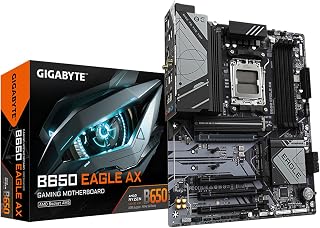
With DDR5 support up to 5200 MHz and a triple M.2 configuration that pairs a PCIe 5.0 slot with two PCIe 4.0 slots, this board gives AM5 gamers meaningful storage flexibility without forcing a chipset upgrade. The USB 3.2 Gen 2x2 Type-C port is a practical bonus for anyone connecting high-speed peripherals or capture devices alongside their gaming rig.
Pros
- Triple M.2 slots with one PCIe 5.0 and two PCIe 4.0 for current and future storage
- 12+2+2 phase VRM supports sustained gaming workloads across Ryzen 7000-9000 CPUs
- WiFi 6E and dual Gigabit Ethernet cover wired and wireless gaming setups
- Q-Flash Plus enables BIOS recovery without a CPU installed
Cons
- B650 chipset lacks a handful of niche features found on X670 and X870 platforms
- WiFi antenna placement and network throughput can vary depending on case and environment
For gamers weighing B650 against X670, the GIGABYTE B650 Eagle AX makes a strong case that the mainstream chipset covers everything most gaming builds actually need. Supporting Ryzen 7000, 8000, and 9000 series processors on the AM5 platform, it pairs DDR5 memory up to 128 GB and 5200 MHz with AMD EXPO for stable, fast memory operation in game-heavy workloads. The triple M.2 configuration is a genuine highlight: one PCIe 5.0 slot positions the board for next-generation storage, while two PCIe 4.0 slots handle current-generation drives without bottlenecking. A 12+2+2 phase VRM gives mid-to-high-end Ryzen CPUs clean, consistent power delivery during sustained gaming sessions. USB 3.2 Gen2x2 Type-C, dual Gigabit Ethernet, and WiFi 6E round out a connectivity package that matches or exceeds what many X670 boards offered at launch. Q-Flash Plus adds practical insurance against a failed BIOS update, a real convenience when updating firmware to support newer Ryzen generations. For gaming specifically, the B650 chipset gap versus X670 rarely surfaces in practice.
Socket and Compatibility: Socket AM5, supports AMD Ryzen 7000/8000/9000 series processors. Fully backward compatible with prior generation Ryzen chips on supported BIOS versions.
Memory and Storage: 4 DDR5 DIMM slots, maximum 128GB capacity, 5200MHz support with AMD EXPO profile compatibility. Triple M.2 slots: 1x PCIe 5.0 NVMe, 2x PCIe 4.0 NVMe for total of 3 fast storage drives.
Power Delivery: 12+2+2 phase digital VRM solution with advanced thermal design. 24-pin main power connector supports stable operation under overclocking and heavy workloads.
Connectivity: 4x SATA 3 ports, USB 3.2 Gen2x2 Type-C, 6x USB 3.2 Gen1 Type-A, 4x USB 2.0. Dual Gigabit Ethernet (2 ports) with WiFi 6E module. 1x HDMI display output with integrated audio I/O.
Form Factor and Physical: Standard ATX layout with 4 PCIe expansion slots. Includes Q-Flash Plus utility for BIOS recovery and Smart Fan 6 for custom thermal profiles.
Gamers building a Ryzen 7000, 8000, or 9000 system who want PCIe 5.0 storage readiness, solid WiFi 6E, and room to expand without moving to X670 will find everything they need here. It also suits builders who run dual-monitor or streaming setups alongside gaming thanks to dual Ethernet and ample USB options. Skip it if you specifically need features exclusive to X670 or X870 chipsets, such as full PCIe 5.0 across multiple slots.

Pros
- Handles Ryzen 9 CPUs reliably with 12+2+1 power phases and dual 8-pin connectors
- WiFi 6E and 2.5Gbps LAN for fast wireless and wired gaming
- DDR5 support up to 7200+ MHz with good thermal management
- PCIe 4.0 and M.2 Shield Frozr keep storage performance strong
Cons
- Only two DIMM slots limit memory expansion to 256GB
- Single PCIe x16 slot restricts multi-GPU configurations
For builders choosing B650, the MSI Gaming Plus WiFi represents the chipset at its best. This board gives you everything the B650 standard offers without leaving performance on the table: full Ryzen 7000/8000/9000 compatibility, DDR5 certified to 7200+ MHz, PCIe 4.0 lanes for your GPU and Lightning Gen 4 M.2 slots for fast storage. The 12+2+1 phase power system with dual 8-pin connectors handles even Ryzen 9 processors reliably, and the extended heatsink design with MOSFET thermal pads keeps things stable under gaming loads. WiFi 6E and 2.5Gbps Ethernet deliver excellent connectivity for online play. Build quality feels solid and the layout is sensible. The two DIMM slots limit total capacity to 256GB, but that's rarely a concern for gaming-focused rigs. If you're not chasing PCIe 5.0 for future-proofing or planning extreme memory configurations, this board captures the B650 value proposition perfectly: modern platform features, reliable power delivery, and strong wireless capability without the premium markup.
Buy this if you're building a Ryzen 7 or 9 gaming system on B650 and want WiFi 6E plus strong connectivity without spending for features you won't use. The dual 8-pin power delivery and quality thermals make it suitable even for higher-tier CPUs. Skip it if you need more than two memory sticks for capacity expansion, plan a multi-GPU setup, or want PCIe 5.0 storage readiness for the long haul.

For gamers debating whether B650 can keep pace with X670, the 6400 MHz DDR5 memory support here makes a strong case: that headroom lets Ryzen 7000 and 9000 series CPUs hit memory-sensitive frame rate targets that tighter platforms cannot reach. The 12+2 power stages and three M.2 slots round out a build that punches well above the B650 entry tier.
Pros
- PCIe 5.0 M.2 plus two PCIe 4.0 slots cover current and future storage needs
- 12+2 power delivery with effective VRM cooling handles gaming CPUs reliably
- WiFi 6E and abundant USB ports eliminate connectivity compromises
- Solid construction and clear labeling simplify builds
Cons
- BIOS flash required before first boot with newer Ryzen chips
- LAN controller may need manual driver updates
For B650 versus X670 gaming in 2026, the ASUS ROG Strix B650-A Gaming WiFi delivers everything most gamers need without the X670 premium. The 12+2 power stage design handles Ryzen 7000, 8000, and 9000 series processors with confidence, keeping voltage stable during intense gaming sessions. Three M.2 slots, including one PCIe 5.0 compatible, give you storage flexibility that rivals X670 boards at a lower cost. WiFi 6E eliminates the need for ethernet cables while maintaining competitive latency in online matches. The VRM cooling is effective enough for sustained gaming workloads, and four SATA ports accommodate legacy drives without forcing you onto expensive NVMe-only setups. USB 3.2 Gen 2x2 Type-C provides fast external storage connectivity for recording gameplay or moving large files. ROG branding brings solid construction and Aura Sync RGB compatibility across ASUS peripherals. The board supports DDR5 up to 6400 MHz, letting you take advantage of modern memory without chasing diminishing returns from extreme speeds. BIOS flashing is required for newer Ryzen chips, and some LAN controller quirks may need driver attention, but once configured, this board runs reliably.
Socket and Compatibility: AM5 socket supports AMD Ryzen 9000, 8000, and 7000 series processors with BIOS update for newer generations. Supports up to 128GB DDR5 memory at speeds up to 6400 MHz across 4 DIMM slots.
Storage and Expansion: One PCIe 5.0 M.2 slot, two PCIe 4.0 M.2 slots, all with heatsinks. Includes 4 SATA 6Gb/s ports for traditional drives. Four PCIe slots total provide GPU and expansion card compatibility.
Power Delivery: 12+2 power stages with 8+4 pin ProCool connectors. Premium alloy chokes and durable capacitors ensure stable multi-core performance and overclocking headroom.
Connectivity: WiFi 6E, 2.5G LAN, 9 USB ports including USB 3.2 Gen 2x2 Type-C, 1 HDMI output, and optical S/PDIF. Comprehensive I/O covers gaming, streaming, and content creation needs.
Form Factor and Design: ATX motherboard with dimensions 10.8in L x 13.4in H. Massive VRM heatsinks with airflow channels and thermal pads maintain cool operating temperatures. Includes 3-year warranty from ASUS.
Buy this if you want B650 savings with features that close the gap to X670 for pure gaming, especially if you value WiFi 6E, multiple M.2 slots, and RGB ecosystem integration. Skip it if you lack patience for BIOS updates or need guaranteed plug-and-play compatibility with the latest Ryzen processors out of the box. Also pass if you're building a basic 1080p rig where cheaper B650 boards make more sense.

Pros
- Supports Ryzen 7000, 8000, and 9000 CPUs
- PCIe 5.0 x16 graphics slot
- WiFi 6E and 2.5G LAN
- Gen5 plus dual Gen4 M.2 storage
Cons
- Less expansion than higher-tier platforms
- 90-day warranty
For a gaming PC where the motherboard needs to support a current AM5 Ryzen chip and a fast graphics card, the B650 Steel Legend WiFi 6E focuses on core gaming hardware rather than making expansion the headline. It supports Ryzen 7000, 8000, and 9000 series processors, offers DDR5 overclocking up to 7200MHz, and uses a 14+2+1 power design with 80A Dr.MOS for stable CPU operation and overclocking headroom. The PCIe 5.0 x16 slot serves the graphics card, while one Gen5 M.2 socket and two Gen4 M.2 sockets provide a useful storage mix for a gaming library and a faster drive later on. It also covers both network preferences with 2.5G LAN and WiFi 6E. Nineteen USB ports leave room for a keyboard, mouse, headset, controllers, and other accessories. HDMI and DisplayPort are available for APU-based systems or troubleshooting. In a B650 versus X670 decision, this ATX board is a strong fit when its gaming-oriented connectivity and expansion are enough, rather than needing broader platform expansion.
Socket & Compatibility: AMD Socket AM5, supports Ryzen 9000/8000/7000 series processors, Windows 10/11
Memory: 4x DDR5 DIMM slots, supports up to 256GB, rated for 7200MHz (OC)
Storage: 4x SATA3 ports, 1x PCIe Gen5 x4 M.2 slot (Blazing), 2x PCIe Gen4 x4 M.2 slots (Hyper)
Expansion: 3 PCIe slots (1x Gen5 x16, 1x Gen3 x16, 1x Gen4 x1)
I/O Ports: 19 USB ports total (1x USB 3.2 Gen2x2 Type-C rear, 1x Gen1 Type-C front, 1x Gen2 Type-A rear, 8x Gen1 Type-A), 8x USB 2.0, 1x Gigabit Ethernet, Optical S/PDIF
Audio: Realtek ALC4082 7.1 channel codec with Nahimic audio
Connectivity: WiFi 6E 802.11axe, Bluetooth 5.3 capable, 2.5G Dragon LAN
Power: 24-pin main connector, 14+2+1 phase design with 80A Dr.MOS
Warranty: 90 days

Pros
- 8+2+1 phase VRM sustains stable power delivery during long gaming sessions
- Three PCIe 4.0 x4 M.2 slots support multiple high-speed NVMe drives
- WiFi 6E and 2.5GbE cover both fast wired and modern wireless gaming setups
- AMD EXPO DDR5 support pushes memory up to 5200 MHz
Cons
- No PCIe 5.0 lanes, so next-gen storage upgrades hit a ceiling
- Single 2.5GbE port limits multi-network or advanced wired configurations
For gamers deciding between B650 and X670, the GIGABYTE B650 Gaming X AX makes a strong case that the lower-tier chipset handles everything a gaming PC actually needs. The 8+2+1 phase digital VRM keeps Ryzen 7000, 8000, and 9000 series processors running stable under sustained gaming loads, which is the core concern for this use case. Three PCIe 4.0 x4 M.2 slots mean you can run a boot drive, a game library drive, and a spare without touching a single SATA port. DDR5 with AMD EXPO support lets you push memory speeds up to 5200 MHz, closing much of the practical performance gap between B650 and pricier X670 boards. WiFi 6E and 2.5GbE cover both competitive wired connections and flexible wireless setups. For pure gaming workloads, the features X670 adds over B650 rarely translate into higher framerates, and this board illustrates exactly why B650 remains the sensible chipset choice for most gaming builds in 2026.
Socket and Processor Support: AMD Socket AM5, compatible with Ryzen 9000, 8000, and 7000 series processors.
Memory: 4 DDR5 DIMM slots supporting up to 128GB, DDR5-5200 native speed with AMD EXPO and Intel XMP support.
Storage: 3 PCIe 4.0 x4 M.2 slots, 4 SATA 3 ports, including M.2 thermal guard for drive cooling.
Power Delivery: 8+2+1 phase digital VRM, 24-pin main connector for stable power to processor and memory.
Connectivity: WiFi 6E, 2.5GbE Ethernet, 1 USB 3.2 Gen 2x2 Type-C, 4 USB 3.2 Gen 1 Type-A, 4 USB 2.0 headers, 1 HDMI output, optical S/PDIF audio.
Additional: 5-year warranty with online registration, Q-Flash BIOS update, RGB Fusion lighting, EZ-Latch M.2 sockets, weighs 1.9kg.

Pros
- PCIe 5.0 support future-proofs GPU and storage upgrades
- 14+2+1 power delivery with excellent thermals for overclocking
- Four M.2 slots with thermal shielding for storage expansion
- DDR5 up to 7800+ MHz and strong connectivity suite
Cons
- May require BIOS flash for Ryzen 9000/8000 compatibility
- Some users reported early boot instability before updates
The MSI X670E Gaming Plus WiFi shows exactly why X670E costs more: PCIe 5.0 across GPU and storage lanes, stronger power delivery with a 14+2+1 Duet Rail system, and DDR5 support reaching 7800+ MHz. This board handles Ryzen 7000/8000/9000 CPUs with authority, staying under 62°C in gaming thanks to the extended heatsink and Frozr thermal design. Four M.2 slots with thermal shielding give you expansion room that B650 boards often lack. The dual 8-pin CPU connectors and robust VRM make overclocking viable if you want it. WiFi 6E, Bluetooth 5.3, 2.5Gbps Ethernet, and multiple USB 3.2 Gen 2 ports ensure connectivity won't limit you. Build quality is excellent with a thick PCB and clean black-and-silver design. Some users needed BIOS updates for Ryzen 9000 compatibility and a few reported early boot quirks, though most resolved these quickly. If you're considering X670E for gaming, this board delivers the chipset's headline features without flagship pricing.
Socket and CPU Support: Socket AM5 compatible with AMD Ryzen 7000, 8000, and 9000 series processors.
Memory: DDR5 support up to 7800+ MHz (overclocked), maximum 192GB across 4 DIMM slots, Frozr thermal design for stable performance.
Storage: 4 M.2 slots with Lightning Gen5 support, PCIe 5.0 connectivity, M.2 Shield Frozr thermal protection. 4 SATA 6Gb/s ports for legacy storage.
Power Delivery: 14+2+1 Duet Rail power system, dual 8-pin CPU power connectors, Core Boost and Memory Boost for enhanced stability.
Connectivity: Wi-Fi 6E, Bluetooth 5.3, 2.5Gbps LAN, 8 USB ports total (4 USB 2.0, USB 3.2 Gen 2x2), HDMI and DisplayPort video outputs.
Choose this if you want PCIe 5.0 readiness for future GPU and storage upgrades, need four M.2 slots for expansion, or plan to overclock a Ryzen 9 chip. The stronger power delivery and thermal design justify the X670E premium. Skip it if you're staying with PCIe 4.0 hardware and don't need the extra M.2 capacity, or if dealing with potential BIOS updates before first boot sounds frustrating.

Gamers who want a reliable AM5 foundation without overcomplicating their build will find the 14+2+1 power phase design here genuinely useful: it delivers stable VRM headroom for sustained Ryzen 9000 series loads during long gaming sessions. PCIe 5.0 M.2 support means NVMe storage bottlenecks stay out of the picture, and the onboard WiFi 6E keeps wireless latency competitive on modern routers.
Pros
- 14+2+1 power phases with 70A stages match X670-class voltage stability
- PCIe 5.0 M.2 and comprehensive thermal management prevent bottlenecks
- WiFi 6E and 2.5GbE provide flexible low-latency connectivity
- Q-Flash and solid build quality simplify setup and maintenance
Cons
- Only four SATA ports limit traditional storage expansion
- Single HDMI output restricts multi-monitor configurations
In the B650 versus X670 gaming debate, the GIGABYTE B650 AORUS Elite AX makes a strong case for saving money without sacrificing gaming performance. The 14+2+1 phase power system with 70A stages and 8-layer PCB provides stable voltage delivery that matches many X670 boards, ensuring your Ryzen CPU hits its boost clocks consistently during gaming. PCIe 5.0 M.2 support future-proofs your primary storage drive, while the thermal design with 6mm heatpipes prevents throttling during marathon sessions. DDR5 compatibility with AMD EXPO unlocks full memory performance without manual tuning. WiFi 6E gives you low-latency wireless connectivity that keeps up with wired connections in most gaming scenarios, and 2.5GbE ethernet is available when you want absolute consistency. The PCIe armor reinforces your graphics card slot, and M.2 thermal guards keep SSDs cool under load. Q-Flash simplifies BIOS updates, removing a common pain point with AM5 builds. Four DIMM slots accept up to 128GB of RAM, more than enough headroom for gaming plus streaming or background applications. USB 3.2 Gen 2 with front and rear USB-C covers modern peripherals and fast external drives.
Processor Support: AMD Socket AM5, compatible with Ryzen 7000, 8000, and 9000 series.
Memory: 4 DDR5 DIMM slots, up to 128GB maximum, 4400 MHz native speed, AMD EXPO and Intel XMP support.
Power Delivery: 14+2+1 power phases, 70A per stage, 8-layer 2X copper PCB.
Storage: 4 SATA III ports, 1 PCIe 5.0 NVMe M.2 slot, 1 PCIe 4.0 NVMe M.2 slot.
Connectivity: WiFi 6E, 2.5GbE ethernet, 12 USB ports (including USB 3.2 Gen 2 with front/rear USB-C), 1 HDMI output.
Expansion: 3 PCIe slots, comprehensive thermal armor.
Warranty: 5 years with online registration.
Ideal for gamers building with Ryzen 7000 or newer who want strong power delivery and modern features at B650 pricing, especially if WiFi 6E matters for your setup. Also great if you plan to upgrade RAM or add more storage over time. Skip this if you need more than four SATA ports for older drives, require multiple display outputs from integrated graphics, or want the absolute highest-end features that justify X670 boards.

Pros
- 16-stage power delivery handles Ryzen 9 CPUs with excellent stability
- PCIe 5.0, USB 4, and four M.2 slots for future expansion
- DDR5 EXPO II profiles work reliably at 6000 MT/s and higher
- Renewed pricing makes X670E features more accessible
Cons
- Renewed units may need BIOS updates or driver reinstalls
- Manual typically not included and delivery can be slower
This renewed ASUS TUF X670E-PLUS brings flagship X670E capability at a reduced cost, making it compelling if you're comfortable buying refurbished. The 16-stage power system confidently runs Ryzen 7 and 9 processors, and users report rock-solid stability with DDR5 at 6000 MT/s and beyond using AMD EXPO II profiles. PCIe 5.0 lanes cover both GPU and storage, four M.2 slots give you expansion room, and USB 4 future-proofs connectivity in ways B650 can't match. WiFi 6E and 2.5Gb LAN round out a strong feature set. The ASUS TUF build quality shows in the solid heatspreader design and overall durability. For gaming, this board gives you everything X670E offers: stronger power delivery than B650, more storage expansion, and PCIe 5.0 readiness. The renewed status means some units need driver reinstalls or BIOS updates out of the box, and manuals are typically missing. Delivery can be slower. If you're patient and can handle basic troubleshooting, this board performs identically to new units once configured.
Socket and CPU Support: Socket AM5 (LGA 1718), compatible with AMD Ryzen 7000 and Ryzen 9000 series processors
Memory: DDR5 support, up to 128GB, four DIMM slots, AMD EXPO II profiles
Storage: Four M.2 slots, six SATA 3 ports, PCIe 5.0 M.2 support
Connectivity: WiFi 6E, 2.5Gb LAN, USB 4, four USB 3.2 ports, optical S/PDIF output
Power Delivery: 16 power stages, 24-pin ATX main connector, 8-pin CPU power
Expansion: Four PCIe x16 slots (supports graphics cards and expansion cards)
Warranty: 90 days limited warranty on renewed unit
Buy this if you want X670E features like PCIe 5.0, strong power delivery, and four M.2 slots but budget constraints make new boards difficult. You should be comfortable flashing BIOS and reinstalling drivers if needed. Skip it if you value immediate plug-and-play reliability, need a manual included, or don't want to deal with potential early setup quirks that renewed units sometimes bring.
Pros
- Excellent power delivery with 12+2 power stages for stable, overclockable performance
- WiFi 6E and 2.5G LAN provide top-tier connectivity for gaming and streaming
- Full DDR5 and PCIe 4.0 support positions you for next-generation performance gains
- Multiple storage options with 3x M.2 slots accommodate high-speed NVMe drives
Cons
- Renewed condition means it may have cosmetic wear or come with limited documentation
- Low user ratings suggest potential reliability issues or customer satisfaction concerns
- 90-day limited warranty provides minimal coverage compared to new motherboards
The ASUS ROG Strix B650-A is a premium AM5 motherboard designed for enthusiasts building high-end Ryzen 7000 gaming rigs. With DDR5 and PCIe 4.0 support, this board positions your system for next-generation performance and longevity. The ROG STRIX branding signals a focus on gaming performance and premium build quality.
The standout features include robust 12+2 power stages for stable power delivery, WiFi 6E for ultra-fast wireless connectivity, and multiple M.2 slots for fast NVMe storage expansion. The 2.5G LAN port supports high-speed wired gaming. These specifications make it a solid choice for competitive gamers, streamers, and content creators who demand reliability and speed.
As a renewed product, this motherboard may show signs of previous use or repackaging. While ASUS motherboards are generally well-built, the low user ratings in this listing raise red flags about potential defects, missing components, or quality control issues with this specific unit. Be cautious and verify the exact condition before purchase.
The 90-day limited warranty offers basic protection but is considerably shorter than typical new product warranties. This timeframe may leave you exposed if issues develop after the initial testing period, making thorough inspection upon arrival critical.
The B650-A offers excellent specifications at a discounted renewed price, but the combination of renewed condition and low ratings suggests this is a higher-risk purchase. It's best suited for experienced builders who can evaluate the board thoroughly and have confidence in troubleshooting if needed.
This motherboard is ideal for budget-conscious PC enthusiasts building or upgrading a Ryzen 7000 gaming system who understand the renewed product market and are comfortable with potential risks. If you value DDR5 support, WiFi 6E, and premium features but need to save money, this option makes sense if the board arrives in acceptable condition.
Avoid this product if you prefer the peace of mind of a new motherboard with full warranty coverage, or if you're a first-time builder with limited troubleshooting experience. The low ratings suggest you should prioritize a new unit from a reputable seller in this case.
Socket and Compatibility: LGA 1718 (AM5) for AMD Ryzen 7000 series processors. Supports up to 128GB DDR5 memory across 4 DIMM slots.
Connectivity: WiFi 6E, 2.5G LAN, 6x USB ports total, USB 3.2 Gen 2x2 Type-C, 1x Ethernet port, and PCIe 4.0 graphics interface.
Storage: 3x M.2 slots for fast NVMe SSDs, 24-pin main power connector, 1x PCIe slot.
Warranty: 90-day limited warranty. UPC 657768426704, manufacturer part number 82RG0048GE-cr.
Pros
- Excellent connectivity package with Wi-Fi 6E, Bluetooth 5.3, and abundant USB 3.2 ports
- Robust DDR5 memory support with high overclocking potential for enthusiasts
- Affordable entry point to AM5 platform with renewed pricing advantage
- Strong PCIe 4.0 bandwidth for next-gen graphics cards and fast NVMe drives
- Clean, gaming-oriented design with practical I/O layout for cable management
Cons
- Lower customer satisfaction at 3 out of 5 stars suggests potential quality or reliability issues with renewed units
- Renewed product status means no full warranty coverage, only 90 days limited warranty
- Limited PCIe slot configuration (1x16, 2x4) may restrict multi-GPU expansion options
The MSI B650 Gaming Plus WiFi is an AM5 ATX motherboard built for gamers and content creators stepping into AMD's Ryzen 7000 generation. This renewed unit combines solid core features with modern connectivity at an attractive price point, making it ideal for builders looking to maximize performance without overspending on their motherboard.
The standout features include comprehensive Wi-Fi 6E and Bluetooth 5.3 for seamless wireless connectivity, alongside DDR5 memory support that reaches 6400+ MHz with AMD EXPO optimization. The board offers 8 USB 3.2 ports, dual video outputs supporting 4K at 60Hz, and PCIe 4.0 connectivity for fast storage and graphics, giving you room to grow your system.
Build quality reflects MSI's gaming heritage with a straightforward design that prioritizes functionality over aesthetics. The power delivery and VRM appear competent for standard and mild overclocking workloads. The dual-channel DDR5 architecture and 6-SATA configuration provide solid flexibility for mixed storage setups combining SSDs and traditional drives.
The main consideration is the 3-star rating and renewed status. This suggests some users encountered issues with their units, so QA may be inconsistent in the refurbished batch. Additionally, the 90-day limited warranty provides less peace of mind than a new product with standard coverage.
Verdict: The MSI B650 Gaming Plus WiFi renewed offers excellent value for budget-conscious AM5 platform builders who prioritize connectivity and DDR5 performance. Purchase with realistic expectations about the renewed condition and factor in the shorter warranty when making your decision.
This motherboard is ideal for first-time AM5 builders, streaming content creators needing Wi-Fi 6E connectivity, and gamers looking to pair it with mid-range to high-end Ryzen 7000 CPUs. The renewed pricing makes it particularly appealing if you are comfortable accepting potential cosmetic wear or manufacturing variations typical of refurbished electronics.
Consider this board if you plan to use DDR5 memory at fast speeds, need robust wireless connectivity, and want multiple NVMe and SATA storage options. It pairs well with Ryzen 5 7600X, Ryzen 7 7700X, and similar processors that benefit from reliable power delivery and memory support without premium BIOS features.
Avoid this unit if you require maximum storage expansion, demand new-product warranty coverage, or need bleeding-edge features like PCIe 5.0. Look at the new model or premium B850 boards if reliability assurance is your top priority.
Buying Guide: Choosing Between B650 and X670
PCIe Lane Distribution and Graphics Card Performance
The most significant difference lies in how each chipset handles PCIe lanes. X670E boards provide dedicated PCIe 5.0 support for both your graphics card and primary M.2 slot, while standard X670 offers PCIe 5.0 for the GPU only. B650 motherboards typically reserve PCIe 5.0 for storage or split it between storage and the graphics slot.
For gaming in 2026, this distinction matters less than you might think. Current GPUs don’t saturate PCIe 4.0 bandwidth, so you won’t see frame rate differences between chipsets. The latest graphics cards perform identically whether connected via PCIe 5.0 or 4.0. Future GPU generations may eventually leverage that extra bandwidth, but you’re building for today’s gaming needs.
Power Delivery and Overclocking Capability
X670 boards generally feature beefier VRM configurations, though several B650 models now match them. The GIGABYTE B650 AORUS Elite AX AMD AM5 ATX delivers a robust 14+2+1 phase design that rivals many X670 offerings. Meanwhile, the MSI X670E GAMING PLUS WIFI Gaming Motherboard provides enhanced power stages specifically engineered for extreme overclocking scenarios.
If you’re running a Ryzen 9 7950X or 9950X at stock settings, B650 handles the thermal load without issue. Competitive overclockers pushing for benchmark records will appreciate X670’s superior power delivery and additional temperature monitoring. Similar considerations apply when comparing Intel chipset tiers, where enthusiast features command premium pricing.
Storage Expansion and M.2 Slot Configuration
X670 chipsets provide more downstream PCIe lanes, translating to additional M.2 slots and SATA ports. The ASUS TUF Gaming X670E-PLUS WiFi 6E Socket AM5 includes four M.2 slots with comprehensive heatsink coverage, while most B650 boards offer three slots. This matters if you’re running multiple high-speed SSDs for game libraries, content creation, or virtualization workloads.
B650 boards like the GIGABYTE B650 Eagle AX AM5 LGA 1718 ATX still accommodate triple M.2 drives with proper thermal management. Unless you’re building a massive storage array, three M.2 slots cover gaming needs plus ample space for projects and media. Browse the complete motherboard selection to compare specific slot configurations across different models.
Connectivity Features and Network Performance
Both chipsets support WiFi 6E and 2.5 Gigabit Ethernet on most boards, though X670 models occasionally include USB 4.0 ports and additional USB 3.2 Gen 2×2 connections. The MSI B650 Gaming Plus WiFi Gaming Motherboard demonstrates that B650 can match X670’s networking capabilities while maintaining aggressive pricing.
Evaluate your peripheral requirements carefully. If you’re connecting high-speed external storage, capture cards, or VR headsets, verify the specific USB configuration rather than assuming chipset tier guarantees certain features. When planning your complete system, check component compatibility to ensure your chosen board supports all planned devices.
Final Thoughts
For pure gaming performance, B650 delivers everything you need without the premium attached to X670 boards. The chipset doesn’t bottleneck modern GPUs, and quality B650 models provide sufficient power delivery for high-end Ryzen processors. Choose X670 if you need maximum storage expansion, plan aggressive overclocking, or want guaranteed future-proofing with full PCIe 5.0 implementation. Budget-conscious builders should grab the ASUS ROG Strix B650-A Gaming WiFi for excellent features at midrange pricing, while enthusiasts seeking premium connectivity will appreciate the MSI X670E GAMING PLUS WIFI with its enhanced power delivery and comprehensive I/O options.
Frequently Asked Questions
Does X670 improve gaming FPS compared to B650?
No, you won’t see frame rate differences between chipsets when using the same CPU and GPU combination. Both B650 and X670 provide identical gaming performance since the Ryzen processor handles graphics processing independently from chipset features. The chipset affects connectivity and expansion options, not raw gaming speed.
Can I use PCIe 5.0 SSDs with B650 motherboards?
Yes, many B650 boards include at least one PCIe 5.0 M.2 slot connected directly to the CPU. The ASRock B650 Steel Legend WiFi 6E AMD Socket AM5 features a Gen5 M.2 slot for maximum storage performance. Secondary M.2 slots typically run at PCIe 4.0 speeds, which remains plenty fast for gaming and general use in 2026.
Will B650 support future Ryzen processors?
AMD has committed to supporting the AM5 socket through at least 2026, meaning both B650 and X670 boards should receive BIOS updates for upcoming Ryzen generations. Your upgrade path remains identical regardless of chipset choice. When considering platform longevity, socket support matters more than chipset tier for future CPU compatibility.
Is X670E worth the extra cost over standard X670?
X670E adds PCIe 5.0 support for both the graphics card and primary M.2 slot, whereas standard X670 reserves Gen5 exclusively for the GPU. Since current graphics cards don’t utilize PCIe 5.0 bandwidth, the distinction provides minimal practical benefit for gaming builds today. Enthusiasts prioritizing maximum future compatibility may value X670E, but most gamers achieve better value with B650 or standard X670 configurations.


Write Your Review
No reviews yet. Be the first to share your experience!