

You sit down for a competitive session and your IPS or VA panel just isn’t keeping up. Motion blur creeps in during fast pans, blacks look more like dark grays, and HDR feels underwhelming. A 240Hz OLED monitor solves all three problems at once, pairing a near-instant 0.03ms response time with pixel-perfect contrast and color that pops without any backlight compromise. Whether you’re chasing frames in a fast-paced shooter or soaking in a cinematic RPG, the right panel makes a measurable difference.
This guide rounds up nine of the strongest 240Hz OLED monitors available in 2026, spanning 27-inch QHD panels, 4K options, and ultrawide curved screens. If you’re also building out your setup, check out our picks for the best gaming monitors under a certain budget for additional context on where OLED fits in the broader market. Whatever your resolution preference or desk size, there’s a standout option below.
Quick Comparison
Ratings reflect the most recent data pull. Check each listing for current price and availability.
Quick answer
This guide compares 9 picks, with MSI MAG 274QP QD-OLED Gaming Monitor 27" 2560x1440 ranked first. ASUS ROG PG32UCDM 32" 4K 240Hz QD-OLED Gaming Monitor holds the highest customer rating among them. MSI MAG 341CQP QD-OLED X28 34" Ultrawide Gaming Monitor leads this list on refresh rate.

Esports-focused gamers wanting fast QHD performance in a smaller footprint will find this 27 inch Quantum Dot OLED panel practical. Its glossy finish enhances color saturation for vivid game worlds, while the 1,500,000:1 contrast ratio keeps night scenes convincingly dark. HDMI 2.1 support and a 240Hz refresh rate round out a setup built for responsive, colorful competitive play.
Pros
- Exceptional motion clarity combines elite response time with high refresh rate, eliminating blur in competitive shooters
- Superior color accuracy and contrast with Quantum Dot OLED technology outperforms standard LCD gaming monitors
- Robust connectivity with DisplayPort 1.4a and dual HDMI 2.1 ports supports all modern gaming platforms
- Thoughtful design with passive cooling, adjustable ergonomics, and premium build quality
Cons
- OLED panels require ongoing care and software management to prevent potential burn-in over extended use
- Premium pricing reflects cutting-edge technology, making it inaccessible for budget-conscious buyers
- Glossy screen finish may cause reflections in brightly lit rooms without anti-glare measures
The MSI MAG 274QP QD-OLED X24 is a flagship gaming monitor built for competitive players and content creators who refuse to compromise on speed or visual quality. With its groundbreaking Quantum Dot OLED panel, 240Hz refresh rate, and industry-leading 0.03ms response time, this monitor delivers the technical foundation needed to dominate fast-paced games while maintaining exceptional color accuracy.
The standout feature is undoubtedly the combination of motion clarity and color performance. The 0.03ms Grey-to-Grey response time achieves a VESA ClearMR 13000 rating, the highest possible score for eliminating motion blur. The Quantum Dot OLED panel reproduces 1.07 billion colors with 99% DCI-P3 coverage and a native 1.5M:1 contrast ratio, making dark scenes genuinely black and vibrant scenes pop with authority. This rare pairing of gaming speed and professional-grade color makes the MAG 274QP exceptional for both esports and content work.
Build quality is premium throughout. The passive graphene heatsink keeps the OLED panel cool without audible fans, while the 4-way adjustable stand offers height, tilt, swivel, and pivot adjustments for custom ergonomics. Connectivity is comprehensive with DisplayPort 1.4a and dual HDMI 2.1 ports, supporting PC, Mac, and next-gen consoles at full 2560x1440 resolution and 240Hz. The included Gaming Intelligence software with OLED Care 2.0 actively manages burn-in prevention through pixel shifting and usage monitoring.
The main consideration is OLED panel longevity. While modern OLED gaming monitors are far more durable than older generations, users should follow the software recommendations and vary their content to maximize lifespan. Additionally, the glossy screen finish can reflect ambient light in bright rooms. The premium pricing also positions this as a luxury purchase for serious enthusiasts rather than casual gamers.
Verdict: The MSI MAG 274QP QD-OLED X24 is the benchmark gaming monitor for players who want both maximum speed and visual excellence. If you're competing at high levels or creating professional video content, the combination of 240Hz performance, elite response time, and Quantum Dot OLED color accuracy justifies the investment.
Display Panel: 27-inch Quantum Dot OLED, 2560x1440 (WQHD), 16:9 aspect ratio, 178-degree viewing angles
Performance: 240Hz refresh rate, 0.03ms response time (Grey-to-Grey), VESA ClearMR 13000 rating, 1.07 billion colors (10-bit), 99% DCI-P3 color gamut
Brightness and Contrast: 400 nits peak brightness, 1.5M:1 native contrast ratio, HDR support
Connectivity: DisplayPort 1.4a, dual HDMI 2.1 with CEC, compatible with PC, Mac, and gaming consoles
Design: 4-way adjustable stand (height, tilt, swivel, pivot), VESA 100mm wall mount compatible, passive graphene heatsink, 20.7 lbs, glossy screen finish
Software: Gaming Intelligence with OLED Care 2.0 burn-in prevention, AI Crosshair, console modes, game assistance
Warranty: 3-year manufacturer coverage
Best For: Competitive esports players, professional video editors, high-end PC gamers with RTX 4080 Ti or equivalent GPU, and anyone prioritizing motion clarity and color accuracy in a single monitor.
Gaming Sweet Spot: Fast-paced competitive shooters (CS2, Valorant, Apex Legends), fighting games, and high-refresh rate multiplayer titles where frame timing matters. The 240Hz and 0.03ms response time eliminate ghosting and provide measurable competitive advantage.
Content Creation: Videographers, colorists, and digital artists benefit from the 99% DCI-P3 coverage and exceptional contrast for precise color work and HDR content review.
Not Ideal For: Budget buyers, users with bright rooms prone to glare, casual single-player gamers, or those with older GPU hardware unable to sustain 240fps at WQHD resolution.

Gamers seeking a compact, desk-friendly QD-OLED experience will find this 27 inch QHD panel appealing. Its matte finish is well suited to shared or brightly lit rooms where glare matters, and the 240Hz refresh rate keeps fast-paced shooters fluid. The 1,000,000:1 contrast ratio still delivers OLED's signature deep blacks without the size commitment of a 32 inch display.
Pros
- Exceptional value for QD-OLED technology at this price point compared to competing 1440p OLED monitors
- Stunning visual quality with deep blacks, accurate colors, and smooth 240Hz performance that rivals monitors costing significantly more
- Lightweight yet durable construction makes setup and repositioning effortless without compromising stability
- Versatile use cases work equally well for competitive gaming, PS5 console play, and professional color-critical work
- Effective anti-glare matte finish eliminates screen reflections without introducing graininess or reducing image clarity
Cons
- Limited HDMI connectivity with only one HDMI port may require adapters or purchasing additional cables for multiple device connections
- At full retail price, value proposition diminishes compared to purchasing multiple 1440p VA panel monitors for the same investment
- OLED burn-in risk remains a consideration despite thermal safeguards, particularly with static UI elements during extended idle periods
The Samsung Odyssey OLED G6 is a 27-inch QHD gaming monitor built for players who demand both smooth performance and exceptional image quality. Whether you're a competitive esports player, PS5 enthusiast, or creative professional, this QD-OLED display combines vibrant color reproduction with lightning-fast response times to deliver an immersive experience across gaming, streaming, and professional workflows.
What sets this monitor apart is its standout performance metrics. The 0.03ms response time and 240Hz refresh rate eliminate motion blur and ghosting, while the QD-OLED panel delivers a stunning 1,000,000:1 contrast ratio with true blacks and vibrant colors. The Pantone-validated display accurately reproduces 2,100+ lifelike colors, making it capable of handling both demanding gaming and color-sensitive creative work. HDR10 support adds depth to shadows and highlights, transforming gameplay into visually rich environments.
Build quality impresses despite the lightweight construction. The matte Glare Free finish effectively reduces reflections in well-lit rooms without sacrificing color vibrancy or introducing screen grain. The ergonomic stand offers full height adjustment, tilt, and swivel capabilities, allowing you to dial in the perfect viewing angle for marathon gaming sessions. OLED Safeguard technology with thermal modulation actively helps prevent burn-in, adding confidence to long-term ownership.
The main limitation is connectivity, with just one HDMI port that may require adapters for multi-device setups. Additionally, at full retail price, you could purchase multiple traditional monitors for the same investment, though the OLED visual experience justifies the cost for serious gamers and creators.
The Samsung Odyssey OLED G6 represents an excellent entry point into premium OLED gaming. At discounted prices, it offers exceptional value that competitors charge significantly more for, making it a smart choice for anyone prioritizing visual quality and competitive gaming performance.
Display Technology: QD-OLED panel with 27-inch screen, 2560 x 1440 (QHD) native resolution, 16:9 aspect ratio, and 178-degree viewing angles. Contrast ratio reaches an exceptional 1,000,000:1 with zero pixel light bleed characteristic of OLED technology.
Refresh Rate and Response Time: 240Hz refresh rate paired with 0.03ms gray-to-gray response time eliminates motion artifacts and screen tearing when combined with AMD FreeSync Premium support. This combination creates buttery-smooth visuals in fast-paced competitive titles.
Color and Brightness: 400 cd/m2 brightness delivers excellent visibility even in well-lit rooms. Pantone-validated color accuracy reproduces the full 110+ skin tone shades and 2,100+ lifelike colors. HDR10 support provides enhanced dynamic range with brighter highlights and nuanced shadow detail.
Thermal Management: OLED Safeguard technology includes automatic thermal modulation and brightness adjustment to prevent burn-in while maintaining performance. Logo and taskbar dimming features activate automatically during idle periods to reduce static image retention risk.
Best For: Competitive esports players seeking razor-sharp response times, console gamers using PS5, and creative professionals requiring accurate color reproduction. Also suitable for homeschool setups and content creators who benefit from dual-monitor configurations with sharp text and vivid visuals.
Consider If: You game in well-lit environments, as the matte Glare Free finish handles reflections without introducing screen grain. You plan to use the monitor for extended periods, as OLED Safeguard technology actively prevents burn-in. You want a lightweight monitor that's easy to reposition or mount on an adjustable arm.
Skip If: You need multiple HDMI connections without adapters, as only one HDMI port is available. You require the absolute lowest price for any 1440p monitor, since OLED technology commands a premium. You're concerned about OLED longevity despite safeguard technology, though the 3-year warranty provides protection against manufacturing defects.
Timing Tip: Customer reviews indicate this monitor offers the best value during sales events. At full retail price, evaluate whether the OLED visual quality justifies the premium over traditional VA or IPS panels for your specific use case.

Competitive players who prioritize speed over resolution will appreciate this 27 inch 1440p option. The glossy screen finish preserves color vibrancy and image punch, while the 1,500,000:1 contrast ratio keeps dark scenes inky rather than gray. It's a fitting pick for anyone wanting OLED richness paired with a lighter GPU load than 4K demands.
Pros
- 1300 cd/m2 peak brightness, highest on this list
- 1,500,000:1 contrast ratio for true blacks
- 99% color gamut for vibrant, accurate visuals
- Easier to drive at full 240Hz than 4K panels
Cons
- Glossy finish shows fingerprints and reflections
- 1440p resolution is less sharp than 4K options here
For readers comparing 240Hz OLED monitors specifically for competitive play, the XG27AQDMGR stands out as the 1440p option that keeps pace without the GPU demands of 4K. Its 27-inch glossy OLED panel hits 1300 candela per square meter brightness, among the highest on this list, which helps HDR highlights and colors pop. The 1,500,000:1 contrast ratio and 99% color gamut mean visuals stay sharp whether you're tracking enemies or watching a match replay. Because 1440p is easier to drive at 240Hz than 4K, this monitor suits players who want smooth, consistent frame rates without needing top-end hardware. The glossy screen finish adds vibrancy, though it's worth noting it shows fingerprints more readily than matte alternatives. Included details like the aluminum stand and thin bezels round out a monitor built for long sessions at a desk. In a roundup of 240Hz OLED monitors, this one earns its place as the resolution-friendly middle ground between speed and visual punch.
Display and Resolution: 27-inch 1440p QHD (2560 x 1440) TrueBlack Glossy OLED with 16:9 aspect ratio, 240Hz refresh rate, and 0.23mm pixel pitch.
Performance Metrics: 0.03ms gray-to-gray response time, 1,500,000:1 contrast ratio, 1300 nits peak brightness, 178-degree viewing angles.
Color and HDR: 99% DCI-P3 color gamut, true 10-bit color depth, Delta E less than 2, VESA DisplayHDR 400 True Black compliance.
Connectivity: 1x DisplayPort, 1x HDMI, 2x USB ports, 1x audio output. Includes DisplayPort cable and HDMI cable.
Physical Specifications: 23.8 inches wide, 7.4 inches deep, 19.7 inches high, 14.6 pounds. Wall-mount compatible.
Power and Protection: 26.8 watts typical power consumption, ASUS OLED Care Pro with proximity sensor, flicker-free technology, TÜV Low Blue Light certification, 3-year warranty with burn-in coverage.
Good for gamers who want 240Hz OLED performance without needing a flagship GPU to reach full frame rates, since 1440p is far easier to drive than 4K. Also worth it for anyone who wants the brightest panel on this list. Skip it if you need 4K sharpness for content work, or if you dislike glossy screens that pick up fingerprints and reflections.

For gamers wanting maximum screen real estate without sacrificing motion clarity, this 32 inch 4K panel hits the sweet spot. A 1500000:1 contrast ratio delivers the deep blacks OLED is known for, while the matte finish cuts glare during long sessions. Combined with QD-OLED's wider color volume, it suits anyone chasing both sharpness and immersion at 240Hz.
Pros
- 32-inch 4K QD-OLED panel at 240Hz
- 1500000:1 contrast ratio for deep blacks
- Matte finish reduces glare
- Built-in KVM switch and included cables
Cons
- Large footprint may not suit smaller desks
- Requires a high-end GPU to hit full 4K 240Hz
When the goal is simply the best 240Hz OLED experience money can buy, the PG32UCDM earns its spot through sheer scale and panel quality. Its 32-inch QD-OLED screen gives you the size to fully appreciate 4K detail while still hitting 240Hz, a combination that's rare at this size. The 1500000:1 contrast ratio and matte finish deliver deep blacks without glare, and the 178 degree viewing angle means the image holds up even if you're not dead center. For anyone building a 240Hz OLED setup meant to double as a media and creative hub, the larger canvas and color accuracy make text, timelines, and game HUDs easier to read at a glance. The built-in KVM switch and included cables simplify a multi-device desk. It's a big monitor with big presence, and it fits this list as the pick for buyers who want maximum screen real estate alongside top-tier refresh rate and panel technology, not just the fastest response numbers.
Display: 32-inch QD-OLED, 4K UHD (3840x2160), 240Hz, 0.03ms response time, 178-degree viewing angle
Color & Brightness: 99% DCI-P3 gamut, true 10-bit, 1000 cd/m2 peak brightness, VESA DisplayHDR 400 True Black, Delta E less than 2
Connectivity: DisplayPort, HDMI, USB Type-C (90W power delivery), USB Type-A, G-Sync Compatible
Thermal Management: Custom heatsink, advanced airflow design, graphene film for heat dissipation
Dimensions & Weight: 38"W x 49"H x 21"D, 19.4 lbs, wall-mount compatible
Power & Warranty: 42W power consumption, 3-year warranty with burn-in coverage, includes DisplayPort and HDMI cables
Buy this if you want a 240Hz OLED monitor with the largest screen on this list and have a GPU strong enough to push 4K at high frame rates. Also a fit if you switch between multiple PCs or consoles thanks to the KVM switch. Skip it if you sit close to your desk, have limited desk depth, or would rather put that budget toward a smaller, more affordable 240Hz OLED panel.
Pros
- Exceptional motion handling with 0.03ms response time and 240Hz refresh rate for smooth, competitive gameplay
- Superior color reproduction from QD OLED technology makes this monitor excellent for gaming and creative professionals
- Stunning contrast and black levels thanks to HDR400 True Black certification and OLED technology
- Extensive connectivity and ergonomic adjustments provide flexibility for any gaming setup
- Strong customer satisfaction with 4.5-star rating indicates reliable, quality performance
Cons
- Glossy screen finish may reflect ambient light in bright rooms, requiring careful placement
- Premium QD OLED technology commands a higher price point compared to traditional LCD gaming monitors
- Limited HDMI ports (single HDMI 2.0) may require adapters for users with multiple legacy devices
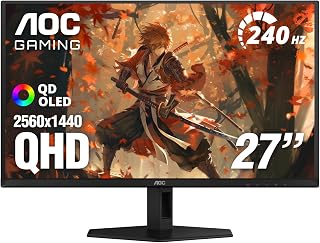
The AOC Q27GAZD is a premium gaming monitor built for competitive players and professionals who demand both speed and visual quality. Its 27-inch QHD resolution provides sharp detail without consuming excessive GPU power, making it ideal for high-refresh gaming on mid to high-end systems.
The standout feature is its combination of 240Hz refresh rates with 0.03ms response time and QD OLED technology. This creates a truly responsive gaming experience where fast-paced gameplay remains smooth and blur-free, while the quantum dot OLED panel ensures colors pop with exceptional vibrancy and accuracy for both gaming and creative work.
Build quality is solid with a fully adjustable stand offering tilt, swivel, pivot, and height adjustment for ergonomic positioning. The glossy OLED screen provides stunning visuals but may reflect light in bright environments. Connectivity includes DisplayPort 1.4 and one HDMI 2.0 port, with USB 3.2 hubs for peripheral support.
The main limitation is that glossy OLED panels work best in controlled lighting, and the single HDMI port may feel limiting for users managing multiple legacy devices. Pricing reflects the premium QD OLED technology, so budget-conscious buyers should consider more affordable alternatives.
Overall, this is an excellent choice for gamers and creative professionals willing to invest in a high-performance monitor that excels in both speed and image quality. The 3-year warranty and strong customer reviews underscore its reliability and long-term value.
Display: 27-inch QHD (2560x1440), QD OLED, 16:9 aspect ratio, 178-degree viewing angles
Performance: 240Hz refresh rate, 0.03ms (GtG) response time, 1,500,000:1 contrast ratio, HDR400 True Black
Color: 147.6% sRGB, 110.2% DCI-P3 color gamut coverage, Quantum Dot OLED technology
Connectivity: 1x DisplayPort 1.4, 1x HDMI 2.0, USB 3.2, 3.5mm audio jack
Design: Fully adjustable stand (tilt, swivel, pivot, height), VESA mount compatible, 23.99"W x 17.89"H x 7.5"D, weighs 8.03 kg
Additional Features: G-SYNC Compatible, Adaptive-Sync, anti-glare, flicker-free, eye care, frameless design
Warranty: 3-year manufacturer warranty
Best For: Competitive gamers wanting premium 240Hz performance, professional content creators needing color accuracy, esports enthusiasts, streamers and video editors
Great For: High-end gaming PC owners, console gamers on PS5 or Xbox Series X, anyone combining gaming with creative work like photo or video editing
Consider Alternatives If: You need budget-friendly options under $250, prefer a matte screen finish for bright rooms, require multiple HDMI ports for legacy equipment, or want a larger 32-inch display
Must-Have If: You want the fastest response times combined with OLED image quality, prefer G-SYNC compatibility, or frequently play competitive shooters and fast-paced games where responsiveness matters

Sim racers and open-world fans wanting peripheral immersion should look at this 34.2 inch ultrawide with its 1800R curve. The 21:9 aspect ratio wraps the field of view naturally, and DisplayHDR TrueBlack 400 certification backs up highlight detail against OLED's inherent black levels. A 0.03ms response time rounds out the case for fast-paced, wide-view gaming.
Pros
- 0.03ms response time with 240Hz refresh for competitive play
- 99.3% color gamut coverage suits creative work too
- 1800R curve and 3440x1440 resolution add immersion
- Matte finish cuts glare, DisplayHDR TrueBlack 400 for HDR
Cons
- Premium positioning puts it above budget 240Hz options
- OLED static-image burn-in risk on extended sessions
Searching for a 240Hz OLED that goes beyond the standard 16:9 experience? The AW3425DW brings that speed to a 34-inch QD-OLED ultrawide, so you get the pixel-response benefits of OLED plus the immersive 3440x1440 canvas and 1800R curve that wraps around your peripheral vision. The 0.03ms response time keeps fast-moving targets sharp at 240Hz, a combination that matters most in competitive shooters where every frame counts. What sets it apart from typical 240Hz OLED picks is how well it doubles as a creative tool: 99.3% color gamut coverage and a contrast ratio of 1,500,000:1 mean the same panel that wins matches also handles color-critical editing work convincingly. DisplayHDR TrueBlack 400 adds punch to HDR scenes without washing out shadow detail. The matte screen finish is worth noting too, since many curved ultrawides skip anti-glare coatings. If your idea of a 240Hz OLED monitor includes wide-format immersion and color accuracy alongside raw speed, this is one of the more complete packages in that category.
Display: 34.2-inch QD-OLED curved ultrawide, 3440x1440 native resolution, 240Hz refresh rate, 0.03ms response time, 1800R curve, 178-degree viewing angles.
Color: DCI-P3 99.3% color gamut, Delta E less than 2 color accuracy, DisplayHDR TrueBlack 400, 1000 nits peak HDR brightness, 1,500,000:1 contrast ratio.
Connectivity: 2x HDMI, DisplayPort, 3x USB ports, USB Type-B for connectivity hub functionality.
Physical: 31.71 inches deep, 9.13 inches wide, 21.84 inches tall, 20 pounds. Height, tilt, and swivel adjustable stand. VESA mounting compatible.
Additional: Blue light filter, matte screen finish, 36.7W power consumption, 3-year warranty, includes DisplayPort cable, HDMI cable, USB cable, microfiber cloth, and Alienware sticker.
Best for competitive gamers and hybrid gamer-creators who want 240Hz OLED speed without giving up screen real estate or color accuracy, especially anyone who edits video or does color-sensitive work on the side. Skip it if you prefer a flat panel, need a smaller footprint, or mainly run static-UI productivity apps for long stretches, since OLED burn-in risk applies here as it does with any OLED panel.

Gamers who want 4K detail without giving up refresh rate should consider this 27 inch Quantum Dot OLED panel. Its glossy finish boosts color pop for cinematic single-player titles, and DisplayHDR True Black 400 certification pairs with the 1500000:1 contrast ratio for genuinely dark shadows. Built-in USB-C power delivery also simplifies cable management for compact 4K gaming setups.
Pros
- Exceptional color accuracy and black levels outperform traditional LED monitors and compete with professional displays
- Blazing fast 0.03ms response time eliminates ghosting in fast-paced competitive titles
- Rare combination of high refresh rate (240Hz) and 4K resolution on a single panel
- OLED Care 2.0 mitigates the traditional OLED burn-in concern with proven results from user reviews
- Comprehensive I/O connectivity supports gaming across PC, Mac, console, and laptop platforms simultaneously
Cons
- Premium pricing at $649.99 positions this as a luxury option, not a budget gaming monitor
- Glossy screen finish may cause reflections in bright rooms despite superior color reproduction
- Limited HDR image settings when in HDR mode, restricting customization for some users
The MSI MAG 272UP QD-OLED X24 is a premium 27-inch gaming monitor engineered for discerning gamers and content creators who refuse to compromise on visual quality. With its 4K UHD resolution (3840 x 2160) and 240Hz refresh rate, this display caters to users seeking both immersive visual fidelity and competitive responsiveness, whether in AAA titles or fast-paced esports.
The standout technology here is the 4th-generation Quantum Dot OLED panel, which merges 10-bit Quantum Dot color conversion with OLED's self-emitting pixels. This delivers an exceptional 1.07 billion colors at 99% DCI-P3 coverage, native 1,500,000:1 contrast, and peak brightness of 1,000 nits. Paired with a 0.03ms response time and VESA ClearMR 13000 certification, the monitor eliminates motion blur while maintaining extraordinary color accuracy. Real-world testing from reviewers confirms that image clarity and color vibrancy exceed expectations, making it competitive with professional-grade displays.
Build quality and design reflect the premium positioning. The monitor features a graphite heatsink for durability, a fully adjustable stand (height, tilt, swivel), and a sleek frame-less design. OLED Care 2.0, backed by AI-supported software and multiple console modes, addresses the historical burn-in concern on OLED panels, with user reviews confirming peace of mind. Connectivity is comprehensive: DisplayPort 1.4a, dual HDMI 2.1 ports with 48Gbps bandwidth, and USB-C with 15W Power Delivery for peripheral charging.
The glossy screen finish maximizes color reproduction but may introduce reflections in bright environments. Additionally, HDR mode restricts access to some image settings, limiting advanced tweaking. A handful of user reviews report rare hardware stability issues, though the majority experience reliable performance out of the box.
The MSI MAG 272UP QD-OLED X24 represents a mature intersection of high refresh rate gaming and OLED quality. At $649.99, it delivers measurable value for competitive gamers upgrading from 1440p displays and creative professionals working in color-critical fields.
Display: 26.5-inch QD-OLED panel, 3840 x 2160 (4K UHD), 16:9 aspect ratio, 240Hz refresh rate, 0.03ms response time (GtG), 1,500,000:1 contrast ratio, 178-degree viewing angles, 400 nits peak brightness, 99% DCI-P3 color gamut, VESA DisplayHDR True Black 400 certified.
Connectivity: DisplayPort 1.4a, HDMI 2.1 (x2, 48Gbps), USB Type-C with 15W Power Delivery, USB Hub, 3.5mm audio jack.
Physical: 24W x 9.5D x 20.9H inches, 10.25kg weight, 100mm x 100mm VESA mount compatible, fully adjustable stand (height, tilt, swivel), frame-less design.
Features: OLED Care 2.0 burn-in protection, AI-supported software, Smart Crosshair, Console Modes, Game Assistance (Optix Scope), Picture-in-Picture (PiP), Picture-by-Picture (PbB), AMD FreeSync Premium Pro, ALLM (Auto Low Latency Mode), Blue Light Filter.
Warranty: 3-year manufacturer warranty. Model: MAG272UPQDOLEDX24. Manufacturer: MSI.
Who Should Buy: Competitive esports gamers seeking 240Hz performance without sacrificing 4K visual quality. Content creators and photographers needing 10-bit color accuracy and professional-level contrast depth. Console gamers leveraging HDMI 2.1 at 120Hz with VRR. Streamers requiring USB-C connectivity and multi-platform support.
Who Might Skip: Budget-conscious gamers under $400. Users in bright environments prone to screen glare. Those hesitant about OLED technology despite burn-in protections. Gamers content with 1440p or 1080p at higher refresh rates.
Key Comparison Points: This monitor uniquely delivers 240Hz at 4K on a current-gen OLED panel, a combination rare in 2024. Versus traditional LED gaming monitors, it offers superior contrast and color accuracy. Versus professional OLED displays, it adds gaming-focused features and lower price. Versus other QD-OLED gaming monitors, MSI's OLED Care 2.0 and full connectivity suite provide practical advantages.
Setup Considerations: Ensure your GPU supports DisplayPort 1.4a or HDMI 2.1 for full 4K 240Hz performance. High refresh rate 4K gaming requires RTX 4070 Ti or higher for modern AAA titles. The adjustable stand accommodates most desk setups; verify desk depth (9.5 inches required) before purchase. Test in your lighting environment if sensitivity to glossy screens concerns you.

For players who want ultrawide immersion plus headroom above standard 240Hz, this 34 inch panel pushes to 280Hz refresh. Its 1300 candela per square meter peak brightness helps HDR highlights punch through despite the glossy finish's reflectivity. The 1800R curve and 21:9 layout make it a strong fit for flight sims and strategy titles needing wide peripheral context.
Pros
- 280Hz refresh rate, higher than the typical 240Hz class
- DarkArmor Film and AI Care Sensor aid OLED longevity
- DisplayHDR True Black 500 and ClearMR 15000 for HDR and clarity
- Works with both FreeSync Premium Pro and G-SYNC Compatible
Cons
- Glossy finish may reflect more ambient light than matte panels
- Larger dimensions and weight need more desk space
If 240Hz is your baseline requirement, the MSI MAG 341CQP X28 raises the ceiling to 280Hz, giving competitive players extra headroom on this Tandem QD-OLED panel. It shares the same 34-inch, 3440x1440, 1800R curved format as other ultrawide OLED contenders on this list, but distinguishes itself with a brightness spec of 1300 nits and a feature set built specifically around OLED longevity and clarity. DarkArmor Film and an AI Care Sensor are included to manage panel wear and adjust for ambient conditions, while Uniform Luminance and RGB Stripe technology aim to keep the image consistent across the whole screen. ClearMR 15000 and DisplayHDR True Black 500 point to strong motion clarity and deep blacks for HDR content. Response time matches the class standard at 0.03ms, and both AMD FreeSync Premium Pro and NVIDIA G-SYNC Compatible support mean it adapts to either graphics ecosystem. For readers of this article prioritizing the highest refresh rate on an OLED ultrawide, this is one of the faster options covered.
Display: 34" curved ultrawide, 3440x1440 UWQHD resolution, 21:9 aspect ratio, 1800R curvature
Panel Technology: 5th-Gen QD-OLED with RGB Stripe layout, glossy screen finish, 1300 nits peak brightness
Performance: 280Hz refresh rate, 0.03ms gray-to-gray response time, VESA ClearMR 15000 certified motion clarity
Color & Contrast: DisplayHDR True Black 500, Delta E less than or equal to 2 calibration, 5-layer Tandem OLED with EL Gen 3 technology
Connectivity: HDMI 2.1 (4K 120Hz support), adaptive sync with AMD FreeSync Premium Pro and NVIDIA G-Sync compatibility
Protection: DarkArmor Film (40% deeper blacks, 2.5x scratch resistance), AI Care Sensor, 3-year warranty
Dimensions: 31.96"W x 16.94"H x 9.05"D, 31.8 lbs
Suited to gamers who want the fastest refresh rate on this list paired with ultrawide immersion, and who value the added panel-care features like DarkArmor Film and AI Care Sensor for long-term OLED use. Less ideal for buyers who want a matte finish, since this panel is glossy, or anyone who prioritizes a compact desk footprint given its size and weight.

This 27 inch 4K QD-OLED model targets gamers who want pixel density for detail work and gaming alike without stepping up to a 32 inch footprint. Its matte screen finish reduces reflections in bright rooms, and the 1500000:1 contrast ratio ensures shadows stay true black. It balances resolution and desk space well for dedicated 240Hz setups.
Pros
- 27-inch 4K QD-OLED at 240Hz
- 0.16 pixel pitch for sharp detail
- 1500000:1 contrast ratio
- Matte finish reduces glare
Cons
- 4K at 240Hz still demands a powerful GPU
- Smaller screen than the 32-inch option on this list
If the priority in choosing a 240Hz OLED monitor is balancing sharpness with speed, the PG27UCDM hits that middle ground well. Its 27-inch 4K panel packs a tighter 0.16 pixel pitch, the finest on this list, so detail stays crisp even at a 240Hz refresh rate. The QD-OLED panel delivers a 1500000:1 contrast ratio and a wide 145 color gamut figure, giving it strong color depth alongside its speed credentials. The matte finish helps keep glare down during long gaming or work sessions. This size and resolution combination makes it a practical pick for anyone who wants 4K clarity without stepping up to a 32-inch screen, keeping pixel density high for both gaming and everyday desktop use. For readers weighing several 240Hz OLED options in this roundup, this model represents the 27-inch 4K tier, positioned between the larger 32-inch panel and the 1440p alternatives also featured here.
Display Specifications
Panel Type: 26.5-inch 4K QD-OLED (3840 x 2160) | Refresh Rate: 240Hz | Response Time: 0.03ms | Contrast Ratio: 1,500,000:1 | Brightness: 1541.7 lm | Viewing Angle: 178 degrees | Pixel Pitch: 0.16mm | Color Gamut: 99% DCI-P3 | Color Accuracy: Delta E less than 2 | Screen Finish: Matte | Aspect Ratio: 16:9
Connectivity
DisplayPort 2.1a UHBR20 (80Gbps bandwidth) | USB-C with 90W Power Delivery | Dual HDMI 2.1 | 3.5mm audio output | 2 USB 3.2 ports | 100x100mm VESA mount | 1/4-inch tripod socket
Physical Dimensions
Screen Size: 26.5 inches | Dimensions: 24"W x 21.6"H x 8.6"D | Weight: 16.8 lbs | Height Adjustability: 3 positions
Power & Warranty
Power Consumption: 80 watts | Voltage: 240V | Warranty: 3 years with Accidental Damage Recovery and burn-in coverage
Consider this if you want 4K sharpness in a more compact 27-inch frame rather than a 32-inch screen, and you value high pixel density for both gaming and desktop tasks. It suits users who want strong color performance alongside speed. Skip it if you prefer a larger screen size or don't need 4K resolution and would rather save GPU headroom with a 1440p panel.
What to Look for in a 240Hz OLED Monitor
Resolution vs. Screen Size
Matching resolution to screen size is the first decision to nail down. A 27-inch panel at QHD (2560×1440) hits a sweet spot between sharpness and GPU load, which is why options like the Samsung 27″ Odyssey OLED G6 (G61SH) QD-OLED and the AOC 27″ Gaming Monitor QHD 240Hz QD OLED NVIDIA are so popular among competitive players.
If you want 4K at 240Hz, you’ll need a capable GPU to drive it. The ASUS ROG PG32UCDM 32 Inch 4K 240Hz OLED and the ASUS ROG PG27UCDM 27 Inch 4K 240Hz OLED are outstanding visually but demand serious hardware to run at native resolution. For a larger canvas with less GPU strain, ultrawide WQHD via the Alienware 34 240Hz QD-OLED Curved Gaming Monitor is a compelling middle ground.
QD-OLED vs. WOLED Panel Technology
Most monitors on this list use QD-OLED panels, which layer quantum dot film over an OLED substrate for significantly higher peak brightness and more saturated colors than standard WOLED. QD-OLED panels routinely cover 99% DCI-P3 and reach 400 to 1000 nits of peak HDR brightness, making them far more versatile in bright rooms.
WOLED, used in the ASUS ROG XG27AQDMGR 27 Inch 1440p 240Hz Glossy, features a glossy TrueBlack finish that deepens perceived contrast and enhances color vibrancy in controlled lighting. Each technology has trade-offs, so think about where you game before deciding. For a broader look at display options for specific platforms, our guide to the best monitors for Xbox Series X is worth a read.
Burn-In Protection Features
Burn-in is the most common concern with OLED panels, and every reputable manufacturer has built-in safeguards to address it. ASUS includes OLED Care Pro with a Neo Proximity Sensor on monitors like the ASUS ROG XG27AQDMGR 27 Inch 1440p 240Hz Glossy and the ASUS ROG PG27UCDM 27 Inch 4K 240Hz OLED, automatically switching to a black screen when you step away.
MSI deploys OLED Care 2.0 with a graphene heatsink across their lineup, including the msi MAG 274QP QD-OLED X24 27-Inch WQHD and msi MAG 272UP QD-OLED X24 27-Inch 4K UHD. Samsung’s OLED Safeguard system on the Odyssey G6 uses thermal modulation. ASUS also backs their OLED monitors with three-year burn-in coverage, which adds meaningful peace of mind. You can also pair your monitor with proper cable infrastructure; see our roundup of the best DisplayPort 2.1 cables to make sure your signal chain keeps up.
Connectivity and Ergonomics
Modern 240Hz OLED monitors have leveled up their connectivity considerably. The ASUS ROG PG32UCDM 32 Inch 4K 240Hz OLED includes 90W USB-C power delivery for single-cable laptop setups, while the ASUS ROG PG27UCDM 27 Inch 4K 240Hz OLED adds DisplayPort 2.1a UHBR20 with full 80Gbps bandwidth. HDMI 2.1 is standard across most models, keeping console compatibility solid.
Stand flexibility matters more than people expect during long sessions. The Samsung 27″ Odyssey OLED G6 (G61SH) QD-OLED offers height, tilt, pivot, and swivel adjustment. The MSI models feature four-way adjustable stands with VESA 100mm compatibility. If you’re planning to mount multiple displays, our guide on the best dual monitor arms covers mounts that pair well with OLED panels. Look for VESA compatibility before committing to a mounting solution.
Final Thoughts
240Hz OLED monitors have matured into a genuinely diverse category, with strong options at every screen size and resolution tier. For competitive players who want the best QHD value, the msi MAG 274QP QD-OLED X24 27-Inch WQHD delivers elite performance with excellent burn-in protection at an approachable entry point. If you want the absolute pinnacle of visual fidelity with a large 4K canvas, the ASUS ROG PG32UCDM 32 Inch 4K 240Hz OLED sets the standard with third-generation QD-OLED technology and a comprehensive feature set that rewards every type of gamer.
Frequently Asked Questions
Is a 240Hz OLED monitor worth it for gaming in 2026?
Yes, for most gamers it represents a genuine upgrade over conventional IPS or VA panels. The combination of a 240Hz refresh rate and a 0.03ms response time virtually eliminates ghosting and motion blur, while OLED’s infinite contrast ratio makes dark scenes dramatically more detailed. If you play competitive titles or visually rich games, the jump in experience is noticeable from the first session.
Do 240Hz OLED monitors suffer from burn-in?
Burn-in is a real risk with any OLED display, but current-generation monitors include robust mitigation systems. Features like MSI’s OLED Care 2.0, ASUS’s Neo Proximity Sensor, and Samsung’s thermal modulation system actively reduce static image retention. Following manufacturer guidelines, such as avoiding static HUD overlays at maximum brightness for extended periods, further reduces any risk. Many ASUS monitors also include a three-year burn-in warranty for added reassurance.
What resolution should I choose for a 240Hz OLED monitor?
That depends on your GPU and your use case. QHD (1440p) on a 27-inch screen is the most GPU-friendly choice and is ideal for competitive gaming where frame rate matters most. 4K at 240Hz delivers a stunning visual experience but requires a high-end graphics card to drive consistently. Ultrawide WQHD, as seen on the Alienware 34 and the msi MAG 341CQP QD-OLED X28 34″ UWQHD Tandem, offers an immersive field of view without the full GPU cost of 4K. Our best 32-inch gaming monitor guide explores that size category in more depth if you’re weighing your options.
Do I need a specific cable to run 240Hz at 4K on an OLED monitor?
Yes, bandwidth requirements at 4K and 240Hz are significant. You’ll want a certified DisplayPort 2.1 cable or a 48Gbps HDMI 2.1 cable to achieve the full signal throughput without compression artifacts. Using an older cable can silently cap your resolution or refresh rate without any obvious error message. Always verify the cable spec matches the port capability on both your GPU and your monitor.




Write Your Review
No reviews yet. Be the first to share your experience!