

Streaming or recording your PS5 gameplay requires more than just hitting the share button. The PS5’s built-in capture has limitations that serious content creators quickly outgrow: no 4K60 recording, restricted editing options, and no way to add live commentary or overlays. A dedicated capture card bridges that gap, letting you produce polished content with full control over resolution, frame rates, and production workflow.
This guide covers 10 capture cards evaluated for PS5 compatibility, from budget-friendly USB dongles to professional-grade internal cards. Whether you’re building a single-PC streaming setup or upgrading to dual-PC production, you’ll find options matched to your technical requirements and content goals. For creators expanding their entire studio setup, our best laptops for freelancers guide covers portable powerhouses that pair well with external capture solutions.




What to Look for in a PS5 Capture Card
Resolution and Frame Rate Support
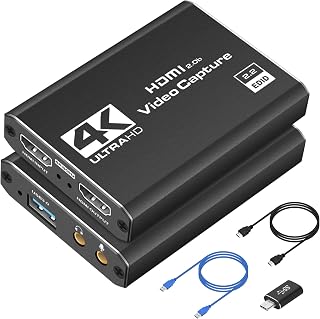
The PS5 outputs up to 4K at 120Hz, but not every capture card can handle that bandwidth. Most mid-range cards like the Elgato HD60 S+, External Capture Card capture at 1080p60 while passing through 4K60 to your display. High-end models such as the Elgato 4K S Capture Card for PS5, Xbox Series X/S record in true 4K60 with support for 1440p120 and 1080p240 passthrough.
Consider your content format when choosing resolution capabilities. Streaming platforms compress 4K footage heavily, so 1080p60 capture often delivers better visual results at typical bitrates. Competitive shooters benefit more from high refresh rate passthrough that keeps your display running at 120Hz or 240Hz while recording at lower resolutions. If you’re producing edited YouTube content rather than live streams, prioritize capture quality over passthrough specs.
Latency and Passthrough Quality
Capture cards introduce encoding delay between your console and recording software, but passthrough latency affects your actual gameplay. Zero-lag passthrough means the signal going to your monitor bypasses encoding entirely, keeping your display responsive. The Elgato 4K Pro Internal Capture Card uses HDMI 2.1 for 8K60 passthrough with Variable Refresh Rate support, eliminating screen tearing without compromising input response.
Budget cards often sacrifice passthrough quality, downscaling 4K input to 1080p on both capture and display outputs. This matters less if you’re using a 1080p monitor, but PS5 owners with 4K displays should verify the card supports independent passthrough at your screen’s native resolution. HDR passthrough adds another compatibility layer since not all cards preserve HDR metadata correctly through the signal chain.
Connection Type and Power Requirements
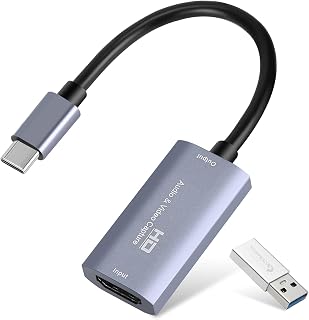
External USB 3.0 cards like the Guermok Video Capture Card offer plug-and-play convenience without opening your PC case. They draw power through the USB connection and work with laptops for portable streaming setups. Internal PCIe cards provide higher bandwidth and lower system overhead but require a desktop PC with available slots and power connectors.
USB 3.0 provides 5Gbps theoretical bandwidth, sufficient for 1080p60 capture but constrained at 4K60. USB-C variants offer the same speed with reversible connectors. PCIe cards access dedicated lanes directly to your motherboard, supporting higher resolutions without competing for USB controller bandwidth. If you’re running multiple USB peripherals like webcams, microphones, and lighting controls, internal cards prevent bottlenecks in your streaming rig. Content creators who also need powerful mobile workstations should review our best laptops for working from home recommendations.
Software Compatibility and Audio Features
Most capture cards function as UVC (USB Video Class) devices, appearing as webcams in OBS Studio, Streamlabs, and XSplit without custom drivers. The acer USB 3.0 HDMI Capture Card, 4K HDMI Loop-Out includes a 3.5mm mic input for commentary, letting you mix game audio and voice without a separate mixer. Cards without audio inputs require virtual audio routing through software like VoiceMeeter.
Check whether the card captures embedded HDMI audio separately from microphone input. Some models merge both into a single stereo stream, limiting post-production flexibility. Advanced cards like the PORTTA DX20R HDMI Video Capture Card include companion software for firmware updates, EDID management, and audio mixing controls. This matters when troubleshooting HDCP handshake issues or adjusting capture parameters beyond what streaming software exposes.
Final Thoughts
Your ideal capture card depends on whether you prioritize maximum quality or flexible portability. For creators streaming competitive gameplay at high refresh rates, the BlueAVS 4K60 HDMI Video Capture Card for PS5 Game handles 1440p144 and 1080p240 with VRR passthrough while maintaining 4K60 capture. Budget-conscious streamers who primarily produce 1080p content get excellent value from the Guermok Video Capture Card, which delivers clean 1080p60 recording without requiring internal PC installation.
Frequently Asked Questions
Do I need a capture card if I only stream to Twitch?
Yes, if you want production features beyond the PS5’s native sharing. The console can stream directly to Twitch, but you cannot add overlays, alerts, multiple camera angles, or custom layouts without capture card integration with streaming software. Capture cards also let you archive full-quality recordings separately from compressed live streams.
Can capture cards record PS5 party chat audio?
No, HDMI carries only game audio and system sounds. Party chat routes through the PS5’s internal audio system and exits through your controller or USB headset. To capture party chat, you need a separate audio interface that connects between your headset and PC, or use Discord on your computer instead of PlayStation Party.
Will capture cards work with PS5 games that have HDCP protection?
The PS5 disables HDCP during gameplay by default, allowing capture cards to record game content freely. HDCP activates when viewing streaming apps like Netflix or Disney+, which blocks capture during those sessions. If you encounter HDCP errors during gaming, verify the setting is disabled in System Settings under HDMI output options.
What PC specs do I need to run a 4K capture card in 2026?
For 4K60 capture with streaming, you need at least a 6-core CPU, 16GB RAM, and a dedicated GPU that supports hardware encoding like NVIDIA’s NVENC or AMD’s VCE. Recording 4K without streaming requires less CPU power since you’re not encoding in real time. Storage speed matters too since 4K60 footage generates large files quickly. Students and professionals building powerful editing workstations should also explore our guide to best laptops for computer science students for portable processing power.
Common questions
What is the best capture card for Nintendo Switch and Switch 2?
The Guermok Video Capture Card is an excellent choice for both Switch models, capturing 1080p60 and 2K30 with USB-C and USB 3.0 connectivity. It explicitly supports both the original Switch and the Switch 2, which launched in June 2025, making it a future-proof option. The plug-and-play design works seamlessly across platforms, and the compact form factor is ideal for portable setups. Most budget 4K capture cards in the product lineup will handle Switch content well, but verified compatibility with Switch 2 gives the Guermok an edge.



Write Your Review
No reviews yet. Be the first to share your experience!