

You’re working from home when your video call freezes. Again. Your kids are streaming in the basement while you’re trying to finish a presentation upstairs, and suddenly your router can’t keep up. Traditional single-router setups create dead zones, force you to manually switch networks, and leave entire floors of your home with weak signals.
Mesh WiFi systems solve these problems by using multiple nodes that work together as one unified network. This guide covers the ten best mesh WiFi systems in 2026, from budget-friendly options to premium WiFi 7 models, helping you find the right solution for your home size, device count, and internet speed.






What to Consider When Choosing a Mesh WiFi System
Coverage Area and Home Layout
Calculate your square footage before shopping. A 2,000 square foot single-story home has different needs than a 3,500 square foot multi-level house with thick walls and a basement. Most mesh systems list coverage per node, so you can add units as needed.
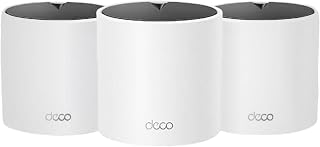
The TP-Link Deco M5 Mesh WiFi System Deco M5 3-Pack covers up to 5,500 square feet with three units, while the TP-Link Deco 7 BE23 Dual-Band BE3600 WiFi 7 Mesh extends to 6,500 square feet. Concrete walls, metal studs, and multiple floors require more nodes than open floor plans. If you’re setting up a home office, check out our guide to laptops optimized for remote work that pair well with robust WiFi coverage.
WiFi Standard and Speed Requirements
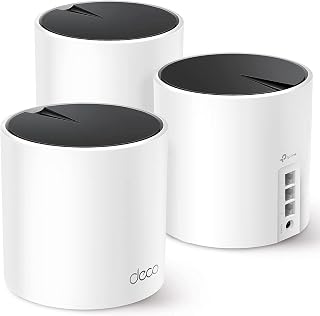
WiFi 6 systems like the TP-Link Deco X55 AX3000 WiFi 6 Mesh System deliver speeds up to 3 Gbps and handle more simultaneous connections than older WiFi 5 models. WiFi 6E adds a dedicated 6 GHz band that cuts through congestion, while WiFi 7 systems bring multi-link operation for even lower latency.
Match your mesh system to your internet plan. Gigabit fiber needs a system with gigabit or multi-gig ethernet ports. The TP-Link Deco XE70 Pro AXE4900 Tri-Band WiFi 6E includes 2.5 Gbps ports, while the Amazon eero Pro 7 tri-band mesh Wi-Fi 7 router supports internet plans up to 5 Gbps with dual 5 GbE ports.
Device Capacity and Network Demand
Count every connected device in your household: phones, laptops, tablets, smart TVs, security cameras, smart speakers, thermostats, and gaming consoles. Budget systems support 100 to 120 devices, while premium models like the Amazon eero Pro 7 tri-band mesh Wi-Fi 7 router handle 600 plus devices.
Families with heavy streaming, online gaming, and video conferencing need systems with strong quality of service features and tri-band operation. Students working remotely should also consider our recommendations for computer science laptops and engineering student laptops that complement fast mesh networks.
Security Features and Parental Controls
Look for systems with built-in security scanning, automatic firmware updates, and WPA3 encryption. TP-Link systems include HomeShield with basic network security, IoT device identification, and parental controls at no cost. Amazon eero models offer basic security features with optional eero Plus subscriptions for advanced protection.
Parental controls let you set screen time limits, filter content, and pause internet access by device or user profile. The TP-Link Deco M5 Mesh WiFi System Deco M5 3-Pack includes lifetime HomeCare access, while newer models require HomeShield subscriptions for premium features. Teachers managing classroom technology might find our laptop recommendations for educators helpful for planning complete tech setups.
Final Thoughts
The right mesh WiFi system eliminates dead zones and keeps your entire household connected without constant troubleshooting. For budget-conscious buyers who need solid performance across medium-sized homes, the TP-Link Deco S4 delivers reliable AC1900 speeds and supports up to 100 devices. If you’re future-proofing your network with the latest technology and need to support gigabit-plus internet plans, the TP-Link Deco 7 BE23 brings WiFi 7 performance with multi-link operation and 2.5 Gbps ports at a reasonable price point.
Frequently Asked Questions
How many mesh nodes do I need for my home?
Most manufacturers recommend one node per 1,500 to 2,500 square feet depending on construction materials and layout. A typical 2,000 square foot single-story home works well with two nodes, while multi-story homes with basements often need three or more. Start with a multi-pack and add individual nodes if you discover remaining dead zones after installation.
Can I mix different mesh system brands or models?
No, mesh nodes must be from the same product family to communicate properly. TP-Link Deco models work together across generations, and eero devices are cross-compatible within the eero ecosystem. You cannot combine a TP-Link system with an eero system or mix mesh brands. If you need to expand coverage, purchase additional nodes from your existing system’s product line.
Do mesh systems work with my existing modem and router?
Mesh systems replace your existing router but require your modem to connect to your internet service provider. Simply connect the primary mesh node to your modem via ethernet cable, then set up additional nodes wirelessly. Your old router becomes unnecessary unless you want to use it in access point mode in a specific location. Business professionals and freelancers setting up home offices can learn more about optimizing their workspace in our freelancer laptop guide.
What is the difference between WiFi 6, WiFi 6E, and WiFi 7?
WiFi 6 operates on 2.4 GHz and 5 GHz bands with improved efficiency over WiFi 5. WiFi 6E adds a new 6 GHz band that reduces interference in crowded environments. WiFi 7 introduces multi-link operation that lets devices transmit across multiple bands simultaneously for lower latency and higher throughput. In 2026, WiFi 6 offers excellent value, WiFi 6E provides breathing room for demanding users, and WiFi 7 delivers cutting-edge performance for future-proofing your network.
Common questions
What is the best mesh router for gaming in 2026?
The TP-Link Deco X55 AX3000 is the best choice from this list for gaming because it supports WiFi 6 (802.11ax), which delivers lower latency and better performance under load compared to older WiFi 5 systems like the Deco S4 or M5. WiFi 6 handles multiple devices more efficiently, reducing lag when other household devices are active. The X55 works with gaming consoles and offers dual-band coverage. For serious gaming setups, consider pairing any mesh system with a wired Ethernet backhaul between nodes to maximize stability and speed.


Write Your Review
No reviews yet. Be the first to share your experience!